CLARK FIELD: Defense ministers from the Association of Southeast Asian Nations (ASEAN) signed a joint declaration during the 11th ASEAN Defense Ministers Meeting (ADMM) on Monday, promising cooperation to counter terrorism and violent extremism in the region.
ASEAN consists of the Philippines — this year's host of the ADMM, Cambodia, Indonesia, Laos, Malaysia, Myanmar, Singapore, Thailand, Vietnam, and Brunei Darussalam.
The ministers released a statement, read during the signing ceremony, which said: “The joint declaration being signed embodies the collective sense of the ASEAN defense ministers on the regional security environment. More importantly, it contains the ministers’ shared thrust and specific undertakings to address the security challenges facing the region as well as practical measures to promote cooperation.”
The defense chiefs also used the joint declaration to condemn “in the strongest terms the attacks carried out by violent extremists across the world, particularly in Southeast Asia, including the attack by the Maute Group in Marawi City, Philippines, which led to casualties, destruction of properties, and displacement of people, among others.”
The officials likewise declared full support for the Philippines' efforts to address the security and humanitarian crisis in Marawi City, where more than 250,000 villagers were displaced by the five-month battle between government forces and the Maute group.
They also acknowledged the need for enhanced regional cooperation through intelligence- and information-sharing, surveillance measures, and promoting public awareness.
North Korea
In the same document, the officials expressed grave concern over the escalation of tensions in the Korean Peninsula, including the testing and launching of intercontinental ballistic missiles by the Democratic People's Republic of Korea (DPRK), in addition to its previous nuclear tests and ballistic missile launches.
“(We) strongly urge the DPRK to immediately comply with its obligations arising from all the relevant UN Security Council resolutions,” the officials said.
South China Sea
The ministers also reaffirmed the importance of maintaining and promoting safety and freedom of navigation in and over the South China Sea, along with the need to avoid further actions that may complicate the situation in the region. All parties expressed their commitment to implementing the Declaration on the Conduct of Parties in the South China Sea (DOC).


![]()
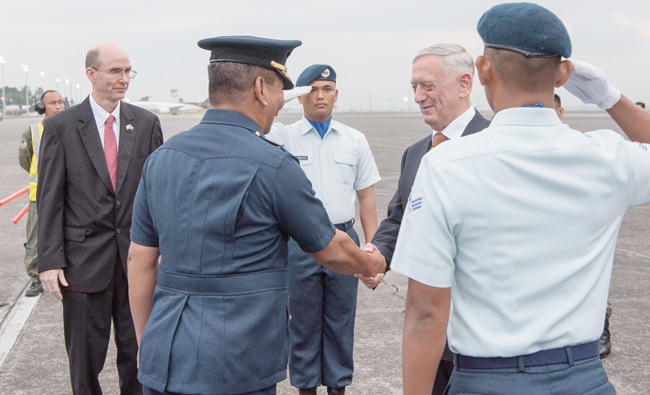
ASEAN defense chiefs pledge cooperation in fight against terrorism
ASEAN defense chiefs pledge cooperation in fight against terrorism

Latest updates


© 2026 SAUDI RESEARCH & PUBLISHING COMPANY, All Rights Reserved And subject to Terms of Use Agreement.