WASHINGTON: David Letterman was never known as a particularly political comedian, preferring a detached irony-drenched tone that favored the surreal and silly over topical humor. But there was an unmistakable political tint to much of Sunday night’s ceremony to present Letterman with the Mark Twain award for American humor.
Several of the comedians honoring Letterman took shots at President Donald Trump and the general state of the country. More than one comedian quipped that the Kennedy Center’s funding was about to be cut off mid-show. Meanwhile, the center announced that Secretary of Education Betsy DeVos was a Kennedy Center benefactor.
Kimmel jokingly blamed Letterman for helping to bring Trump to power.
“It’s like you went out for cigarettes one day and left us in the hands of our abusive, orange stepfather,” Kimmel quipped.
He praised Letterman profusely, recalling a monologue he delivered on his show shortly after the 9/11 attack.
“You let us know it was OK to move on and OK to laugh again,” Kimmel said. “Dave, you led the way for all of us.”
But Kimmel also noted that in that same monologue, Letterman offered glowing praise to then-New York City mayor Rudy Giuliani, who went on to become a vocal public Trump supporter.
“Well Dave, we all make mistakes sometimes,” Kimmel said.
Comedian-turned-senator Al Franken thanked Letterman for a post-retirement series of videos that he and Letterman recorded together designed to raise awareness on climate change. Comedians Martin Short and Steve Martin, a previous Mark Twain honoree, needled Letterman about his bushy white retirement beard with a line touching on the country’s current divisive political atmosphere.
“Dave has always had excellent instincts. What better time than now to choose to look like a Confederate war general,” Steve Martin said.
Speakers Sunday night included comedians John Mulaney, Amy Schumer and Jimmie Walker of the 1970s television series “Good Times.” Walker gave Letterman one of his first jobs as a joke writer in Hollywood.
Schumer poked fun at Letterman’s famed reputation for grumpiness, saying she performed on his show three times.
“By the end of my third appearance, Dave was no longer totally indifferent to me,” she said.
Mulaney credited Letterman’s appeal with his determination to mine humor from ordinary people, and occasionally their pets.
“The Johnny Carson show said, ‘Take a break from your weird life and watch these famous people have fun in show business,’” Mulaney said. “Dave’s show said, ‘Your weird life is just as funny as show business.’“
The 70-year-old Letterman spent 33 years on late-night TV, hosting long-running shows on NBC and then on CBS. His final broadcast on May 20, 2015, was episode No. 6028 that Letterman hosted. It shattered the record of his mentor, Carson.
Former First Lady Michelle Obama sent in a video tribute and Pearl Jam lead singer Eddie Vedder thanked Letterman for being a longtime “friend to music” and performed the song “Keep me in your heart” by the late Warren Zevon, a Letterman favorite.
Letterman’s run on NBC in particular was hugely influential, introducing a sardonic, smartly silly comedic style that influenced a generation.
His time slot immediately following Carson’s “The Tonight Show” allowed Letterman to draw a huge following of young, largely college-age viewers seeking an alternative to the somewhat staid Carson model.
Letterman introduced the country to fringe musical acts that might never have received an opportunity on “The Tonight Show.”
His humor was undeniably intelligent, but also at times surrealistic and goofy. He pioneered segments called Stupid Pet Tricks and Stupid Human Tricks. He tossed watermelons and other objects off a five-story building; at one point, he wore a suit made of Velcro and jumped onto a Velcro-covered wall, sticking in place. He turned bizarre characters like Larry “Bud” Melman and Biff Henderson into cult celebrities.
Letterman started his career as a radio talk show host and TV weatherman in Indiana. In the mid-1970s he moved to Los Angeles, performing stand-up comedy and writing jokes for (at the time more famous) stand-up comic Walker of “Good Times” fame. Eventually he caught the eye of “The Tonight Show” and Carson, performing several times on the show and becoming a regular guest host starting in 1978.
NBC gave Letterman his own show following Carson; “Late Night with David Letterman” debuted on Feb. 1, 1982. Letterman’s first guest that night? Bill Murray, the Twain award recipient in 2016.
On Sunday, Murray predictably stole the show with a surreal performance dressed as an Elizabethan monarch.
Murray said the perks of the Twain award elevate you above normal humans.
“You’re not exactly a god but you’re way up there,” he said. “You will be able to walk up to any man or woman on the street, take a lit cigar out of their mouth and finish it. You’ll be able to board any riverboat in this country.”
Murray then announced he was hungry and had a burger brought to him on stage. He then ordered platters of burgers delivered to Letterman’s balcony and cajoled Letterman’s son Harry to toss a pickle to the masses below.


![]()
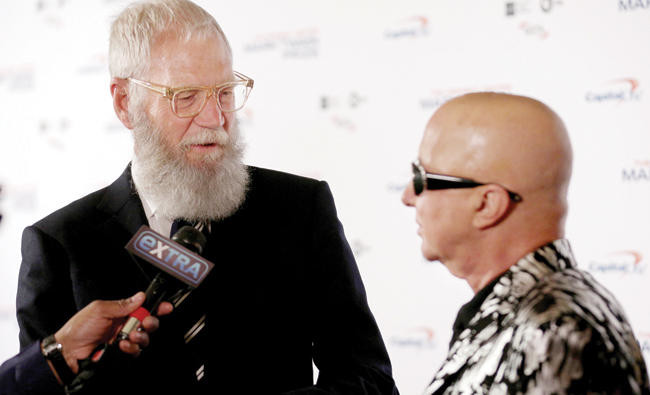
Politics on display as Letterman receives Mark Twain Prize
Politics on display as Letterman receives Mark Twain Prize
Latest updates


© 2026 SAUDI RESEARCH & PUBLISHING COMPANY, All Rights Reserved And subject to Terms of Use Agreement.