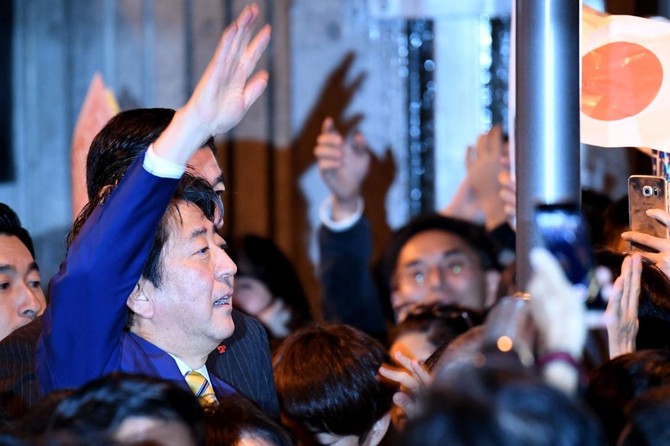
TOKYO: Japanese Prime Minister Shinzo Abe swept to a comfortable victory in a snap election Sunday, handing him a mandate to harden his already hawkish stance on North Korea and re-energize the world’s number-three economy.
Abe’s conservative coalition was on track to win 311 seats in the 465-seat parliament, according to a projection published by private broadcaster TBS, putting the nationalist blue blood on course to become Japan’s longest-serving leader.
The comfortable election win is likely to stiffen Abe’s resolve to tackle North Korea’s nuclear menace, as the key US regional ally seeks to exert maximum pressure on the regime in Pyongyang after it fired two missiles over Japan in the space of a month.
Millions of Japanese braved torrential rain and driving winds to vote, as a typhoon bears down on the country with many heeding warnings to cast their ballots early.
“I support Abe’s stance not to give in to North Korea’s pressure,” said one voter, Yoshihisa Iemori, as he cast his ballot in rain-swept Tokyo.
Abe’s Liberal Democratic Party (LDP) benefitted from a weak and splintered opposition, with the two main parties facing him created only a matter of weeks ago.
Support for the Party of Hope founded by popular Tokyo Governor Yuriko Koike fizzled after an initial blaze of publicity and was on track to win around 50 seats, the TBS projection suggested.
A new center-left Constitutional Democratic Party fared slightly better than expected but was still far behind Abe.
“The LDP’s victory is simply because the opposition couldn’t form a united front,” political scientist Mikitaka Masuyama from the National Graduate Institute for Policy Studies, said.
The short 12-day campaign was dominated by the economy and the global crisis over North Korea, which has threatened to “sink” Japan into the sea.
Nationalist Abe stuck to a hard-line stance throughout, stressing that Japan “would not waver” in the face of an increasingly belligerent regime in Pyongyang.
Despite the saber-rattling from North Korea, many voters said reviving the once-mighty Japanese economy was the top priority, with Abe’s trademark “Abenomics” policy failing to trickle down to the general public.
The three-pronged combination of ultra-loose monetary policy, huge government spending and structural reform has catapulted the stock market to a 21-year high but failed to stoke inflation and growth has remained sluggish.
“Neither pensions nor wages are getting better ... I don’t feel the economy is recovering at all,” said 67-year-old pensioner Hideki Kawasaki.
Although voters turned out in their millions to back Abe, support for the 63-year-old is lukewarm and surveys showed his decision to call a snap election a year earlier than expected was unpopular.
Voter Etsuko Nakajima, 84, said: “I totally oppose the current government. Morals collapsed. I’m afraid this country will be broken.”
“I think if the LDP takes power, Japan will be in danger. He does not do politics for the people,” added the pensioner.
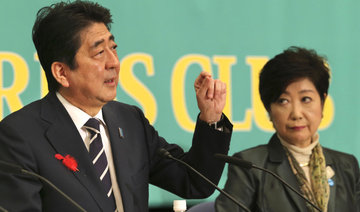
Koike briefly promised to shake up Japan’s sleepy political scene with her new party but she declined to run herself for a seat, sparking confusion over who would be prime minister if she won.
In the end, the 65-year-old former TV presenter was not even in Japan on election day, preferring an official engagement in Paris as head of the world’s biggest city.
“I thought that I would vote for the Party of Hope if it’s strong enough to beat the Abe administration. But the party has been in confusion ... I’m quite disappointed,” said 80-year-old pensioner Kumiko Fujimori.
The 12-day campaign was marked by a near-constant drizzle in large parts of the country and rallies frequently took place under shelter and a sea of umbrellas.
But this did not dampen the enthusiasm of hundreds of doughty, sash-wearing parliamentary hopefuls, who have driven around in minibuses pleading for votes via loudspeaker and bowing deeply to every potential voter.


![]()
Abe sweeps to big win in Japan vote
Abe sweeps to big win in Japan vote


Latest updates


© 2026 SAUDI RESEARCH & PUBLISHING COMPANY, All Rights Reserved And subject to Terms of Use Agreement.