COX’S BAZAR: The worsening conditions of thousands for Rohingya refugees stranded in no-man’s land at the Bangladesh-Myanmar border have sparked concern among human rights organizations and NGOs.
More than 6,000 Rohingya — fleeing persecution in Rakhine State, Myanmar — have been stuck in makeshift camps on the banks of Tombru Canal, on Myanmar’s side of the border, for the past 53 days.
Border Guard Bangladesh (BGB) is currently looking after them, providing food and support to around 1,279 families. Local and international NGOs are also helping to ensure clean drinking water and sanitation are available.
“Until now, 80 lavatories and more than 100 wells have been established by the NGOs for the well-being of refugees,” said Jahangir Kashem, Ghumdhum union council chairman in Bangladesh’s Bandarban district. “We are yet to receive orders from authorities regarding the eventual destination of these refugees, but, while here, they are receiving the maximum level of aid from our administration.”
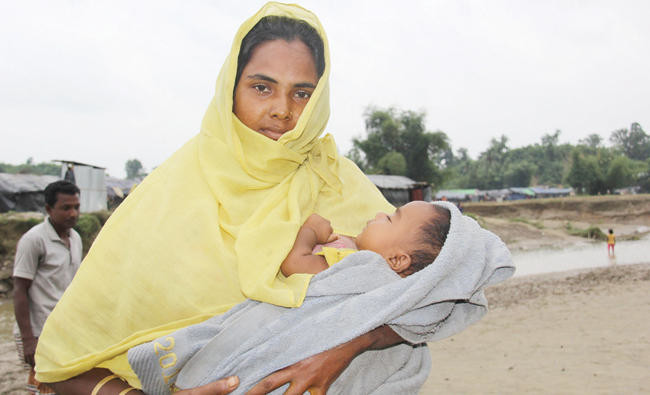
Anowara Begum, a 25-year-old refugee, told Arab News, “I gave birth to a child here at this makeshift house just 13 days after my arrival. It was a nightmare for me to deliver without the support of any doctor or midwife. The child, Yasin Arafat, is 40 days old now.”
Begum said she later received medical support from the mobile medical camps run by Bangladesh’s government, the Bangladesh Islamic foundation, the BGB, and an NGO called BRAC. In the last 53 days, around 150 babies have reportedly been born in the no-man’s land on the Bangladesh-Myanmar border.
Begum’s husband Jafor Alam, 30, was a well-off farmer in Garatobil village in Myanmar’s Mongdu district. He owned two acres of land and cultivated his own field. Begum says she and her husband began their four-day walk to the Bangladesh border after witnessing the army setting their house on fire.
“The Myanmar army approached our village, (shooting their guns in the air) and torched all the houses,” she said. “We were around 8,000 to 10,000 villagers who fled from Myanmar in one big group.”
Although the refugees receive food, medical care and other support, their position is precarious. The BGB will not allow them to cross into Bangladesh, but turning back is not an option.
“These Rohingyas are not allowed to enter into mainland Bangladesh. But considering the humanitarian ground, we allow them to shop in the local markets to fulfill their daily needs,” a member of the BGB told Arab News on condition of anonymity.
However, it is hard to find firewood in no-man’s land, so fuel for cooking is at a premium. Some refugees have risked their lives returning to Myanmar looking for wood — excursions which have reportedly led to fatal encounters with Myanmar’s Border Guard Police.
“In the border area, the Myanmar army is planting land mines so we cannot go back to our homeland,” said 43-year old Mohammad Nobi Hossain of Arakan State. “We pulled out six of these mines and dumped them in a big hole in the nearby hills right after the army planted them.
“We don’t want to go back to Myanmar amidst this violence. We are better off here,” Hossain continued. “We will live anywhere the Bangladesh government wants.”


![]()
Thousands of Rohingya fight for survival at Bangladesh border
Thousands of Rohingya fight for survival at Bangladesh border

Latest updates


© 2026 SAUDI RESEARCH & PUBLISHING COMPANY, All Rights Reserved And subject to Terms of Use Agreement.