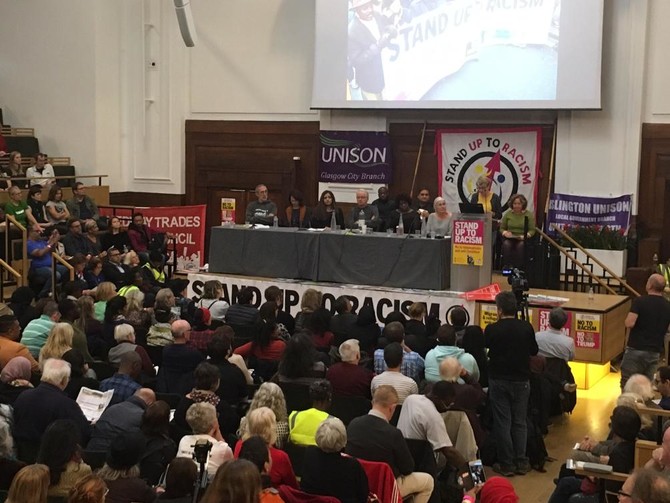
LONDON: The rise of far-right political parties across Europe is normalizing racism, politicians and activists warned at an event in London.
Islamophobia, anti-Semitism and other forms of prejudice are on the rise, the Stand Up to Racism event in London heard yesterday.
“Populism is on the march,” Claude Moraes, a Labour member of the European Parliament for London, told the audience. “In Hungary, in Poland, where you see the turning back day by day of democracy, where you see the targeting of minorities, the scapegoating of minorities, it is an incremental move backwards.”
Far-right parties have made major gains in elections across Europe this year, often running campaigns infused with anti-Muslim or anti-immigrant rhetoric.
In parliamentary elections held in September, Alternative for Germany (AfD), which has drummed up fears about the “Islamification” of Germany, won 13 percent of the vote.
Last week Austria’s Freedom Party, which has decried Islam as “fascistic,” earned 51 seats in Parliament.
The far-right was also poised to emerge as the winner in Czech elections held this weekend, with the Freedom and Direct Democracy party set for major gains.
“The growth of Islamophobia, the acceptability is sharpening and making racism acceptable. We have to make sure it doesn’t get normalized,” said Weyman Bennett, a co-convenor of Stand Up to Racism.
The belief that Muslims represent a risk to British values and a security threat is propagated by politicians, he said.
Attacks against Islam in the popular media, said Labour MP Catherine West, were particularly concerning.
“I’m very worried that it somehow acceptable to criticize Muslims, and that dog-whistle politics which is on the front page of many of our tabloids seems to be gaining ground. We need to challenge that.”
Julie Ward, a member of the European Parliament representing North West England, agreed. “I’ve been witnessing in the media and in the public domain an increasing normalization of racism which has certainly led to the Brexit vote,” she told Arab News. “I have a huge Muslim community in my constituency, and they are on the receiving end of some of the most horrendous racism.”
“I’m worried. I’m worried because racism seems to be the new norm in the center right, let alone the far right,” she said.
Attendee Sabina Khan said that as a woman of color she was concerned about racism in the UK.
“There is always a different rule, for white people and for ethnic minorities,” she said. “We live in a multicultural society but we’re not accepted.”
Jemima Miah, a young volunteer and activist attending the day-long event, said that she had stood by as her sister, who wears a hijab, faced verbal abuse on the Tube.
“A really elderly woman said: “I’m disgusted by you,” Miah recalled, shaking her head. “We can’t ignore it. It’s not just islamophobia, It’s all hate crimes. They need to go.”
Hate crimes have increased dramatically in the UK by 29 percent in the past year, according to recently released statistics.
There is reason to be hopeful, however. West lauded the cooperation between Muslims and Jews in the wake of the attack at the Finsbury Mosque which killed a worshipper during Ramadan.
“We do have a really strong sense of solidarity in London communities,” she said. “Unity and resistance is necessary in the face of rising intolerance.”