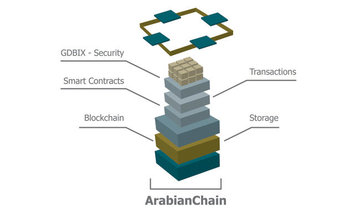
DUBAI: The research arm of the Islamic Development Bank plans to use blockchain technology to develop Shariah-compliant products, aiming to support financial inclusion efforts across its member countries.
The Jeddah-based Islamic Research and Training Institute said it had signed an agreement with local firm Ateon and Belgium-based SettleMint, with the first stage to focus on a technical feasibility study.
The agreement is the latest effort to combine blockchain technology to tap demand from Muslim investors, with firms from Indonesia to Canada having already received Shariah-compliant certification for their products.
Involvement of the IDB, a multilateral development institution, could also encourage other fintech firms to incorporate Islamic finance to tap markets across the Middle East, Asia and Africa.
Islamic finance follows religious principles such as a ban on gambling and outright speculation, but until now the sector has focused on traditional retail banking services.
Blockchain involves a shared electronic ledger that allows all parties to track information through a secure network, removing the need for third-party verification.
The IDB said such features would allow for instantaneous clearing and settlement of transactions and asset exchanges, while helping eliminate counterparty risk.

Saudi Arabia’s IDB plans blockchain technology for Shariah-compliant products
Acwa signs key terms to develop 5GW of renewable energy capacity in Turkiye
JEDDAH: Saudi utility giant Acwa has signed key investment agreements with Turkiye’s Ministry of Energy and Natural Resources to develop up to 5 gigawatts of renewable energy capacity, starting with 2GW of solar power across two plants in Sivas and Taseli.
Under the investment agreement, Acwa will develop, finance, and construct, as well as commission and operate both facilities, according to a press release.
The program builds on the company’s first investment in Turkiye, the 927-megawatt Kirikkale Independent Power Plant, valued at $930 million, which offsets approximately 1.8 million tonnes of carbon dioxide annually, the statement added.
A separate power purchase agreement has been concluded with Elektrik Uretim Anonim Sirketi for the sale of electricity generated by each facility.
Turkiye aims to boost solar and wind capacity to 120GW by 2035, supported by around $80 billion in investment, while recent projects have already helped prevent 12.5 million tonnes of CO2 emissions and reduced reliance on imported natural gas.
Turkiye’s energy sector has undergone a rapid transformation in recent years, with renewable power emerging as a central pillar of its strategy.
Raad Al-Saady, vice chairman and managing director of ACWA, said: “The signing of the IA (implementation agreement) and PPA key terms marks a pivotal moment in Acwa’s partnership with Turkiye, reflecting the country’s strong potential as a clean energy leader and manufacturing powerhouse.”
He added: “Building on our long-standing presence, including the 927MW Kirikkale Power Plant commissioned in 2017, this step elevates our partnership to a new level,” Al-Saady said.
In its statement, Acwa said the 5GW renewable energy program will deliver electricity at fixed prices, enhancing predictability for grid planning and supporting long-term industrial investment.
By replacing imported fossil fuels with domestically generated clean energy, the initiative is expected to reduce Turkiye’s exposure to global energy market volatility, strengthening energy security and lowering long-term power costs.
The company added that the economic impact will extend beyond the anticipated investment of up to $5 billion in foreign direct investment, with thousands of jobs expected during the construction phase and hundreds of high-skilled roles created during operations.
The energy firm concluded that its existing progress in Turkiye reflects a strong appreciation for Turkish engineering, construction, and manufacturing capacity, adding that localization has been a strategic priority, and it has already achieved 100 percent local employment at its developments in the country.