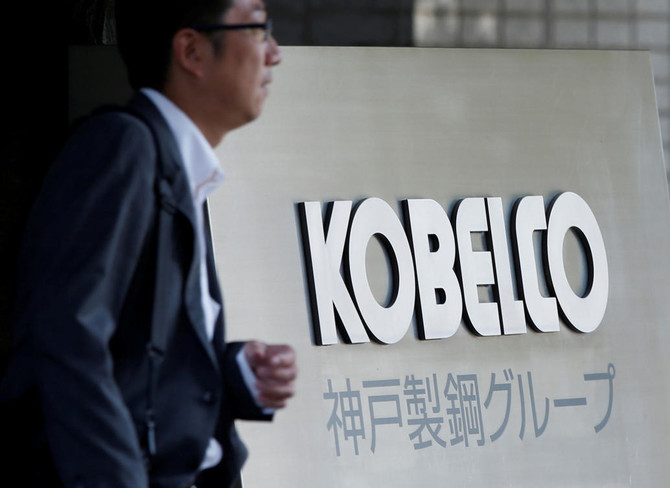
TOKYO: The Japanese government wants to get actively involved in the issue of Kobe Steel’s data fabrications, Hiroshige Seko, the minister of economy, trade and industry, said on Friday, as the company’s widespread misconduct has sent a chill along global supply chains.
Kobe Steel, Japan’s third-biggest steelmaker, admitted earlier this month that it had falsified specifications on the strength and durability of its products. The falsifications stretch back for more than 10 years, a senior executive told Reuters.
“This is a problem between companies, but we want to be actively involved in the issues,” Seko told a news conference, adding that he hoped Kobe Steel would take proper and prompt actions to remedy the situation.
Japan’s Transport Minister Keiichi Ishii also urged the company to investigate the falsifications and take proper prevention measures.
“It was extremely regrettable,” Ishii told a news conference on Friday.
“We want the company to take measures to make sure that it complies with laws and reinforces safety management,” he said.
The ministry has also asked Kobe Steel’s customers to ensure the safety of automobiles and planes.
No safety problems have surfaced as Kobe Steel attempts to confirm the extent of the data tampering. But in Europe, aviation safety authorities earlier this week issued a directive advising aircraft manufacturers to avoid using Kobe Steel products if they can until checks are completed.
Four Japanese automakers on Thursday said they found no safety issues with aluminum parts supplied by Kobe Steel, allaying some concerns that falsified quality data on products from the steelmaker had compromised their vehicles.
Nonetheless, the company’s fate hangs in the balance while checks are being carried out. It must report to Japan’s industry ministry by around the end of next week on any safety concerns and provide a more extensive account of the problems a fortnight later.

Japan government wants to get actively involved in Kobe Steel issue — trade minister

European gas prices soar almost 50% as Iran conflict halts Qatar LNG output
- Analysts warn prolonged disruption could push prices higher
- Some shipments of oil, LNG through Strait of Hormuz suspended
- Benchmark Asian LNG price up almost 39 percent
LONDON: Benchmark Dutch and British wholesale gas prices soared by almost 50 percent on Monday, after major liquefied natural gas exporter Qatar Energy said it had halted production due to attacks in the Middle East.
Qatar, soon to cement its role as the world’s second largest LNG exporter after the US, plays a major role in balancing both Asian and European markets’ demand of LNG.
Most tanker owners, oil majors and trading houses have suspended crude oil, fuel and liquefied natural gas shipments via the Strait of Hormuz, trade sources said, after Tehran warned ships against moving through the waterway.
Europe has increased imports of LNG over the past few years as it seeks to phase out Russian gas following Russia’s invasion of Ukraine.
Around 20 percent of the world’s LNG transits through the Strait of Hormuz and a prolonged suspension or full closure would increase global competition for other sources of the gas, driving up prices internationally.
“Disruptions to LNG flows would reignite competition between Asia and Europe for available cargoes,” said Massimo Di Odoardo, vice president, gas and LNG research at Wood Mackenzie.
The Dutch front-month contract at the TTF hub, seen as a benchmark price for Europe, was up €14.56 at €46.52 per megawatt hour, or around $15.92/mmBtu, by 12:55 p.m. GMT, ICE data showed.
Prices were already some 25 percent higher earlier in the day but extended gains after QatarEnergy’s production halt.
Benchmark Asian LNG prices jumped almost 39 percent on Monday morning with the S&P Global Energy Japan-Korea-Marker, widely used as an Asian LNG benchmark, at $15.068 per million British thermal units, Platts data showed.
“If LNG/gas markets start to price in an extended period of losses to Qatari LNG supply, TTF could potentially spike to 80-100 euros/MWh ($28-35/mmBtu),” Warren Patterson, head of commodities strategy at ING, said. The British April contract was up 40.83 pence at 119.40 pence per therm, ICE data showed.
Europe is also relying on LNG imports to help fill its gas storage sites which have been depleted over the winter and are currently around 30 percent full, the latest data from Gas Infrastructure Europe showed. In the European carbon market, the benchmark contract was down €1.10 at €69.17 a tonne