BEIRUT: Lebanon’s Parliament has approved the 2017 state budget, the first in 12 years.
The approval is “a real accomplishment resulting from a political consensus,” economic expert Issam Al-Jurdi told Arab News.
“It will show the whole world that today, the Lebanese state is solid and its institutions have actually begun functioning,” he said.
“The political crisis — which has paralyzed and divided the country for years, and harmed it politically, economically and socially — was solved by a one-year deadline to audit the past 12 years of extra-budgetary spending,” he added.
“I think this deadline will be renewed, and the auditing accounts will remain an instrument of pressure whenever political tensions are exacerbated,” Al-Jurdi said.
“People warn us that we would face the same fate as Greece, but our condition is far worse… because in Greece, the people hold the government accountable for all its actions. The Greeks overthrew three governments a year after the crisis began. In Lebanon, who dares to question a minister who belongs to a political party?”
During Wednesday’s parliamentary session, Prime Minister Saad Al-Hariri urged lawmakers to “seize the opportunity of approving the new state budget, to renew trust among the Lebanese people and work together for our nation’s interest.”
He criticized some politicians “who attempted to divert Parliament’s attention from studying the important state budget, and… to score illusive victories.”
Al-Hariri added: “If the law was violated in the past years in the absence of a state budget, today we stand here in Parliament to put an end to those violations, to respect and abide by legal and constitutional timeframes, and to start preparing the draft law of the 2018 state budget according to an economic, administrative, financial and developmental vision.”
Economic expert Dr. Louis Hobeika said: “Despite the delay, it’s a positive step that will show the whole world that Lebanon is making real progress.”
But he cautioned: “An $11-billion amount was spent in the past years with no auditing reports. This issue, which was behind many political tensions, was dropped, as some deputies said during the parliamentary session that it couldn’t be solved.”
Hobeika added: “Despite the fact that the discussions were shallow, they aimed to remind people of the deputies’ presence as they’ve extended their own term three times in a row, and the next elections will be held soon.”
Thirty-five deputies discussed the state budget. The Lebanese Forces MP accused Banque Du Liban (BDL) Gov. Riad Salameh of “failing to submit yearly budget reports for 20 years.”
This prompted many to defend the bank, saying it was working to maintain a stable exchange rate.
Salameh said: “The BDL has submitted yearly auditing reports to the Finance Ministry for the past 20 years, and the bank’s records are subject to auditing by two international firms that have nothing to do with the BDL. The national bank has paid the government over the past 20 years $4.5 billion.”
Finance Minister Hassan Khalil said before voting: “For 20 years, the BDL has been sending the government detailed reports that are subject to international auditing.” The budget “will reinforce financial regularity,” he added.
Until the end of 2016, the public debt service had reached 112.89 billion Lebanese lira, meaning that 48 percent of state revenues go to the public debt service due to increased spending, Khalil said.


![]()
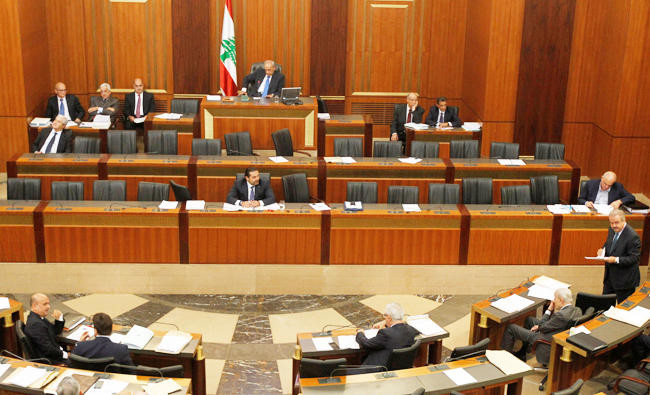
Lebanon approves first state budget in 12 years
Lebanon approves first state budget in 12 years
Latest updates


© 2026 SAUDI RESEARCH & PUBLISHING COMPANY, All Rights Reserved And subject to Terms of Use Agreement.