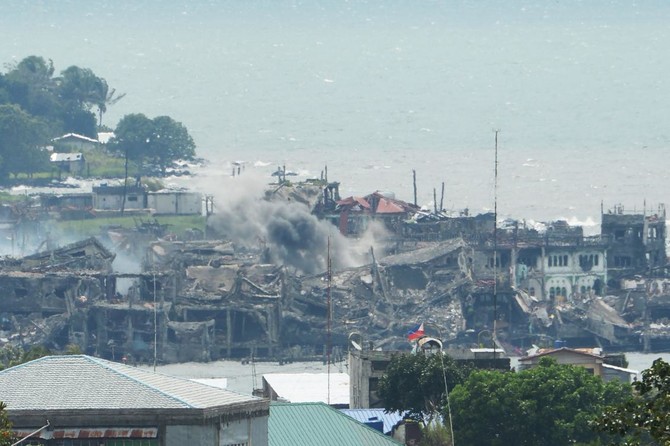
MANILA/JAKARTA: Malaysia’s most wanted, Mahmud Ahmad, was among 20 militants killed Wednesday and Thursday in the Philippine military’s offensive in Marawi City, military officials said.
The head of the Armed Forces of the Philippines (AFP), Gen. Eduardo Ano, described the operation as “very positive.”
He added: “We were able to neutralize 13 (militants Wednesday night)... Early this (Thursday) morning, we were able to get seven more.”
Philippine President Rodrigo Duterte confirmed the death of Ahmad, 39, an alleged financer of Maute militants.
The latest operation also resulted in the rescue of two civilians, a mother and daughter, who claim to have seen Ahmad among the slain terrorists, said AFP spokesman Maj. Gen. Restituto Padilla.
Ano said one of the rescued hostages revealed that Ahmad was immediately buried Wednesday night. “We’ll look for the cadaver,” said the AFP chief.
Ahmad’s reported killing comes four days after the deaths of Isnilon Hapilon and Omar Maute.
Hapilon was Daesh’s designated leader for Southeast Asia, and was regarded by the US as one of the world’s most dangerous terrorists.
Omar and his brother Abdullah formed the Maute group, which attacked and has held parts of Marawi City since May 23. Ahmad had been touted as Hapilon’s potential successor as Daesh’s emir in Southeast Asia.
Ahmad, who also went by the name Abu Handzalah, was a former university lecturer in Kuala Lumpur.
He was reportedly trained in an Al-Qaeda camp in Afghanistan under Osama bin Laden in the 1990s, when he was a student at the Islamic International University in Islamabad, Pakistan.
Ahmad is suspected of channeling more than 30 million Philippine pesos ($600,000) from Daesh to fund the Marawi siege.
He was believed to be hiding in a building inside the main battle zone after the deaths of Hapilon and Omar.
Padilla described Ahmad as a “very significant asset” to local militants, as he was the one providing funds and serving as a conduit to Daesh. “He was the financier and logistical enabler, but not a fighter,” Padilla told Arab News.
A report released by the Indonesia-based Institute of Policy Analysis and Conflict (IPAC) in July cited Ahmad’s crucial role in how the chain of command functioned between Syria and Marawi.
“All foreigners wanting to join the East Asia Wilayah — as the command structure in Marawi refers to itself — had to go through Dr. Ahmad,” said the report.
“He also arranged for ISIS (Daesh) funding for the Marawi operations to be laundered through Indonesia, using operatives of Jamaah Ansharud Daulah (JAD).”
Col. Romeo Brawner, deputy commander of the Joint Task Group Ranao, said they have yet to retrieve all the bodies of the slain militants. The latest enemy casualties were due mostly to sniper shots, he added.
Brawner described enemy resistance as “organized” but now limited to urban terrain less than a hectare in size.
“They’ve established their defensive positions and are using hostages as human shields,” he said.
“Sometimes they (militants) would use them as bait. They’ll tell them to run down the road, and if they get fired at, that means there are soldiers where the shots are coming from.”
More than 20 militants are still in the area, according to the rescued hostages. Padilla predicts retaliatory attacks following the deaths of their leaders.
“We’re prepared. We’re monitoring potential areas where they might launch retaliatory attacks,” he said.
He identified the areas as Maguindanao, Cotabato, parts of Lanao Del Sur, Basilan, Jolo, Sulu, Tawi Tawi in Mindanao, and major cities including Metro Manila.
Meanwhile, Indonesian security forces remain on alert to thwart a spill-over of fighters from Marawi City to the country via its outermost northern islands, which share a sea border with the Philippines.
“We always anticipate the possible infiltration of militants from Marawi,” Indonesian police Brig. Gen. Hamidin, a senior official with Indonesia’s National Counterterrorism Agency (BNPT), told Arab News.
Hamidin said Ahmad established Katibah Al-Muhajir (Battalion of Migrants) in the southern Philippines, helping at least 40 Indonesians arrive there since 2016.
His men were familiar with using the island trail on the porous maritime border between the two countries, as they smuggled weapons that were used in the Jan. 14, 2016 terrorist attack in central Jakarta, Hamidin added.
The fighting in Marawi, which prompted Duterte to place Mindanao island under martial law, has left more than 1,000 dead, including 882 militants, 164 soldiers and policemen, and 47 civilians. More than 350,000 residents have been displaced.

Malaysia’s ‘most wanted’ killed in Marawi: Officials
Epstein files reveal links to cash, women, power in Africa
- Documents attest to Epstein’sclose ties with Karim Wade, son of former Senegalese president Abdoulaye Wade
- They also reveal his ties to Nina Keita, niece of Ivorian president Alassane Ouattara
PARIS: Jeffrey Epstein built close ties with powerful figures in Senegal and Ivory Coast, files released by the US government last month show, detailing the late sex offender’s influence network across Africa.
Emails, scheduled meetings, investment projects, and loans reviewed by AFP attest to the disgraced New York financier’s close relationship with Karim Wade, son of former Senegalese president Abdoulaye Wade.
They also reveal his ties to Nina Keita, niece of Ivorian president Alassane Ouattara.
Wade and Epstein met in 2010 through Emirati businessman Sultan Ahmed bin Sulayem, who recently resigned as CEO of port giant DP World after mounting pressure over his close friendship with Epstein.
The pair quickly struck up a rapport.
“Thanks for coming. I think there are many things to consider... I feel confident that we will have fun,” Epstein wrote to Wade on November 15, 2010 after their first meeting in Paris.
“Have a safe trip back to your paradise Island,” Wade replied.
While Wade’s exchanges show no link to Epstein-related sex trafficking crimes, they do reveal conversations on potential business ventures in various sectors, such as finance and energy.
Nicknamed the “Minister of Heaven and Earth” for the multiple portfolios he held including international cooperation, energy, and air transport, Wade was a powerful figure in Senegal until April 2012, when his father’s bid for a third term sparked deadly riots.
Epstein saw him as “one of the most important players in africa” and invited him to meet close contacts such as Ehud Barak, then Israel’s defense minister.
He also put him in touch with Chinese businessman Desmond Shum to discuss “offshore banking.”
The US Department of Justice documents show Shum and Wade met in Beijing on May 9, 2011.
That same month, Wade planned an African tour through Senegal, Mali, and Gabon for Epstein.
‘You will not suffer’
Epstein and Wade’s relationship became even more apparent after the latter’s fortunes reversed when his father left office in 2012.
That autumn, Epstein proposed that his “friend” — under the Dakar authorities’ scrutiny over his assets — use his house in Florida.
“You and your family are welcome to use my house in palm beach, staff is there, pool etc. you will not suffer,” Epstein wrote.
“Txs a lot Brother for the advise,” Wade replied a few weeks later to another email, in which Epstein urged him to “stay mentally strong.”
Numerous files suggest Epstein became financially involved on Karim Wade’s behalf after his arrest in 2013 and his 2015 sentencing to six years in prison for corruption.
Karim Wade’s lawyer, Mohamed Seydou Diagne, sent two invoices in May 2014 and July 2015 of $500,000 to one of Epstein’s companies.
Contacted by AFP on Monday, Diagne said he “did not consider it useful to comment.”
Other archives suggest that Epstein covered at least $50,000 in fees for the US lobbying firm Nelson Mullins, hired by Wade’s entourage to secure his release.
Epstein regularly exchanged emails with Robert Crowe, a partner at the firm who kept him informed of their efforts in the US and Senegal.
In a June 16, 2016 email thread where Epstein and Crowe discussed whether then Senegalese president Macky Sall would pardon Wade, Crowe writes: “He has told my friends high up at State that he was going to do it. They have been putting pressure on him!“
Karim Wade was released from prison eight days later, on June 24, and went into exile in Qatar, which he credited for efforts toward his release.
Jeffrey Epstein was told by Sultan Ahmed bin Sulayem and Nina Keita.
‘A very interesting person!’
The DOJ documents show Nina Keita was close to both Epstein and Karim Wade and that she acted as a regular intermediary while Wade was in prison.
Keita also helped put Epstein in contact with her uncle, president of Ivory Coast since May 2011, and his team.
“He thought you were a very interesting person! ... they were all very happy to have you here,” she wrote on January 20, 2012, after the financier’s visit to Abidjan.
She had booked him the “ministerial suite” of the luxury Hotel Ivoire for that trip.
Ahead of the visit, Epstein had said he hoped to see “very pretty girls there, as well as interesting places.”
“You will!” Keita replied.
Emails show Keita, a former model, at least once sent photos and the phone number of a young woman to Epstein.
He then met this woman at the Ritz hotel in Paris on August 31, 2011.
“ask sadia to send pictures of her sister. i prefer under 25,” Epstein wrote to Keita after the meeting.
Now the deputy general director of Ivorian petroleum stocks company GESTOCI, Keita also appears in a February 2019 will in which Epstein requested that debts owed to him by a number of people be canceled upon his death.
AFP received no response to its requests for comment from both Keita and the Ivorian presidency, or from Karim Wade, who was contacted through his entourage.
The mere mention of a person’s name in the Epstein files does not in itself imply wrongdoing.