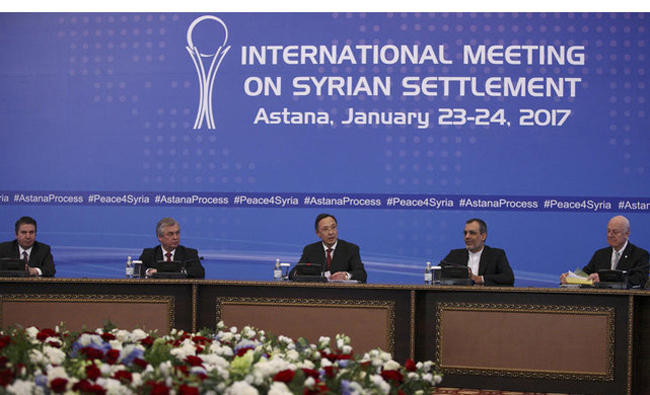
ASTANA: Fresh talks on the Syria conflict will be held in Astana at the end of the month, Kazakhstan said on Thursday, as part of a Moscow-led push to end the six-year conflict.
The two-day meeting, which will take place on Oct. 30-31 in the Kazakh capital, will be the seventh round of negotiations this year that are co-sponsored by regime backers Russia and Iran and rebel supporter Turkey.
“The guarantor states of the cessation of hostilities have agreed that the seventh round of high-level talks on Syria as part of the Astana process will be held on Oct. 30-31,” the Kazakh Foreign Ministry said in a statement.
At the last set of talks in September, the three powers agreed to allocate forces to patrol the zone covering Idlib province and neighboring regions.
The diplomatic push brings together the Syrian regime and representatives of the opposition, including some key armed groups who had previously steered clear of other negotiations.
Moscow has been spearheading the talks in a bid to pacify Syria after its game-changing intervention on the side of President Bashar Assad.
France criticized Russia on Thursday for calling into question an international inquiry into who is to blame for chemical weapons attacks in Syria.
Russia has questioned the work and future of the joint inquiry by the UN and the Organization for the Prohibition of Chemical Weapons (OPCW), and said it would decide whether to support extending the mandate after investigators submit their next report.
“We cannot accept that the credibility and independence of these mechanisms are challenged on the grounds that their conclusions are not suitable for Russia,” said French Foreign Ministry spokeswoman Agnes Romatet-Espagne.
“This undermines the international consensus that it is our responsibility to build to stop the use of these weapons in Syria.”
The inquiry, known as the Joint Investigative Mechanism (JIM), is due to report by Oct. 26 on who was responsible for an April 4 attack on the opposition-held town of Khan Sheikhoun that killed dozens of people.
France, Britain and the US have accused Assad’s regime of being behind the attack and the probe is expected to back those claims.
The US said on Wednesday it would push the UN Security Council to renew within days the JIM’s mandate, setting the stage for a likely showdown with Russia, which backs Assad and denies Assad has used chemical weapons.
France, under President Emmanuel Macron, has been pushing for closer cooperation with Moscow, especially over Syria, and has said dialogue with Russia on enforcing a 2013 Security Council resolution to prevent the use of chemical weapons in Syria was one of its priorities.
“The JIM (already) concluded in its August and October 2016 reports the responsibility of the Syrian armed and security forces in three cases of chlorine use and IS (Daesh) in one case. The methodology of the investigation is indisputable,” Romatet-Espagne said.

Next round of Syria talks at end October: Kazakhstan
Israel says carrying out ‘large-scale strikes’ on Tehran
JERUSALEM: The Israeli military said it launched “large-scale strikes” on Tehran on Monday, two days since the start of a US-Israeli campaign against Iran.
“The Israeli Air Force... has begun an additional wave of strikes against the Iranian terror regime at the heart of Tehran,” the military said in a statement.
Israei's new “large-scale” strikes followed mile fire from Iran that injured three people in Jerusalem late on Sunday.
“A direct impact of a munition was identified on one of the main roads in Jerusalem,” police said in a statement, sharing footage showing officers at a highway section littered with rubble.
Israel’s emergency medical service Magen David Adom said three people were injured, including a 46-year-old man with moderate shrapnel wounds.
The medical organization earlier said several others were treated for light injuries at the site.
AFP journalists heard a series of loud blasts above the city, after the Israeli military said it had detected missiles launched from Iran.
Israel’s Kan public television and Channel 12 broadcast footage showing police officers and rescuers deployed in areas where visible damage could be seen, one “in the center of the country” and the other in the Jerusalem area.
In the Jerusalem area, the footage showed a road strewn with debris and rocks.
In the center of the country, damaged cars could be seen.
Military censorship prohibits the media from disclosing the exact locations of the impact sites.
In other developments:
• The European Union has warned of the cost to the Middle East of a long war, and said it was reinforcing its naval mission in the Red Sea with additional vessels as Iran’s retaliation to US-Israeli strikes threatens maritime traffic, a European diplomat said.
Two new French ships will join the EU’s Aspides mission, bringing to five the number of warships taking part, the diplomat told AFP.
• Gulf states vowed to defend themselves against Iranian attacks, including by “responding to the aggression” if need be, after the Gulf Cooperation Council convened via video-link to formulate a unified response.
• Top US officials including Secretary of State Marco Rubio will make the case Tuesday to Congress for the attack on Iran. Rubio, Defense Secretary Pete Hegseth, CIA Director John Ratcliffe and military chief General Dan Caine “will brief the full membership of both chambers of Congress,” White House spokesman Dylan Johnson said.
• Container shipping company Maersk said it was halting passage through the Suez Canal and the Strait of Hormuz for “safety” reasons.
The Danish group was the latest of several shipping groups to make similar announcements after Iran’s Revolutionary Guards declared the strait closed on Saturday.
• Seven people were injured in the Jerusalem area following the latest salvo of missiles fired from Iran, Israeli firefighters said.
• British Prime Minister Keir Starmer said he had agreed to let the United States use UK bases to fire “defensive” strikes aimed at destroying Iranian missiles and their launchers. But in a video address posted to social media, he added: “We were not involved in the initial strikes on Iran and we will not join offensive action now.
• Iranian media reported that a police station in a city on the outskirts of Tehran had been hit, killing an unspecified number of people, with others reportedly trapped under debris. “According to initial reports, a number of citizens were martyred and some were trapped under the rubble,” the Tasnim news agency reported.
• Iranian news agency ISNA reported that Gandhi hospital in northern Tehran had been targeted by strikes. The Fars and Mizan agencies published a video, presented as being from inside the facility, showing debris on the floor among wheelchairs.