LONDON: London Stock Exchange Group said Thursday that its chief executive, French national Xavier Rolet, would leave the company by the end of 2018 after almost a decade in charge.
“The board is now initiating a process to find a successor and will work closely with Xavier to ensure a smooth transition process as the group continues to execute on its successful growth strategy,” a statement said.
It did not give any indication about the reason for Rolet’s departure.
Rolet joined LSEG in 2009 and since then, the company’s market value has rocketed to nearly £14 billion from £800 million, the statement said.
Rolet said he was “extremely proud” to have helped “turn LSEG into a truly global financial market infrastructure group.”
Under his stewardship, the company bought US asset manager Russell for $2.7 billion to diversify and boost its business in the United States.
It also bought LCH.Clearnet, the British clearing house.
But also on his watch, the LSEG — which additionally operates Italy’s Borsa Italiana — failed in separate attempts to merge with the Toronto stock exchange and earlier this year with Germany’s Deutsche Boerse.
The EU in March blocked a proposed blockbuster tie-up of the London and Frankfurt stock markets owing to competition concerns and fallout from Brexit.
Speaking on Wednesday, Rolet warned that more British firms would move business to EU countries should Britain fail to hammer out a post-Brexit transition deal by the end of the year.
“In the absence of certainty in the next few months, the businesses, the CEOs, the boards the executive committees of many companies that are based here will have to start acting on worst case scenarios,” the 57 year-old said in a speech made at Britain’s parliament.


London Stock Exchange says CEO Xavier Rolet to depart
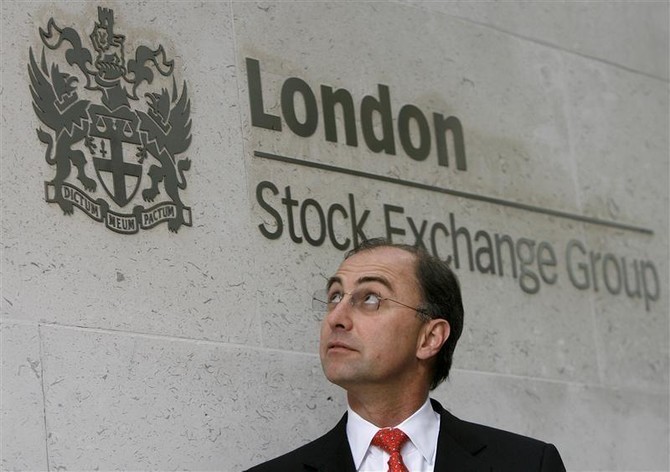
London Stock Exchange says CEO Xavier Rolet to depart


Closing Bell: Saudi main index closes in red at 11,183
RIYADH: Saudi Arabia’s Tadawul All Share Index dipped on Monday, losing 44.79 points, or 0.4 percent, to close at 11,183.85.
The total trading turnover of the benchmark index was SR4.05 billion ($1.08 billion), as 69 of the listed stocks advanced, while 191 retreated.
The MSCI Tadawul Index decreased, down 6.63 points or 0.44 percent, to close at 1,504.73.
The Kingdom’s parallel market Nomu lost 328.20 points, or 1.36 percent, to close at 23,764.92. This comes as 22 of the listed stocks advanced, while 49 retreated.
The best-performing stock was Maharah Human Resources Co., with its share price surging by 7.26 percent to SR6.50.
Other top performers included Arabian Cement Co., which saw its share price rise by 6.27 percent to SR22.71, and Saudi Research and Media Group, which saw a 4.3 percent increase to SR104.30.
On the downside, the worst performer of the day was Arabian Internet and Communications Services Co., whose share price fell by 8.01 percent to SR207.80.
Jahez International Co. for Information System Technology and Al-Rajhi Co. for Cooperative Insurance also saw declines, with their shares dropping by 5.61 percent and 4.46 percent to SR12.79 and SR75, respectively.
On the announcement front, Etihad Etisalat Co. announced its financial results for 2025 with a 7.9 percent year-on-year growth in its revenues, to reach SR19.6 billion.
In a Tadawul statement, Mobily said that this growth is attributed to “the expansion of all revenue streams, with a healthy growth in the overall subscriber base.”
Mobily delivered an 11.6 percent increase in net profit, reaching SR3.4 billion in 2025 compared to SR3.1 billion in 2024.
The company’s share price reached SR67.85, marking a 0.37 percent increase on the main market.