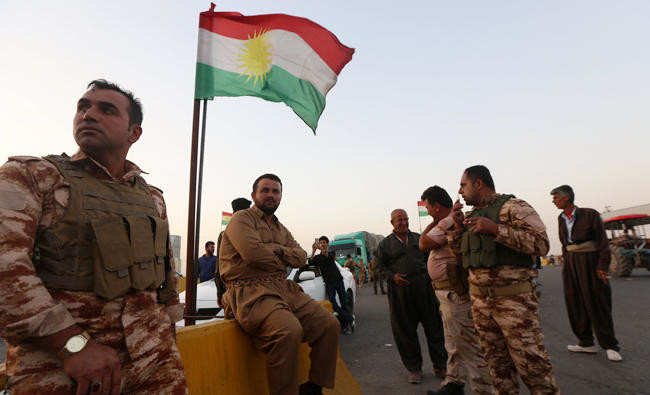
BAGHDAD: The US-led coalition battling Daesh urged Baghdad and Iraq’s Kurds on Monday to “avoid escalatory actions” after Iraqi forces launched an operation to retake parts of Kirkuk province.
“We continue to advocate dialogue between Iraqi and Kurdish authorities. All parties must remain focused on the defeat of our common enemy, ISIS (Daesh), in Iraq,” Maj. Gen. Robert White, a commanding general in the coalition, said in a statement.
The coalition said the clash in the region of Kirkuk was a “misunderstanding.”
“Coalition forces and advisers are not supporting Government of Iraq or Kurdistan Regional Government activities near Kirkuk, but are aware of reports of a limited exchange of fire during predawn hours of darkness,” it said in a statement on its website.
“We believe the engagement this morning was a misunderstanding and not deliberate as two elements attempted to link up under limited visibility conditions,” it added.
The Iraqi operation, which follows weeks of soaring tensions between two US allies in the battle against Daesh, aims to retake oil and military sites in Kirkuk that Kurdish forces took over during the fightback against the terrorists.
It follows the referendum last month, which saw Iraqi Kurds overwhelmingly back independence for their northern region, despite warnings from Washington that the vote would complicate efforts to tackle the jihadists.
At least 10 Kurdish fighters were killed and 27 wounded during fighting overnight with Iraqi pro-government paramilitary forces, a Kurdish official said.
The coalition said it was monitoring movements of military vehicles and personnel in the vicinity of Kirkuk, which is disputed between Baghdad and the Kurds, and denied a wide-scale offensive was underway.
“These movements of military vehicles, so far, have been coordinated movements, not attacks,” the statement said.
It said coalition forces were not supporting activities by the Iraqi or Kurdish governments around Kirkuk.
The coalition was aware of reports of clashes, it said. “We believe the engagement this morning was a misunderstanding and not deliberate.”
Meanwhile, thousands of residents fled Kirkuk for fear of clashes Monday after Iraqi military forces launched operations, an AFP journalist said.
The exodus in buses and cars toward Irbil and Sulaimaniyah, the two main cities of autonomous Iraqi Kurdistan, created traffic jams on roads leading out of Kirkuk.
A local official in charge of the displaced said tens of thousands, mostly Kurds, were heading out of the city, although at the same time crowds on the streets of Kirkuk’s southern outskirts welcomed Iraqi forces.
“We’re leaving because we’re scared there will be clashes” in the ethnically mixed city of 850,000 people, said 51-year-old Chounem Qader.
“We also had to flee Kirkuk back in 1991, like today,” she said, referring to a Kurdish uprising that was put down by forces of late dictator Saddam Hussein and when tens of thousands of Kurds were deported from the region.
Himen Chouani, a 65-year-old Kurd taking flight with his family, pinned the blame on politicians in both Baghdad and Irbil, the capital of Iraqi Kurdistan.
“We were living in peace but politicians don’t want good things for us, neither in Baghdad nor Irbil. They’re fighting to control the oil, and the victims are us, the residents of Kirkuk,” he said.


![]()
US-led coalition urges Baghdad, Kurds to avoid ‘escalatory actions’
US-led coalition urges Baghdad, Kurds to avoid ‘escalatory actions’
Latest updates


© 2026 SAUDI RESEARCH & PUBLISHING COMPANY, All Rights Reserved And subject to Terms of Use Agreement.