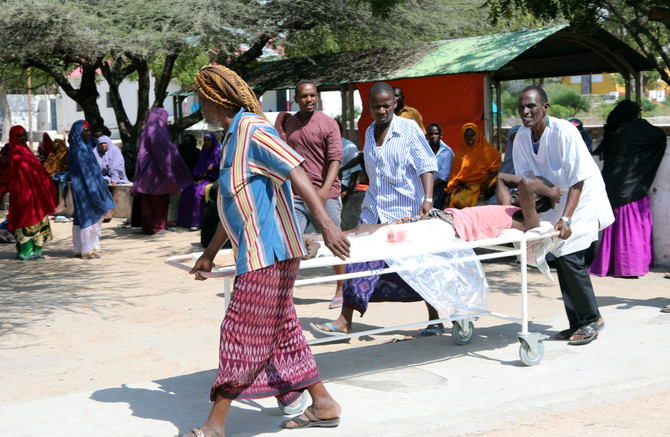
MOGADISHU, Somalia: The most powerful bomb blast ever witnessed in Somalia’s capital killed at least 231 people with more than 275 injured, a senator said Sunday, making it the deadliest single attack in this Horn of Africa nation. The toll could continue to rise.
Abshir Abdi Ahmed cited doctors at overwhelmed hospitals he visited in Mogadishu a day after a truck bomb targeted a crowded street near key government ministries. Many of the bodies in mortuaries had not yet been identified, he said.
As angry protesters gathered near the scene of the attack, Somalia’s government blamed the Al-Qaeda-linked Al-Shabab extremist group for what it called a “national disaster.” However, Africa’s deadliest Islamic extremist group, which often targets high-profile areas of the capital, had yet to comment.
The Mogadishu bombing is one of the deadliest attacks in sub-Saharan Africa, larger than the Garissa University attack in Kenya in 2015 and the US Embassy bombings in Kenya and Tanzania in 1998.
Doctors at Mogadishu hospitals struggled to assist badly wounded victims, many burned beyond recognition. “This is really horrendous, unlike any other time in the past,” said Dr. Mohamed Yusuf, the director of Medina hospital.
Inside, bleary-eyed nurses transported a man whose legs had been blown off. He waited as surgeons attended to another badly injured patient. Exhausted doctors struggled to keep their eyes open, while screams from victims and newly bereaved families echoed through the halls.
“Nearly all of the wounded victims have serious wounds,” said nurse Samir Abdi. “Unspeakable horrors.” The smell of blood was strong.
A teary-eyed Hawo Yusuf looked at her husband’s badly burned body. “He may die waiting,” she said. “We need help.”
Ambulance sirens echoed across the city as bewildered families wandered in the rubble of buildings, looking for missing relatives. “In our 10 year experience as the first responder in #Mogadishu, we haven’t seen anything like this,” the Aamin Ambulance service tweeted.
Grief overwhelmed many.
“There’s nothing I can say. We have lost everything,” wept Zainab Sharif, a mother of four who lost her husband. She sat outside a hospital where he was pronounced dead after hours of efforts by doctors to save him.
The country’s Somali-American leader, President Mohamed Abdullahi Mohamed, declared three days of mourning and joined thousands of people who responded to a desperate plea by hospitals to donate blood. “I am appealing all Somali people to come forward and donate,” he said.
Mogadishu, a city long accustomed to deadly bombings by Al-Shabab, was stunned by the force of Saturday’s blast. The explosion shattered hopes of recovery in an impoverished country left fragile by decades of conflict, and it again raised doubts over the government’s ability to secure the seaside city of more than 2 million people.
“They don’t care about the lives of Somali people, mothers, fathers and children,” Prime Minister Hassan Ali Khaire said of the attackers. “They have targeted the most populated area in Mogadishu, killing only civilians.”
Rescue workers searched for survivors trapped under the rubble of the largely destroyed Safari Hotel, which is close to Somalia’s foreign ministry. The explosion blew off metal gates and blast walls erected outside the hotel.
The United States condemned the bombing, saying “such cowardly attacks reinvigorate the commitment of the United States to assist our Somali and African Union partners to combat the scourge of terrorism.” It tweeted a photo of its charge d’affaires in Somalia donating blood.
But the US Africa Command said US forces had not been asked to provide aid. A spokesman told The Associated Press that first responders and local enforcement would handle the response and “the US would offer assistance if and when a request was made.”
The US military has stepped up drone strikes and other efforts this year against Al-Shabab, which is also fighting the Somali military and over 20,000 African Union forces in the country.
The United Nations special envoy to Somalia called the attack “revolting,” saying an unprecedented number of civilians had been killed. Michael Keating said the UN and African Union were supporting the Somali government’s response with “logistical support, medical supplies and expertise.”
The spokesman for UN Secretary-General Antonio Guterres strongly condemned the attack and urged all Somalis to unite against extremism and work together to build a “functional” federal state.
Saturday’s blast occurred two days after the head of the US Africa Command was in Mogadishu to meet with Somalia’s president, and two days after the country’s defense minister and army chief resigned for undisclosed reasons.
Amid the chaos, the stories of victims began to emerge. Amino Ahmed said one of her friends, a female medical student, was killed on the eve of her graduation. The explosion also killed a couple returning from a hospital after having their first child, said Dahir Amin Jesow, a Somali lawmaker.
“It’s a dark day for us,” he said.
___
Associated Press video journalist Mohamed Sheikh Nor in Mogadishu, Somalia contributed.

Grief descends on Somalia as death toll from truck bomb attack rises to 231
Filmmakers defend Berlin festival chief in Gaza row
- Actors and filmmakers rushed to defend the head of the Berlin film festival Thursday following a media report that her job was on the line over a director’s anti-Israel speech at the event
BERLIN: Actors and filmmakers rushed to defend the head of the Berlin film festival Thursday following a media report that her job was on the line over a director’s anti-Israel speech at the event.
Syrian-Palestinian filmmaker Abdallah Al-Khatib kicked off a controversy during Saturday’s closing ceremony by accusing Germany of being complicit in genocide in Gaza through its support for Israel.
German tabloid Bild had reported that Tricia Tuttle was due to be dismissed at an emergency meeting on Thursday, citing sources close to state-owned KBB, the company that runs the festival.
Culture minister Wolfram Weimer’s office confirmed the meeting had taken place but made no mention of Tuttle being sacked, stating that discussions had been “constructive and open” and would “continue in the coming days.”
A group of cinema luminaries including Tilda Swinton, Todd Haynes, Sean Baker and Tom Tykwer signed an open letter defending the Berlinale as a forum for free expression.
“As filmmakers in Germany and beyond, we are following the debates surrounding the Berlinale and the discussion about the dismissal of Tricia Tuttle with great concern,” they wrote. “We defend the Berlinale for what it is: a place of exchange.”
Angry rows over the Israel-Palestinian conflict have repeatedly rocked the Berlinale, held every February as Europe’s first major film festival of the year.
Environment Minister Carsten Schneider walked out of Saturday’s closing ceremony, labelling Khatib’s remarks “unacceptable.”
Germany, as it has sought to atone for the horrors of the Holocaust, has been a steadfast supporter of Israel, and criticism of Israel’s conduct in Gaza has been more muted than in many other countries.
Conservative lawmaker Ellen Demuth was among those who condemned the “antisemitic incident” at the awards ceremony and urged “a fresh start at the top of the film festival.”
The Berlinale Team in an Instagram post meanwhile defended Tuttle, praising her “clarity, integrity and artistic vision.”
The writers’ association PEN Berlin said Khatib’s comments were protected by freedom of expression and that if Tuttle were to be sacked over them, it would cause “immense damage” to the festival.
“Such wanton destruction of the German cultural scene, such self-inflicted insularity, must not be allowed to happen,” it said.
The backdrop of the Middle East conflict led to a tense 76th edition of the festival from the start.
More than 80 film professionals criticized the Berlinale’s “silence” on the Gaza war in an open letter, accusing the festival of censoring artists “who reject the genocide” they believe Israel has committed in Gaza.
Award-winning Indian writer Arundhati Roy withdrew from the festival after the jury president, German director Wim Wenders, said cinema should “stay out of politics” when asked about Gaza.
Syrian-Palestinian filmmaker Abdallah Al-Khatib kicked off a controversy during Saturday’s closing ceremony by accusing Germany of being complicit in genocide in Gaza through its support for Israel.
German tabloid Bild had reported that Tricia Tuttle was due to be dismissed at an emergency meeting on Thursday, citing sources close to state-owned KBB, the company that runs the festival.
Culture minister Wolfram Weimer’s office confirmed the meeting had taken place but made no mention of Tuttle being sacked, stating that discussions had been “constructive and open” and would “continue in the coming days.”
A group of cinema luminaries including Tilda Swinton, Todd Haynes, Sean Baker and Tom Tykwer signed an open letter defending the Berlinale as a forum for free expression.
“As filmmakers in Germany and beyond, we are following the debates surrounding the Berlinale and the discussion about the dismissal of Tricia Tuttle with great concern,” they wrote. “We defend the Berlinale for what it is: a place of exchange.”
Angry rows over the Israel-Palestinian conflict have repeatedly rocked the Berlinale, held every February as Europe’s first major film festival of the year.
Environment Minister Carsten Schneider walked out of Saturday’s closing ceremony, labelling Khatib’s remarks “unacceptable.”
Germany, as it has sought to atone for the horrors of the Holocaust, has been a steadfast supporter of Israel, and criticism of Israel’s conduct in Gaza has been more muted than in many other countries.
Conservative lawmaker Ellen Demuth was among those who condemned the “antisemitic incident” at the awards ceremony and urged “a fresh start at the top of the film festival.”
The Berlinale Team in an Instagram post meanwhile defended Tuttle, praising her “clarity, integrity and artistic vision.”
The writers’ association PEN Berlin said Khatib’s comments were protected by freedom of expression and that if Tuttle were to be sacked over them, it would cause “immense damage” to the festival.
“Such wanton destruction of the German cultural scene, such self-inflicted insularity, must not be allowed to happen,” it said.
The backdrop of the Middle East conflict led to a tense 76th edition of the festival from the start.
More than 80 film professionals criticized the Berlinale’s “silence” on the Gaza war in an open letter, accusing the festival of censoring artists “who reject the genocide” they believe Israel has committed in Gaza.
Award-winning Indian writer Arundhati Roy withdrew from the festival after the jury president, German director Wim Wenders, said cinema should “stay out of politics” when asked about Gaza.
© 2026 SAUDI RESEARCH & PUBLISHING COMPANY, All Rights Reserved And subject to Terms of Use Agreement.