Riyadh Metro joins station branding ride

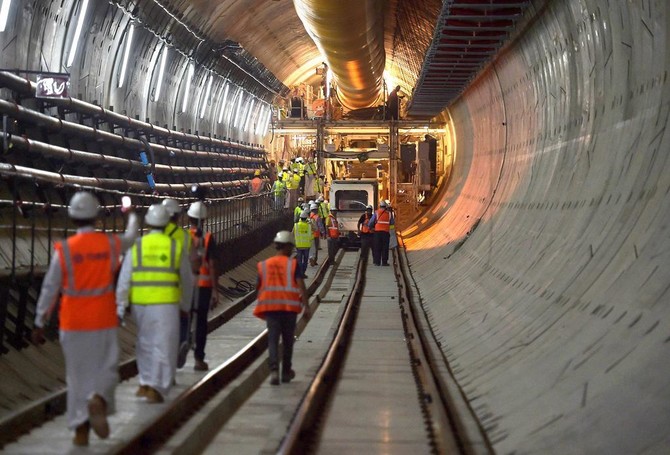
The Riyadh Metro project is part of the country’s ambitious program to reform the economy and society. (Reuters)
Updated 15 October 2017
Follow

Riyadh Metro joins station branding ride

RIYADH — The $23 billion Riyadh Metro launched an auction on Sunday for private companies to name and advertise in select metro stops when the system opens in 2019, an initiative that could generate millions of dollars to help cover operational costs.
Construction on the 176-kilometer metro began in 2014 after contracts were awarded to consortiums headed by US construction giant Bechtel Corp, Spain’s Fomento de Construcciones y Contratas and Italy’s Ansaldo STS.
The metro’s six lines and 85 stations are scheduled to be operational by the end of 2019. They will be served by electric, driverless trains in what officials describe as the world’s largest public transport system currently under development.
Construction has pushed ahead amid speculation the project could be scaled back or delayed following a slump in Saudi Arabia’s oil revenues. The metro is part of the country’s ambitious program to reform the economy and society.
Local and international companies licensed in the kingdom will be eligible to bid for naming and advertising rights at 10 stations, said officials from the state-run Arriyadh Development Authority (ADA), which oversees the metro project.
Another 10 stations could be offered at a later auction. Bids must be submitted by Jan. 25 and winners will be announced by mid-2018, the officials said.
“(The revenues) will be allocated for running the train and supporting the public transit system in the city”, said Alwalid Alekrish, Director of Construction Development Projects and Project Director of the Riyadh Metro.
He declined to specify how much the auction was expected to generate, but the potential is large. The metro in neighboring Dubai has earned hundreds of millions of dollars with a similar initiative, according to local media.
Promotional materials suggested winning companies would have their logos plastered throughout the stations – at turnstiles, elevators, passageways and shopping areas.


Saudi banking sector outlook stable on higher non-oil growth: Moody’s 

Updated 4 sec ago
Follow

Saudi banking sector outlook stable on higher non-oil growth: Moody’s 

RIYADH: Saudi Arabia’s banking sector outlook remains stable as stronger non-oil economic growth and solid capital buffers support lending and profitability, Moody’s Ratings said, forecasting continued expansion despite liquidity constraints. 

In its latest report, credit rating agency Moody’s said the Kingdom’s non-oil gross domestic product is projected to expand by 4.2 percent this year, up from 3.7 percent recorded in 2025. 

In January, S&P Global echoed a similar view, saying banks operating in Saudi Arabia are expected to sustain strong lending growth in 2026, driven by financing demand tied to Vision 2030 projects. 

Fitch Ratings also underscored the healthy state of Saudi Arabia’s banking system last month, stating that credit growth and high net interest margins are supporting bank profitability in the Kingdom. 

Commenting on the latest report, Ashraf Madani, vice president and senior credit officer at Moody’s Ratings, said: “We expect credit demand to remain robust, but tight liquidity conditions will continue to limit the sector’s lending capacity.” 

Madani added that operating conditions in Saudi Arabia will continue to support banks’ strong asset quality and profitability. 

“The operating environment for banks remains buoyant, underpinned by a forecast increase in non-oil GDP growth, robust solvency and continued progress toward the government’s economic diversification goals,” he added.  

Moody’s said authorities in the Kingdom are introducing business-friendly reforms to bolster investment and private sector activity, while implementing key development projects and preparing for major global events. 

Saudi Arabia continues to advance reforms including full foreign ownership rights, simplified capital market registration procedures and improved investor protections, which could accelerate credit growth to 8 percent this year. 

Problem loans are expected to remain near historical lows at around 1.3 percent of total loans, supported by ongoing credit growth, favorable operating conditions and lower interest rates, which collectively strengthen borrowers’ repayment capacity. 

Retail credit risk remains controlled in Saudi Arabia because most borrowers are government employees with stable income streams. 

“Concentration of single borrowers and specific sectors remains high although the growing proportion of consumer loans — now nearing 50 percent of overall sector lending — continues to reduce aggregate concentration risk,” added Moody’s.  

The report said profitability is expected to remain solid among Saudi banks, supported by sustained loan growth and fee income. 

Margins are expected to remain stable despite lower asset yields as banks take advantage of credit demand to widen loan spreads on existing and new lending. 

Moody’s expects net income to tangible assets to remain stable at 1.8 percent to 1.9 percent this year. 

The report added that Saudi banks benefit from a very high likelihood of government support in the event of any failures. 

“We assume a very high likelihood of government support in the event of a bank failure. This is based on the government’s track record of timely intervention,” Moody’s said.  

It added that Saudi Arabia remains the only G-20 country that has not adopted a banking resolution framework. However, it is the only Gulf Cooperation Council member to have introduced a law for systemically important financial institutions.