Baghdad moves to take control of Kirkuk oil fields

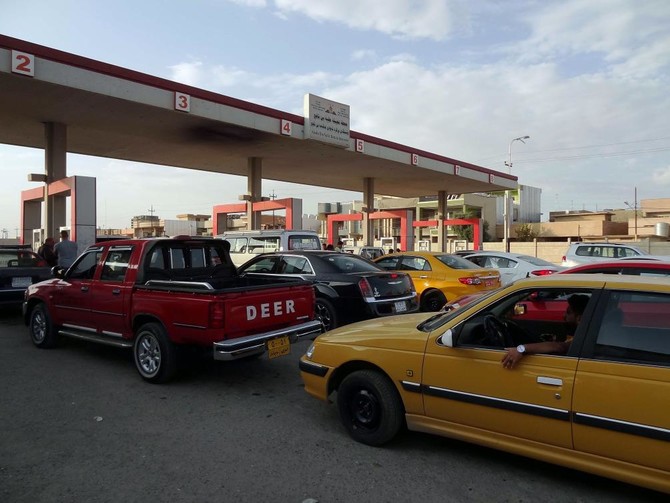
Iraqis queue outside a petrol station in Kirkuk. Iraqi federal forces plan to restore the central government’s control of the city’s oil fields (AFP)
Updated 13 October 2017
Follow

Baghdad moves to take control of Kirkuk oil fields

BAGHDAD: Iraqi federal forces deployed near Kirkuk plan to restore the central government’s control of the northern city’s oil fields, federal officials and military sources told Arab News on Friday.
They have no intention of fighting Kurdish Peshmerga forces if they withdraw without resistance, the sources said. The military build-up on both sides in the ethnically mixed city and adjacent areas is at a peak since the federal government announced its intention to regain control of the region’s oil fields after Kurdistan held a controversial referendum on independence last month.
Kurdish authorities have sent thousands of additional troops to Kirkuk in order to “confront the threats” from Baghdad, as several units of the Iraqi Urgent Response Forces moved Friday morning toward the main road linking Kirkuk to Tikrit.
Units from the Iraqi Counter-Terrorism Squad moved toward the town of Tazza, 10 km south of Kirkuk.
The 9th Armored Division of the Iraqi Army has entered Tazza and remains there “in preparation for any further orders,” military sources told Arab News.
Hadi Al-Amiri, head of the Badr Organization, one of the Shiite groups fighting Daesh, said in a statement on Friday: “Peshmerga troops must withdraw from the areas which were under the control of Iraqi security forces until June 9, 2014.”
At that time, as Daesh overran the provinces of Mosul and Salahuddin and drove Iraqi federal troops out, Kurdish forces took advantage of the resulting chaos and seized Kirkuk and its oil fields.
“We call on all components of the Kurdish people… to prepare fully to respond to those who want war and battle, and to support the Peshmerga forces by all means in order to save the cities of Kurdistan,” Nejervan Barzani, prime minister of the Kurdistan Regional Government (KRG), said in a statement circulated on Friday. “We want to avoid our cities becoming like Mosul, Anbar and other Iraqi cities which have been afflicted by mass murder, devastation, and destruction.”
Iraqi Prime Minister Haider Al-Abadi has said he has no intention of fighting the Kurds, but “federal authority has to be imposed in Kirkuk and the disputed areas.”
A leader of the Popular Mobilization Units (PMU) told Arab News on condition of anonymity: “Orders were issued (Friday morning) to reposition and gain control of the nearby oil fields. We moved on the southern and southwestern areas of Kirkuk as we knew there would be no great resistance.”
The PMU leader said most troops taking part in the latest movements toward Kirkuk are from the regular Iraqi security forces, which are backed by the PMUs, specifically units dominated by Turkmen.
The Peshmerga has withdrawn from its positions in the town of Basheer and Tazza. Turkmen Commander Sheikh Wassfi Al-Assi told Arab News: “Our forces have advanced and taken the Peshmerga’s positions, and are now 10 km from Kirkuk. Peshmerga troops haven’t shown resistance, and not a single shot was fired by either side.”
PMU leader Kareem Al-Nuri told Arab News that his forces had received orders to redeploy to positions held by the national army in June 2014.
Kurdish and federal sources said Iraqi forces slowed their advance in response to a request by Hero Khan, head of the Patriotic Union of Kurdistan (PUK).
Khan’s team contacted Al-Abadi and asked for 48 hours “to arrange the situation in Kirkuk and avoid fighting,” a senior Shiite politician close to the prime minister told Arab News on condition of anonymity.
Khan’s team “promised to change the governor of Kirkuk, who is loyal to (KRG President Masoud) Barzani,” the Shiite politician said.
The PUK and the Democratic Party of Kurdistan (DPK) are the most prominent Kurdish political parties, and have been sharing power in Kurdistan and Baghdad on behalf of Iraqi Kurds.
Kirkuk and most of its suburbs are loyal to the PUK, and used to be run by its staff until the province’s Gov. Kareem Najm Al-Deen shifted his loyalty to the DPK.
“Fighting is likely to take place between the Peshmerga and our troops,” the Shiite politician said.
“Baghdad insists on regaining control of the oil fields, and this is non-negotiable. The PUK doesn’t control all the Kurdish troops deployed in Kirkuk, and those who withdrew this morning (Friday) belonged to the PUK, not the DPK.”


Sudan defense minister dismisses ‘intelligence document’ as fabrication after convoy strike

Updated 12 February 2026
Follow

Sudan defense minister dismisses ‘intelligence document’ as fabrication after convoy strike

  • Gen. Hassan Kabroun tells Arab News claims that army hid weapons in aid convoy are “completely false”

RIYADH: Sudan’s defense minister has firmly denied reports attributed to Sudanese intelligence alleging that a convoy targeted in North Kordofan was secretly transporting weapons under the cover of humanitarian aid.

Gen. Hassan Kabroun described the claims as “false” and an attempt to distract from what he called a militia crime.

The controversy erupted after news reports emerged that a document attributed to Sudan’s General Intelligence Service claimed the convoy struck in Al-Rahad on Friday was not a purely humanitarian mission, but was instead carrying “high-quality weapons and ammunition” destined for Sudanese Armed Forces units operating in the state.

The report further alleged that the convoy had been outwardly classified as humanitarian in order to secure safe passage through conflict zones, and that the Rapid Support Forces had destroyed it after gathering intelligence on its route and cargo.

Kabroun categorically rejected the narrative.

“First of all, we would like to stress the fact that this news is false,” he told Arab News. “Even the headline that talks about the security of the regions, such as Al-Dabbah, is not a headline the army would use.”

He described the document as fabricated and politically motivated, saying it was designed to “cover up the heinous crime they committed.”

The minister affirmed that the area targeted by drones is under full control of the Sudanese Armed Forces and does not require any covert military transport.

“Second, we confirm that the region that was targeted by drones is controlled by the army and very safe,” Kabroun said. “It does not require transporting any military equipment using aid convoys as decoys because it is a safe area controlled by the army, which has significant capabilities to transport humanitarian aid.”

According to the minister, the Sudanese military has both the logistical capacity and secure routes necessary to move equipment openly when needed.

“The army is professional and does not need to deliver anything to Kadugli or Dalang on board aid convoys,” he said. “The road between Dalang and Kadugli is open. The Sudanese forces used that road to enter and take control of the region. The road is open and whenever military trucks need to deliver anything, they can do so without resorting to any form of camouflage.”

Kabroun further rejected any suggestion that the military uses humanitarian operations as cover.

“Aid is transported by dedicated relief vehicles to the areas in need of this assistance,” he said. “Aid is not transported by the army. The army and security apparatus do not interfere with relief efforts at all, and do not even accompany the convoys.”

He stressed that the Sudanese Armed Forces maintains a clear institutional separation between military operations and humanitarian work, particularly amid the country’s crisis.

“These are false claims,” he said. “This fake news wanted to cover up the heinous crime they committed.”

Sudan has been gripped by conflict since April 2023, when fighting broke out between the Sudanese Armed Forces and the Rapid Support Forces, plunging the country into what the United Nations has described as one of the world’s worst humanitarian disasters.

The latest dispute over the convoy comes amid intensified fighting in South Kordofan, a strategically sensitive region linking central Sudan with the contested areas of Darfur and Blue Nile.

The false report suggested that intelligence monitoring had enabled the RSF to strike what it described as a military convoy disguised as humanitarian aid. But Kabroun dismissed that version outright.

“The intelligence agency is well aware of its duties,” he said. “The Sudanese Army has enough weapons and equipment to use in the areas of operations. These claims are completely false.”

He argued that the narrative being circulated seeks to shift blame for attacks on civilian infrastructure and humanitarian movements.

“This shows that they are trying to cover up the atrocities,” he added, referring to the militia.

Kabroun maintained that the army has regained momentum on multiple fronts and remains fully capable of sustaining its operations without resorting to deception.

“The region is secure, the roads are open, and the army does not need camouflage,” he said. “We are operating professionally and transparently.”

“These claims are completely false,” Kabroun said. “The Sudanese Army does not use humanitarian convoys for military purposes.”