SEOUL: The US and South Korea will kick off a major navy drill next week, the US navy said Friday, a fresh show of force against North Korea over its missile and nuclear tests.
Tensions over North Korea’s weapons program have soared in recent months with Pyongyang launching a flurry of missiles and conducting its sixth and most powerful nuclear test in defiance of multiple sets of UN sanctions.
The US has since ramped up military drills with South Korea and Japan, its two closest regional in the region.
In a statement the US 7th Fleet said the USS Ronald Regan aircraft carrier and two US destroyers would take part in the drill alongside South Korean Navy vessels.
The exercise, slated for October 16 to 26 in the Sea of Japan and the Yellow Sea, would promote “communications, interoperability, and partnership,” the statement added.
The move will likely rile Pyongyang which had previous warned against any upcoming joint exercises.
“If US imperialists and the South Korean puppets ignite a nuclear war of aggression against us, it would only advance their own demise,” the state-run KCNA news agency said.
There has been a flurry of US military hardware movement around the Korean peninsula in recent days.
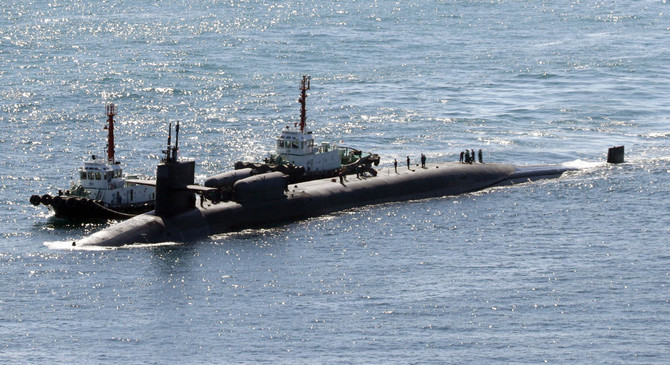
On Friday the nuclear-powered USS Michigan submarine arrived at South Korea’s southern port of Busan, according to Yonhap news agency, just days after another nuclear-powered submarine — the USS Tuscon — left after a five day visit.
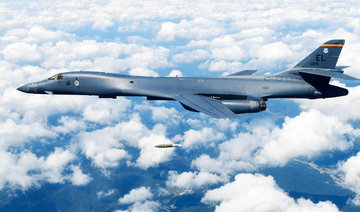
Earlier this week the US flew two supersonic heavy bombers over the Korean peninsula, staging the first night-time joint aviation exercises with Japan and South Korea.
That mission came 17 days after four US F-35B stealth fighter jets and two B-1Bs flew over the peninsula.
President Donald Trump has engaged in an increasingly escalating war of words with North Korean strongman Kim Jong-Un, trading insults amid rising tensions between the two nuclear-armed rivals.
On Tuesday Trump discussed “a range of options” with his national security team to respond to North Korea’s recent missile and nuclear tests.
It came days after he said that diplomatic efforts with North Korea have consistently failed, adding that “only one thing will work.”
The North’s missile and nuclear capabilities have made significant progress under Kim, who on Saturday told party officials that the country’s atomic weapons were a “treasured sword” to protect it from aggression.

US, South Korea to launch major navy drill next week
Bangladesh’s Yunus announces resignation, end of interim govt
- Yunus handed over power after congratulating the Bangladesh Nationalist Party and its leader Tarique Rahman
DHAKA: Bangladesh’s interim leader Muhammad Yunus stepped down on Monday in a farewell broadcast to the nation before handing over to an elected government.
“Today, the interim government is stepping down,” the 85-year-old Nobel Peace Prize winner said.
“But let the practice of democracy, freedom of speech, and fundamental rights that has begun not be halted.”
Yunus returned from self-imposed exile in August 2024, days after the iron-fisted government of Sheikh Hasina was overthrown by a student-led uprising and she fled by helicopter to India.
“That was the day of great liberation,” he said. “What a day of joy it was! Bangladeshis across the world shed tears of happiness. The youth of our country freed it from the grip of a demon.”
He has led Bangladesh as its “chief adviser” since, and now hands over power after congratulating the Bangladesh Nationalist Party (BNP) and its leader Tarique Rahman on a “landslide victory” in elections last week.
“The people, voters, political parties, and stakeholder institutions linked to the election have set a commendable example,” Yunus said.
“This election has set a benchmark for future elections.”
Rahman, 60, chief of the BNP and scion of one of the country’s most powerful political dynasties, will lead the South Asian nation of 170 million.
Rebuilt institutions’
Bangladeshi voters endorsed sweeping democratic reforms in a national referendum, a key pillar of Yunus’s post-uprising transition agenda, on the same day as the elections.
The lengthy document, known as the “July Charter” after the month when the uprising that toppled Hasina began, proposes term limits for prime ministers, the creation of an upper house of parliament, stronger presidential powers and greater judicial independence.
“We did not start from zero — we started from a deficit,” he said.
“Sweeping away the ruins, we rebuilt institutions and set the course for reforms.”
The referendum noted that approval would make the charter “binding on the parties that win” the election, obliging them to endorse it.
However, several parties raised questions before the vote, and the reforms will still require ratification by the new parliament.
The BNP alliance won 212 seats, compared with 77 for the Jamaat-e-Islami-led alliance, according to the Election Commission.
Jamaat chief Shafiqur Rahman conceded on Saturday, saying his Islamist party would “serve as a vigilant, principled, and peaceful opposition.”
Newly elected lawmakers are expected to be sworn in on Tuesday, after which Tarique Rahman is set to become Bangladesh’s next prime minister.
Police records show that political clashes during the campaign period killed five people and injured more than 600.
However, despite weeks of turbulence ahead of the polls, voting day passed without major unrest and the country has responded to the results with relative calm.