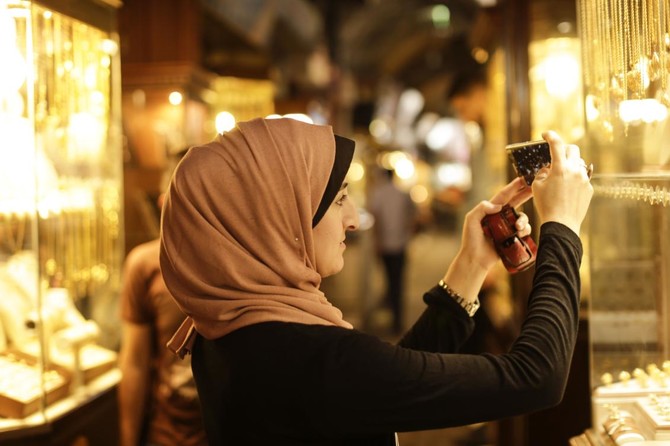
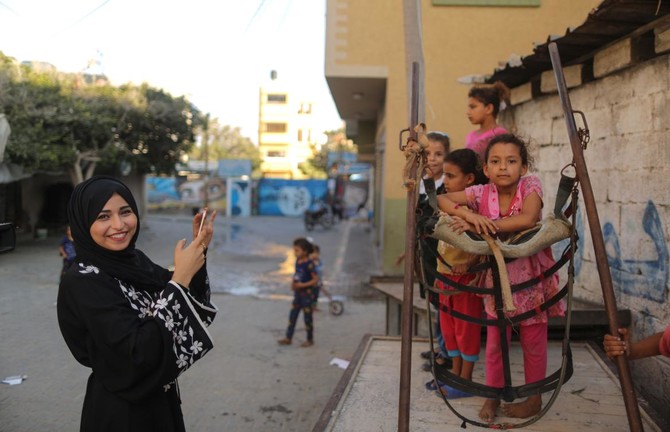
GAZA CITY: They may not be able to leave Gaza without Israeli or Egyptian permission, but their photos can.
The two women are among a small number of Instagram stars in the blockaded Palestinian enclave, showing followers a different side of their homeland from what much of the world may be used to hearing or seeing.
“I see Instagram as a window,” says Kholoud Nassar, 26, wearing a pink hijab and fiddling with a toy car that features in many of her pictures.
Fatma Mosabah, 21, agrees, saying that “when I open the Internet I can talk to people across the world.”
Both have more than 100,000 followers on the social platform and say they get recognized multiple times a day in the tiny territory that is home to two million people.
In the enclave sealed off by Israel to the east and north, Egypt to the south and the Mediterranean Sea to the west, it is impossible for Gazans to leave without permission.
Neither of the women has left Gaza in more than a decade.
Israel also refuses to give permits for tourists to visit the strip, leaving most people outside to imagine life there.
And with three wars since 2008 between the strip’s rulers Hamas and Israel, many people’s ideas of Gaza center on devastation, poverty and suffering.
The women use Instagram, with its focus on pictures over text and political arguments, to show another side.
“War is a part of Gaza, but it is not all Gaza. I wanted to show there was more to Gaza — as in any country,” Nassar tells AFP in a cafe near the coast in Gaza City.
“Take America: there is poverty, there are destroyed homes, but at the same time there are beautiful places. Gaza is the same.”
“Through these pictures I want people to see Gaza, how people live, eat and work.”
Nassar’s pictures range from young children to harvests, all bathed in a range of colors, while Mosabah shows all sides of daily life.
Both women feature heavily in their own pictures, with wide smiles.
Mosabah agrees that the aim is to “change the perception of Gaza” away from political matters.
“To show its beautiful side, that’s the most important thing. Far from the destruction, blockade and the wars.”
A UN official recently said the strip may already be “unlivable.”
Despite Gazans receiving only a few hours of electricity a day in recent months, social media outlets remain popular.
Ali Bkheet, president of the Palestinian Social Media Club, estimates that around 50 percent of Gazans have Facebook, though numbers on Instagram and Twitter are significantly smaller.
He said the decade-long Israeli blockade had made Gazans particularly keen to use social media “to express ourselves and communicate our voice.”
Nassar started before the last war in 2014 and documented the human toll of the conflict.
In the three years since, she has sought to focus on how Gazans struggle through terrible conditions — including creating a “trying to live” hashtag to show how people were putting their lives back together after the war.
The toy car, an old Volkswagen Beetle Nassar carries in her bag at all times and which features in dozens of her photos, has become a trademark helping her connect with others.
People from across the Arab world now send her pictures of the real cars, which she posts on her page.
For Mosabah, Instagram is also a source of revenue — making between $300 and $400 a month from e-marketing and adverts on her page.
In a region where 60 percent of young people are unemployed and the average salary is a couple of hundred dollars, she has carved out a niche for herself.
Sheldon Himelfarb, CEO of US-based PeaceTech Lab which has researched how social media impacts political awareness, said social media can help break down barriers between people across the globe.
But he warned researchers were still trying to assess whether the selective nature of what is published helps or hinders efforts to gain a fuller picture.
“I believe in my conversations with university students. They seem to imply they are more aware about parts of the world than certainly their parents were. But whether or not they are more accurately informed I don’t know.”
Instagram is of course a selective version of life, with the women taking dozens of pictures before deciding on their favorite to show the world.
But despite the thought that goes into their selections, they aren’t protected from the bane of social media — trolls.
Islamist group Hamas has conservative attitudes toward women, as do many Gazans.
Mosabah says she blocks between five and 20 people a day on Instagram who make inappropriate comments.
“Maybe I take a picture with someone, they say the picture is shameful because I was with a man. I do a lot of blocking,” she laughs.
For Nassar, it has even strayed into the real world.
Once she was taking pictures in Beit Lahia, one of Gaza’s most conservative areas, when women started screaming at her.
“There are people here who criticize me — they say ‘you are going out, taking pictures. You should stay at home and cook’,” Nassar says.
“Maybe because I wear a hijab they criticize me more.”