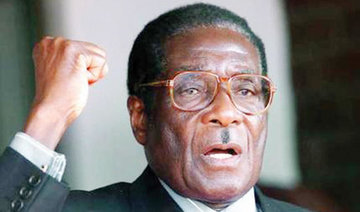
HARARE: Zimbabwean President Robert Mugabe’s cabinet reshuffle quashed opposition within his government, state media said Tuesday, as the 93-year-old leader prepares to stand again in elections next year.
Mugabe stripped Vice President Emmerson Mnangagwa of his role as justice minister, reassigned the finance minister and created a new cyber-security ministry in the major reshuffle late Monday.
Mnangagwa is one of the top candidates likely to succeed Mugabe, but has recently been accused by undermining the president over claims that Mnangagwa was poisoned at a party rally.
The state-run Herald — seen as the government’s official voice — on Tuesday hailed the reshuffle as “a welcome move that would send a reverberating message that the president is fully in control.”
“Ministers to the new cabinet should also ensure that their loyalty is solely to their appointing authority, who is none other than President Mugabe. They should subordinate themselves to him,” it said.
The paper castigated ministers for “squabbling” as in-fighting intensifies between rivals competing to succeed Mugabe, who has ruled since 1980 and is in increasingly frail health.
Mnangagwa’s main opposition for the presidency comes from the “G-40” group led by Mugabe’s wife Grace.
“This is a Grace Mugabe reshuffle. It’s part of the succession plan and aimed at discrediting and emasculating Mnangagwa,” Takavafira Zhou, a political analyst from Masvingo State University, told AFP.
“The reshuffle deflates Mnangagwa’s plans. Mugabe has demoted those who associated with him.”
Mnangagwa — widely known as “the crocodile” — was hospitalized in Johannesburg in August saying he had been poisoned.
His supporters allege he was struck down by ice cream made on a farm owned by first lady Grace Mugabe, who last week publicly denied poisoning him.
“The reshuffle is to deal with the factional and succession politics within the ruling ZANU-PF party,” Bulawayo-based analyst Dumisani Mpofu told AFP.
“Mugabe has also created the cyber-security ministry as an attempt to clamp down on social media movements that pose a big threat to his regime ahead of the election.”
Mugabe has already been named by ZANU-PF as its presidential candidate for the 2018 poll.


![]()

Mugabe reshuffle cracks down on dissent
Mugabe reshuffle cracks down on dissent

Latest updates


© 2026 SAUDI RESEARCH & PUBLISHING COMPANY, All Rights Reserved And subject to Terms of Use Agreement.