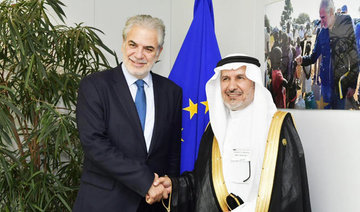
KSRelief provides over $8 billion worth of aid to Yemen in two years

Updated 10 October 2017
Follow

KSRelief provides over $8 billion worth of aid to Yemen in two years

RIYADH: The King Salman Center for Relief and Humanitarian Aid (KSRelief) has spent $8.2 billion on aid for Yemen since its opening in 2015, it was revealed on Monday.
Dr. Samer Al-Jetaily, spokesman of KSRelief, was speaking at a press conference in the non-profit’s headquarters alongside Abdullah Al-Rwaily, the organization’s director of community support services.
“We have spent around $750 million on humanitarian and relief projects (in Yemen),” Al-Jetaily said, citing security, camp management, water and sanitation, nutrition, health, logistical support, telecoms, and relief coordination as examples. He added that there had been around 150 projects initiated in Yemen, in cooperation with 86 local and international organizations.
The remainder of KSRelief’s aid for Yemen was focused on development, aid provided to Yemenis inside Saudi Arabia, bilateral government assistance and $1 billion deposited in Yemen’s central bank, he explained.
Al-Jetaily also pointed out that between 1994 and 2014, Saudi Arabia had spent more than $65 billion in foreign aid, which had benefitted millions in over 38 countries.
Referring to the recently published UN Secretary-General’s Annual Report on Children and Armed Conflict, which claimed that the Saudi-led coalition in Yemen is responsible for killing and maiming hundreds of children there, Al-Jetaily said the report is “full of inaccuracies”.
He stressed that the report originated from areas held by Houthi rebels, and that it is “fully prejudiced, impartial, and tilted towards the interests of the rebels.”
Al-Rwaily concurred, adding that the report is “completely false” and gives “a distorted version” of the state of affairs in Yemen.
He told Arab News that KSRelief has organized rehabilitation for approximately 20,000 child soldiers in Yemen.
“We have four centers to help these children turn over a new leaf and facilitate their re-entry into society as normal people,” he explained.
Al-Rwaily also urged other NGOs to consider rehabilitation programs for child soldiers in Yemen, warning that, without such aid, the situation could become similar to that in Afghanistan.
KSRelief, he added, has been active in Yemen ever since it became apparent that humanitarian assistance was needed there. He said the Kingdom has been almost single-handedly responsible for maintaining hospitals in Saad and Hajja, noting that locals refer to them as the “Saudi hospitals.”
And earlier this week, Yemen’s Deputy Prime Minister and Civil Services Minister, Abdul Aziz Jabari, announced that KSRelief had provided $2 million for the newly opened Orthopedic and Surgical Center at Al-Thawra General Hospital in Taiz.


Deals worth $8bn signed at World Defense Show 2026

Updated 5 sec ago
Follow

Deals worth $8bn signed at World Defense Show 2026

  • Five-day event brought together 1,486 exhibitors from 89 countries and attracted 137,000 visitors

RIYADH: More than 60 military and defense deals worth SR33 billion ($8.8 billion) were signed at the third edition of the World Defense Show, which ended on Thursday in Riyadh.

The flagship defense exhibition is part of Saudi efforts to expand its military industries sector.

Organized by the General Authority for Military Industries, the five-day event brought together 1,486 exhibitors from 89 countries and attracted 137,000 visitors, according to official figures announced at the closing media briefing on Thursday.

Ahmad Al-Ohali, governor of the General Authority for Military Industries, said the event reflects broader efforts to localize defense spending under Vision 2030.

“When we started in 2018, the percentage of military spending from within the Kingdom of Saudi Arabia was 4 percent of total spending; by the end of 2024, it jumped to 25 percent,” he said.

Al-Ohali added that number of national cadres working in the sector increased from 25,000 male and female employees in 2020 to 34,000 — a rise of 40 percent.

Beyond attendance and displays, the exhibition served as a venue for commercial and government agreements.

The number of agreements signed reached 220, including 93 government-to-government agreements and 127 partnership agreements with companies.

Al-Ohali said the deals include technology transfer and local manufacturing projects aimed at strengthening domestic supply chains.

Aerial and static displays included 63 aircraft, alongside more than 700 pieces of military equipment exhibited across indoor and outdoor platforms. Maritime and unmanned systems were also showcased through dedicated demonstration areas.

Andrew Pearcey, CEO of the World Defense Show, said that planning for the next edition had already begun.

“So, what we do is we take stock of our successes, so we’re now starting to see what worked, and we also learned that some things that didn’t work,” Pearcey told Arab News.

“Over time, one of the key things is to try and grow; the demand for this show is huge, so we want to try and accommodate that.

“So, we need to try and build more space. Then we look at ways we brought new features to this show. So, we look at the industry and the trends, and see other new features that we can bring to the show.”

The event also introduced a “Future Talent Program” during its final two days, inviting students aged 16 to university level to explore career opportunities in the defense sector.

“The future talent program is where we invite youngsters, so from 16 up to university level, to come and look at the show, understand what career opportunities there are in the defense industry, sit and do some content programs, and meet the exhibitors that want to demonstrate some of their things,” Pearcey said.

“So, we bring around 4,000 to 5,000 students to the show. So, that’s bringing that next generation through.”