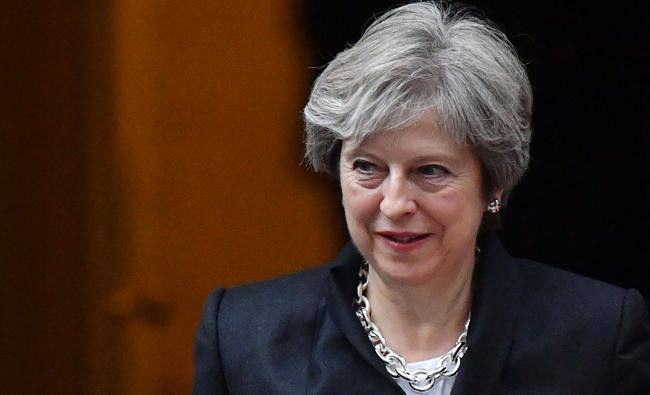
BRUSSELS: The EU and Britain clashed Monday after British Prime Minister Theresa May said the ball was in the EU’s court as Brexit negotiations entered a critical fifth round.
Officials from both sides are meeting in Brussels, but chief EU negotiator Michel Barnier and British counterpart David Davis are not attending the start, underscoring low expectations for the talks.
This round of divorce discussions is the last before European leaders meet at a summit on Oct. 19 to decide whether there is “sufficient progress” to move on to the trade talks that Britain desperately wants.
The European Commission roundly rejected May’s assertion that it was up to Brussels to take the initiative to advance the stalled talks, amid fears that her domestic political woes were threatening the negotiations.
“We do not provide comment on comments but what I can remind you of is there is a clear sequencing to these talks and there has been so far no solution found on step one, which is the divorce proceedings,” the commission’s chief spokesman Margaritis Schinas told a press conference.
“So the ball is entirely in the UK court for the rest to happen,” he added.
Even before the commission’s latest intervention, the prognosis for the talks was grim, with European Commission chief Jean-Claude Juncker having warned that “miracles” would be needed this week to make enough progress to get a positive decision at the summit.
Brussels is particularly alarmed by the leadership crisis engulfing the British prime minister, facing a plot to oust her after a catastrophic, mishap-strewn speech at her Conservative party’s conference.
Barnier and Davis are expected to give a press conference on Thursday after four days of talks, although officials added that was yet to be confirmed. Wednesday’s timetable remains empty for now.
The questions over May’s leadership have seriously damaged hopes that a speech she gave in Florence in September, which contained key concessions, could give a “new dynamic” to the talks.
Initially, Barnier had hoped to achieve “sufficient progress” to move on to discussing future EU-UK relations by the end of October, with the clock ticking for a deal before Britain leaves the bloc in March 2019.
The talks have stalled on all three of the key divorce issues — the exit bill Britain must pay, the rights of EU citizens living in Britain and the fate of the border between Northern Ireland and Ireland.
Irish Prime Minister Leo Varadkar said on Twitter on Monday that “a customs border would be expensive, a barrier to trade and an obstacle to peace. That’s why we are working to prevent it, with support of EU.”
London wants to begin talks on the future, including a possible EU-UK trade deal, as soon as possible.
Barnier tweeted on Friday that “Brexit negotiations next week should continue to advance” but he himself has warned there are still “significant divergences” and a lack of progress.
“It’s quite unlikely there will be sufficient progress made over the coming two weeks,” a senior European source told AFP on condition of anonymity.
Diplomats said there was still an outside chance that the leaders of the EU member states, with an “eye on history,” might decide to approve the next phase anyway. But they would be flying in the face of not only Barnier’s advice but also that of Juncker, European Council President Donald Tusk and the European Parliament.


![]()
Britain, EU clash over who takes next Brexit step
Britain, EU clash over who takes next Brexit step

Latest updates


Recommended


© 2026 SAUDI RESEARCH & PUBLISHING COMPANY, All Rights Reserved And subject to Terms of Use Agreement.