Fire breaks out near passenger jet at Hong Kong airport

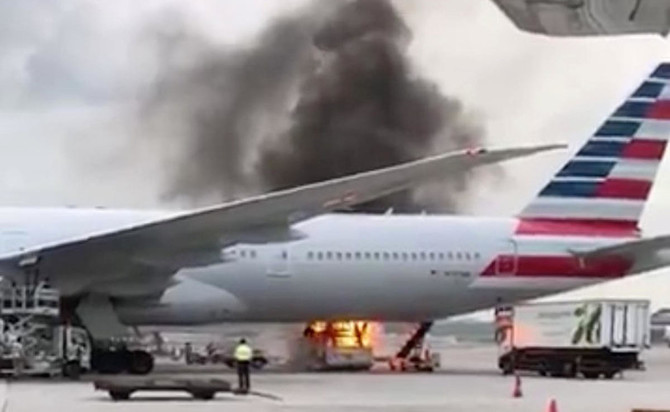
In this still image taken from a video obtained from social media, smoke billows from loading equipment after it caught fire next to an American Airlines plane at Hong Kong International Airport, China on October 9, 2017. (SOCIAL MEDIA WEBSITE/via REUTERS)
Updated 09 October 2017
Follow

Fire breaks out near passenger jet at Hong Kong airport

HONG KONG: A fire broke out on the tarmac of Hong Kong’s international airport Monday, with black smoke seen billowing near the belly of an American Airlines plane.
The blaze began around 5:30 p.m. (0930 GMT) in one of the parking berths and one person was injured, police said.
“When a loading vehicle was loading cargo onto the plane it caught on fire,” a police spokeswoman said, adding that it was an empty American Airlines flight.
Photos on social media showed the fire blazing, with black smoke rising near the belly of the plane in between the right wing and tail wing.
Hong Kong Airport Authority said the fire, which occurred at ground level, had been extinguished and they were investigating its cause.
The plane was bound for Los Angeles, according to the airport website.


Australia to deploy long-range reconnaissance plane to Gulf

Updated 5 sec ago
Follow

Australia to deploy long-range reconnaissance plane to Gulf

  • The government says there are about 115,000 Australian nationals across the Middle East, of whom about 2,600 have returned home.

SYDNEY: Australia will deploy a long-range military reconnaissance plane to the Gulf to protect civilians, Prime Minister Anthony Albanese said Tuesday.
An E-7A Wedgetail aircraft and supporting defense force personnel will be sent for an initial period of four weeks to help “protect and secure the airspace above the Gulf,” Albanese told a news conference.
Australia also plans to provide advanced, medium-range air-to-air missiles to the United Arab Emirates “in response to a request,” the prime minister said.
The UAE, in which there are an estimated 24,000 Australians, has shot down more than 1,500 rockets and drones fired by Iran in reprisal following US-Israeli strikes, he said.
Albanese said he decided to send the advanced radar surveillance plane to the Gulf following a discussion with UAE President Mohammed bin Zayed Al Nahyan.
“The first priority of my government is, and always will be, to keep Australians safe,” the prime minister said.
“Helping Australians means also helping the UAE and other Gulf nations to defend themselves against what are unprovoked attacks,” he added.
“My government has been clear that we’re not taking offensive action against Iran, and we’ve been clear that we are not deploying Australian troops on the ground in Iran.”
The government says there are about 115,000 Australian nationals across the Middle East, of whom about 2,600 have returned home.
“Significant challenges remain, and further work is underway to support those still seeking to leave,” Albanese said.
Australia said last week it had deployed a heavy transport plane and a fuel transport plane to the Middle East as part of plans to get its citizens out of the region.
Canberra has been careful to make clear that its forces are not engaging in offensive operations against Iran.
On Friday, Albanese revealed that Australian military personnel were aboard an American submarine that sank an Iranian navy ship off Sri Lanka.
The personnel were on the submarine as part of training arrangements under AUKUS, a multi-decade defense pact with Britain and the United States, he said, stressing that they did not take part in the attack.