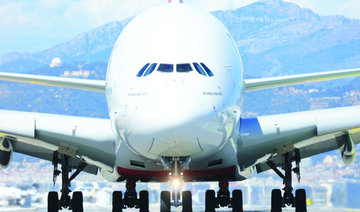
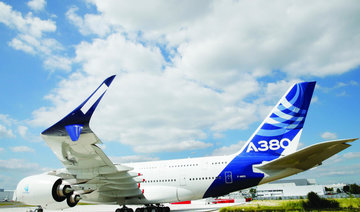
An Emirates Airbus A380 was involved in a midair near miss with another aircraft forcing the pilots to take evasive action on Friday, the Aviation Herald has reported.
The Emirates aircraft, which can carry up to 615 passengers, was flying from Dubai to Mauritius, and had been given clearance to descend to 38,000 feet by Air Traffic Control as it approached the Indian Ocean island, the report stated.
Meanwhile an Air Seychelles Airbus A330, Flight HM54, which has a passenger capacity of 277, had taken off from Mauritius, and was traveling in the opposite direction.
But according to the Aviation Herald report the crew of the Emirates plane, Flight EK703 had mistakenly reported its altitude as 36,000 feet.
As it quickly became apparent that both aircraft were headed towards each other, an onboard traffic collision avoidance system alert was activated and the two crews were able to take evasive action.
The pilot of the Air Seychelles aircraft turned a sharp right, and while the crews were able to see each other’s planes, which were at the same altitude, they passed safely at a distance of 14 kilometers apart.
Saj Ahmad, chief analyst at StrategicAero Research, said there were a number of issues that could be improved on and he said the Emirates crew was not necessarily at fault.
“ATC should have advised the A380 crew again and got them to confirm that clearance was only given to descend to 38,000 feet, not 36,000 feet. By all accounts, it does not appear that the crew of the A380 did anything wrong, but rather, the ATC crew should have double-checked flight levels and they did not.”
Ahmad said such incidents were very rare, adding: “While crews are constantly trained, tested and retrained, that the two airplanes were well over 14km apart meant that safety was not necessarily compromised. This is a testament to the advanced technology aboard today’s airplanes that enables flight changes to happen many miles out before any airplanes come in proximity of another.”
Pointing out that the incident happened over the Indian Ocean, he said despite the large amount of traffic in the Gulf region’s airspace, there was no need for a “beefing up of safety processes.”
“If anything, questions should rightly be being asked about the competencies of ATC staff who did not realize the situation prevailing at the time whereas the flight crews of both airplanes did,” he added.
In a statement sent to Arab News Emirates Airline said: “Emirates has received reports of an event on July 14, 2017 in relation to aircraft separation involving flight EK 703 in Mauritius airspace.”
“The matter has been reported to the respective air transport authorities and Emirates will extend its full cooperation to any investigation. The safety of our passengers and crew is of utmost importance,"
Meanwhile Air Seychelles has praised the pilot for his actions: “We commend our Captain Roberto Vallicelli and Seychellois First Officer Ronny Morel who were operating the HM054 flight from Mauritius to Seychelles on the evening of Friday July 14, 2017.”
Experts say that the ongoing growth in air travel means more aircraft in the sky at any given time, and with that comes an increase in a risk of incidents like Friday’s occurring.
But there are systems in place that can ensure that generally they pass without any serious outcome.
Mark D Martin, founder and CEO of Martin Consulting, an aviation consulting firm involved in improving aviation safety in the Middle East and Asia said “air miss” incidents like this were “natural and standard operating situations.”
“They do correct themselves thanks to the technologies that are in place to prevent such incidents from happening,” he explained.
“TCAS or the Traffic Collision Avoidance System, an imperative installation on all aircraft today does everything technologically possible, including execution from preventing such an incident from happening.
“The growth in aviation in the Middle East is unique in the sense that it plays up on the world hub business model; so in situations and circumstances as this, traffic congestion is a fact of life and a risk that airline’s need to work with, and within.”
He added that air traffic management, including air planning, was a “major concern” in the Gulf and the Middle East. Martin said the sandwiching of airspace and the close proximity of most borders did raise the complexity of managing and maintaining safe aircraft operation.
“Yes, this is a concern,” he added. “But we do believe it is being worked on very closely by both the ICAO and regional air navigation service providers in Saudi Arabia, Bahrain, Oman, Iraq, Iran and until recently prior to the economic sanctions being imposed by Saudi Arabia, Qatar.”