Emirates airline chief says first-half performance better than last year

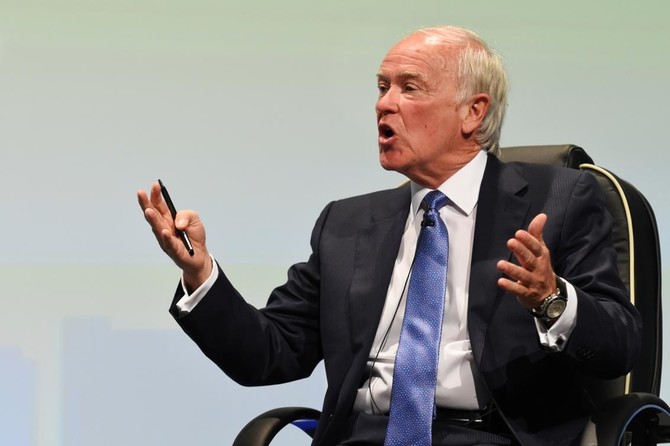
Emirates airline President Tim Clark said demand had fallen by around 15 percent to 18 percent on US flights. (Reuters)
Updated 08 October 2017
Follow

Emirates airline chief says first-half performance better than last year

DUBAI: Emirates, the Middle East’s largest airline, has had a better first half in the current financial year than the same period a year ago when it reported a 75 percent decline in profits.
“The six months were a lot better than this time last year,” Emirates airline President Tim Clark told reporters at an aviation security conference in Dubai.
The state-owned, Dubai-based carrier is expected to report its results next month for the six months ended September 30.
Results a year ago were affected by a strong dollar and tougher competition as it filled a lower percentage of seats on a year-on-year basis.
This year, Emirates has had to contend with travel restrictions imposed by the US which mostly impacted carriers in the Middle East, though have since largely been lifted.
The airline cut frequencies on some US flights in a response to those restrictions weakening passenger demand.
Clark said demand had fallen by around 15 percent to 18 percent on US flights, though the airline had just had “a very robust summer” there.


Saudi non-oil trade surplus with GCC jumps 102% in November  

Updated 13 sec ago
Follow

Saudi non-oil trade surplus with GCC jumps 102% in November  

RIYADH: Saudi Arabia’s non-oil trade surplus with Gulf Cooperation Council countries more than doubled in November, driven by a surge in exports, preliminary government data showed. 

The surplus reached about SR6.6 billion ($1.76 billion), up 102 percent from SR3.3 billion a year earlier, according to the General Authority for Statistics. 

Total non-oil trade with GCC countries rose 30 percent to SR20.4 billion from SR15.7 billion, as exports outpaced import growth. Non-oil goods exports climbed to SR13.5 billion in November from SR9.5 billion a year earlier, while imports increased to SR6.9 billion from SR6.2 billion. 

Re-exports made up the bulk of outbound trade, rising to SR9.76 billion in November from SR6.56 billion a year earlier, while national exports increased to SR3.75 billion from SR2.92 billion. 

The UAE remained Saudi Arabia’s largest GCC trading partner on a non-oil basis. Exports to the Emirates totaled SR10.48 billion in November versus SR7.18 billion a year earlier, comprising SR8.38 billion in re-exports and SR2.10 billion in national exports.   

Imports from the UAE were SR4.79 billion, up from SR3.95 billion, lifting the non-oil trade surplus with the UAE to about SR5.69 billion from SR3.23 billion.  

Trade with Kuwait also expanded, with exports rising to SR769.9 million from SR610.6 million, including SR199.2 million in re-exports and SR570.7 million in national exports. Imports from Kuwait fell to SR176.4 million from SR333.3 million, pushing the trade surplus to SR593.5 million from SR277.3 million.  

With Bahrain, exports edged down to SR900.7 million from SR929.7 million, reflecting a decline in re-exports to SR380.3 million from SR572.7 million, while national exports increased to SR520.4 million from SR356.9 million. Imports rose to SR862.4 million from SR662.4 million, reducing the surplus to SR38.3 million from SR267.2 million.  

Saudi Arabia narrowed its non-oil trade deficit with Oman, as exports increased to SR666.7 million from SR356.5 million, supported by re-exports of SR259.6 million versus SR39.3 million and national exports of SR407.0 million versus SR317.3 million.   

Imports from Oman declined to SR873.2 million from SR1.11 billion, bringing the trade balance to a deficit of SR206.6 million compared with a deficit of SR749.1 million in November 2024.  

Trade with Qatar strengthened, with exports rising to SR691.1 million from SR395.8 million, including re-exports of SR536.2 million versus SR253.9 million and national exports of SR155.0 million versus SR141.9 million. Imports increased to SR199.3 million from SR148.9 million, resulting in a surplus of SR491.8 million, up from SR246.9 million.