MOSCOW: The head of the Russian Direct Investment Fund (RDIF), Kirill Dmitriev, stressed that the historic visit of King Salman to the Russian Federation has been a success.
In a speech during a meeting with Saudi media at the Ritz-Carlton Hotel in Moscow, he said: “The meeting between King Salman and Russian President Vladimir Putin was positive, as they discussed a number of issues and topics of common interest to the Kingdom, Russia and the region of the Middle East, as well as economic and investment cooperation between us, and they agreed on a number of important issues such as military cooperation.”
Dmitriev thanked King Salman and Crown Prince Mohammed bin Salman for their efforts in improving and developing relations with the Russian Federation.
He added that President Putin in 2015 met with Crown Prince Mohammed bin Salman when he visited Russia, during which the two sides discussed levels of cooperation between the two countries. There were no Saudi-Russian investments then, except for a few companies, but a large number of agreements emerged after the visit of the crown prince and his meeting with the president to discuss the stability of the oil market.
Dmitriev talked about investments between the two countries and the investment forum, pointing out that the value of investments currently amounted to $10 billion, adding that these projects have significant positive advantages. “We announced an energy market and another fund in the field of technology,” he stated, indicating that a number of Russian companies such as Cebu, which produces petroleum products, and a gas company based on Russian industrial gas projects, have announced plans to work in Saudi Arabia.
“The Vision 2030 has a great interest in the sectors of the Kingdom in terms of investment and the economy to grow significantly, and we are happy with the trend,” he said.
Dmitriev disclosed that 200 Saudi companies were in the joint agreements with Russian companies to produce fertilizers.
“We welcome other important agreements that have been announced in the technical and military fields, and I am confident that we will continue in the field of energy and efforts to stabilize the price of oil, he emphasized.
He pointed out that local businessmen were impressed by the presence of the delegation of Saudi businessmen, who are supported by King Salman.
“We worked from morning to evening with ministers and businessmen to cooperate between the two parties,” he said, pointing out that the meeting of the king with Russian Prime Minister Dmitry Medvedev was successful and it was agreed that steps to implement the conventions and memoranda of understanding would be accelerated.
Dmitriev praised the role of Crown Prince Mohammed two years ago, who supported relations between the Kingdom and Russia, stressing that his decisive steps led to reaching many agreements in the field of development and investment.


![]()
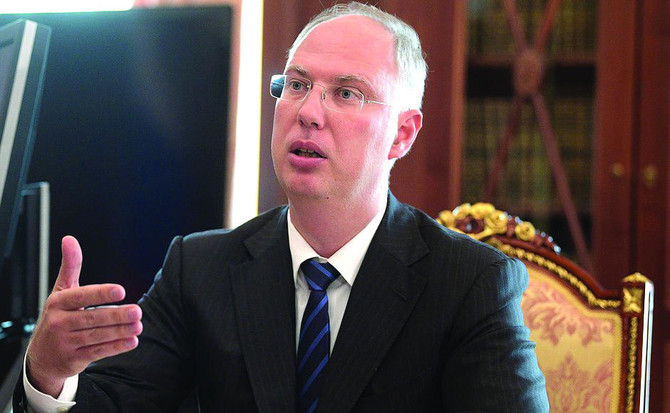
King Salman’s Russia visit a success: RDIF chief
King Salman’s Russia visit a success: RDIF chief
Latest updates



© 2026 SAUDI RESEARCH & PUBLISHING COMPANY, All Rights Reserved And subject to Terms of Use Agreement.