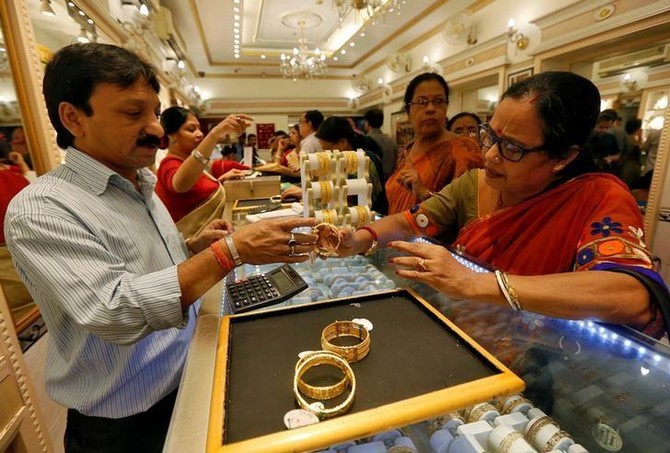
MUMBAI: Indian authorities withdrew on Friday an amendment that made jewelers subject to anti-money laundering legislation and caused a drop in gold sales.
The Prevention of Money Laundering Act obliges banks and other financial institutions to report all cash transactions above 50,000 rupees ($765) to the government, including customers’ personal identification numbers or tax codes.
Transactions by jewelers in the world’s second-biggest gold consumer were added to the list in August but without specifying a financial threshold.
However, that dented jewelry sales during the gold-buying festival season because customers were wary of providing personal details, industry body the All India Gems and Jewellery Trade Federation said.
“For the time being we have withdrawn the notification and we will be reissuing it with clear cut guidelines,” Hasmukh Adhia, revenue secretary at the Finance Ministry, told reporters.
Demand for gold typically rises in the last three months of the year as consumer buy more for the wedding season and for festivals such as Diwali and Dussehra.
“It is a big relief. The timing is right – just before Diwali,” said Ishu Datwani, owner of Mumbai-based Anmol Jewellers.
Indians will celebrate Diwali in the third week of October, a holiday period in which the buying of gold is considered auspicious.

India rethinks jewelry sales oversight after slump in gold demand
Saudi POS spending jumps 28% in final week of Jan: SAMA
RIYADH: Saudi Arabia’s point-of-sale spending climbed sharply in the final week of January, rising nearly 28 percent from the previous week as consumer outlays increased across almost all sectors.
POS transactions reached SR16 billion ($4.27 billion) in the week ending Jan. 31, up 27.8 percent week on week, according to the Saudi Central Bank. Transaction volumes rose 16.5 percent to 248.8 million, reflecting stronger retail and service activity.
Spending on jewelry saw the biggest uptick at 55.5 percent to SR613.69 million, followed by laundry services which saw a 44.4 percent increase to SR62.83 million.
Expenditure on personal care rose 29.1 percent, while outlays on books and stationery increased 5.1 percent. Hotel spending climbed 7.4 percent to SR377.1 million.
Further gains were recorded across other categories. Spending in pharmacies and medical supplies rose 33.4 percent to SR259.19 million, while medical services increased 13.7 percent to SR515.44 million.

Food and beverage spending surged 38.6 percent to SR2.6 billion, accounting for the largest share of total POS value. Restaurants and cafes followed with a 20.4 percent increase to SR1.81 billion. Apparel and clothing spending rose 35.4 percent to SR1.33 billion, representing the third-largest share during the week.
The Kingdom’s key urban centers mirrored the national surge. Riyadh, which accounted for the largest share of total POS spending, saw a 22 percent rise to SR5.44 billion from SR4.46 billion the previous week. The number of transactions in the capital reached 78.6 million, up 13.8 percent week on week.
In Jeddah, transaction values increased 23.7 percent to SR2.16 billion, while Dammam reported a 22.2 percent rise to SR783.06 million.

POS data, tracked weekly by SAMA, provides an indicator of consumer spending trends and the ongoing growth of digital payments in Saudi Arabia.
The data also highlights the expanding reach of POS infrastructure, extending beyond major retail hubs to smaller cities and service sectors, supporting broader digital inclusion initiatives.
The growth of digital payment technologies aligns with Saudi Arabia’s Vision 2030 objectives, promoting electronic transactions and contributing to the Kingdom’s broader digital economy.