NEW YORK: A generation of artists deeply marked by the Tiananmen Square massacre, globalization and the liberalization of China’s economy is at the heart of a new exhibition at New York’s Solomon R. Guggenheim Museum.
The period bookended by Tiananmen (1989) and the 2008 Beijing Olympics witnessed what the museum’s senior curator for Asian art Alexandra Munroe called “the greatest transformations in the lives of 1.3 billion people ever experienced in such a short span in all reported human history.”
Radical socioeconomic and geopolitical changes experienced in such a short period of time could only be brutal.
“Art and China after 1989: Theater of the World,” which opened Friday and runs until January 7, “helps us understand the human impact of those changes,” Munroe said, insisting it was not a comprehensive survey of Chinese contemporary art.
She organized the show along with Chinese contemporary art experts Philip Tinari of the Ullens Center for Contemporary Art in Beijing and Hou Hanru, artistic director of Rome’s MAXXI museum.
What the 71 featured artists and collectives filling most of the museum and its spiral structure “show us about their society and about ours is not always pretty,” noted museum director Richard Armstrong.
Many of the works have express political messages in the face of an authoritarian regime, created by artists often living and working outside of China.
Liu Zheng’s poignant photographic prints show Chinese people on the margins of the race to economic development, while Wu Shanzhuan’s “Today No Water” series plays with the bureaucratic language of state communications.
The most spectacular work is Chen Zhen’s giant “Precipitous Parturition,” a dragon hung above the museum’s rotunda whose body is made of intricately women bicycle inner tubes with toy cars inside, reflecting China’s transformation from a nation of bicycles to a nation of cars.
But “it would be a misunderstanding of this exhibition to see it solely through the lens of politics,” Munroe stressed.
“It’s the lens of life, chaos, globalization, neoliberalism.”
The show also explores the West’s view of China and its art, the influence of man on his environment and the presence of a looming nuclear threat.
But long before the opening, three of the pieces due to be shown sparked waves of protests — both in public and on social media. Ultimately and suddenly, the museum pulled the works citing unspecified “explicit and repeated threats of violence” to its staff.
But the decision also cut short an opportunity for public debate about morality and contemporary art.
Huang Yong Ping’s “Theater of the World” — an enclosure of insects and reptiles vying for dominance — was installed without live creatures.
During a September interview with Artnet, Munroe had bluntly suggested that “if you can’t survive” the piece, “don’t bother seeing the rest of the show.”
A video featuring two pigs mating — their bodies temporarily tattooed by Xu Bing with Chinese characters and Roman letters — was pulled, along with another by Sun Yuan and Peng Yu showing dogs trained to fight instead strapped to treadmills facing each other in pairs in a fruitless struggle.
Both videos document past performances.
Armstrong regretted that the works were pulled “before the public could consider what they say and why they had to be made in a certain way to say it.”
Munroe called it “perhaps the most painful decision in the history of the Guggenheim museum.”
“We hope that this controversy, which is in fact a fascinating controversy and a very timely one, can help the art world and our wider public — including this rather ferocious online community — to perhaps come together and to heal a divide that clearly needs to be healed,” she added.


A changing China on view in New York art show
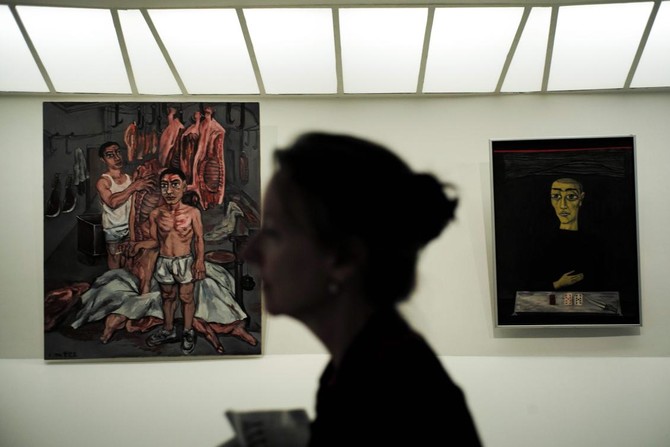
A changing China on view in New York art show


In the light of Andalusia: Luis Olaso’s new body of work
- Luis Olaso transforms Andalusian landscapes and light into abstract art, creating canvases that reflect culture, nature, and the artist’s inner state
- Each work in ‘Photosynthesis’ acts as a sensory and meditative portrait — an immersion into the Andalusian experience and the artist’s emotional universe
DUBAI: Spanish artist Luis Olaso is presenting “Photosynthesis,” his new exhibition, until March 9 at the JD Malat Gallery in Downtown Dubai. The series marks a turning point in his career, born from his recent move to Cadiz, in Andalusia, where the sun, light, and Mediterranean landscapes have profoundly transformed his practice.
For Olaso, relocating to southern Spain was not merely a change of scenery but an immersion into a culture and environment that nourishes his art at every moment.
“It’s very important for me because this is the first exhibition I have created in my new studio … I built it in the middle of the garden, surrounded by nature, fruit trees and olive trees, with a fantastic landscape. The influence of Andalusia and the colors of that place are the driving force behind my work,” said Olaso.
Located at the heart of an estate surrounded by olive, almond, and orange trees, his studio is designed to allow nature to enter the creative process both physically and psychologically. Yet, rather than depicting these elements directly, Olaso absorbs them as a sensory catalyst: Each color, texture, and gesture becomes the expression of a lived moment.
“Even when I work with plants or flowers, I’m not aiming for literal representation; they are vehicles to express abstract metaphors of myself and the moment I’m living while creating the work,” he said.
His artistic process is both spontaneous and meditative. Olaso often works on several canvases simultaneously to free himself from the pressure of the “perfect painting,” allowing intuition to guide his brush. Music — the Spanish band Triana and 1970s psychedelic flamenco — plays a central role in his focus and inner connection.
“Painting, for me, is similar to meditation. I need to be in that precise moment and feel connected with myself,” said Olaso.
“Photosynthesis” also reflects a profound cultural and artistic dialogue. The artist’s work draws from Spanish tradition— with references to Antoni Tapies and Manolo Millares — as well as major international abstract movements, including American gestural abstraction and the San Francisco Bay Area Figurative Movement.
This meeting point between abstraction, culture, and emotion transforms each canvas into a portrait of a lived instant and the artist’s inner state.
After Dubai, Olaso is expected to present a solo exhibition in Madrid in March 2026, followed by another solo exhibition in Helsinki in April. An art fair is scheduled for September, with additional fairs planned throughout the year, notably with the JD Malat Gallery.
These milestones illustrate his universal approach to art, deeply rooted in a specific cultural context: the light, color, and sensory memory of Andalusia. With “Photosynthesis,” the artist offers viewers an experience in which painting becomes a mirror of the self, an emotional journey, and an encounter with a singular place.


