With brushes and paint-splotched palette, Chinese artist Yang Feiyun adds the finishing strokes to his latest work: a portrait of the moustached 17th century Spanish King Felipe IV.
An untrained eye would fail to tell the difference between Yang’s canvas and the original by the Spanish master Velazquez, hanging inches away in a crowded gallery at Madrid’s Prado Museum.
“I have been painting my whole life, ever since I was a child, and Velazquez is a master among painters. He is known in China for his great depth,” Yang tells AFP.
A respected artist in China, where he is head of oil painting at the state Central Academy of Fine Arts in Beijing, Yang is now leading 17 other specialists on a pilgrimage to the Spanish capital.
Their mission: to make first-hand copies of some of the jewels of European oil painting and take them home to use in training curious Chinese artists.
“Our aim is to learn a lot and have these works as teaching material in China,” Yang told AFP.
“There is not a long history of oil painting in China — just the past 100 years or so. We are in a learning period.”
In other halls of the vast museum, their walls heaving with masterpieces by Titian, Rubens, Goya and El Greco, Yang’s companions work quietly at their easels under the curious gaze of visitors.
A few steps from Yang, his companion Guo Zhangzheng is executing a smaller version of Titian’s “Emperor Charles V at the Battle of Muehlberg,” a three-meter portrait of the lance-wielding monarch on horseback from 1548.
The Chinese artists — from the state academy and another top fine arts school, the China Academy of Art — are due to stay for just over two weeks. Each aims to produce a copy of two works from the Prado’s collection.
Yang’s first go at copying Velazquez has taken him just five days to render virtually complete.
Paintings on the list for their first week’s work included “The Three Graces” by Peter Paul Rubens and Goya’s “The Third of May 1808 in Madrid,” a harrowing image of French occupying forces executing Spanish patriots by firing squad.
The copies will be exhibited in Beijing, the Prado said.
In a corner of one gallery Sun Wengong, 47, stands plying his brushes in front of Vicente Lopez’s grim-faced 1826 portrait of the painter Francisco de Goya in a grey-blue coat.
“When I’m in a museum in front of the originals, I always feel like I want to copy them or try and do my own version,” Sun says, the messy palette at his feet resembling that of the man in the portrait.
“It helps me a lot as a painter. I have seen lots of prints of the paintings, but prints are nothing like the originals. Being here in front of the originals, you have more direct and true contact with the artists,” he added.
“To be here copying the masterpieces of these painters is the best apprenticeship you could have.”


![]()
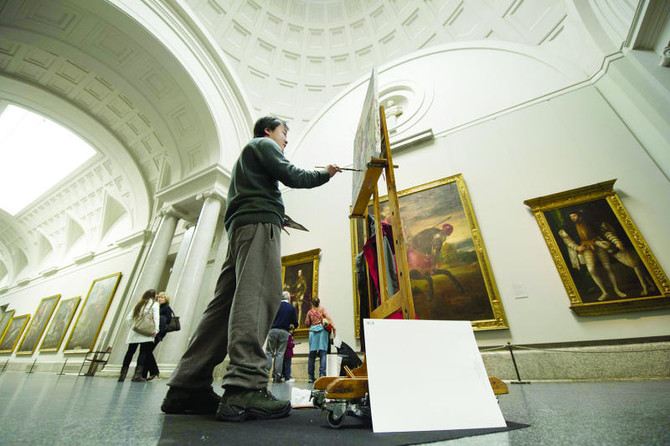
China artists work up-close with old masters in Madrid
China artists work up-close with old masters in Madrid
Latest updates


Recommended


© 2026 SAUDI RESEARCH & PUBLISHING COMPANY, All Rights Reserved And subject to Terms of Use Agreement.