Aid groups seek $434 million for Rohingya crisis for next six months

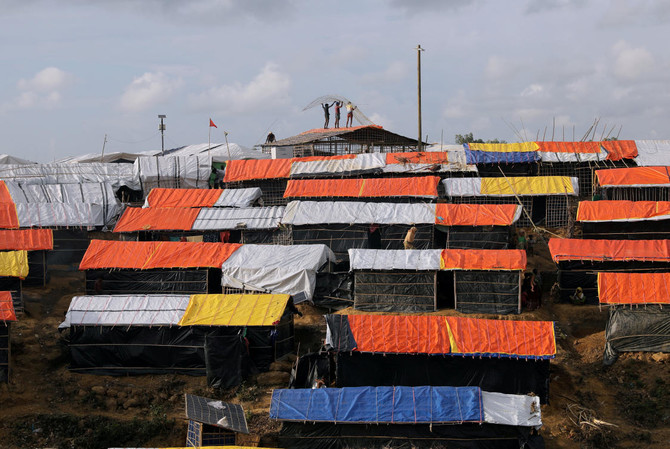
Above, Rohingya refugees build their shelter at the Kutupalang refugee camp in Cox’s Bazar, Bangladesh. (Reuters)
Updated 04 October 2017
Follow

Aid groups seek $434 million for Rohingya crisis for next six months

COX’S BAZAR, Bangladesh: Humanitarian organizations helping Rohingya Muslim refugees in Bangladesh said on Wednesday they need $434 million over the next six months to help up to 1.2 million people, many of them children, who need life-saving help.
There are an estimated 809,000 Rohingya sheltering in Bangladesh after fleeing violence and persecution in Myanmar, more than half a million of whom have arrived since August 25 to join 300,000 Rohingya who were already in Bangladesh.
“The Rohingya population in Cox’s Bazar is highly vulnerable, many having experienced severe trauma, and are now living in extremely difficult conditions,” Robert Watkins, United Nations resident coordinator in Bangladesh, said in a release, referring to the Bangladeshi border district where most are Rohingya living.
Bangladesh and humanitarian organizations are struggling to help the 509,00 Rohingya who have arrived since Aug. 25, when attacks by Rohingya militants triggered a Myanmar military offensive that the United Nations has branded ethnic cleansing.
Myanmar rejects accusations of ethnic cleansing. It says its security forces are fighting insurgents of the Arakan Rohingya Salvation Army who claimed responsibility for attacks on about 30 police posts and an army camp on Aug. 25.
The insurgents were also behind similar but smaller attacks in October last year that also led to a brutal Myanmar army response triggering the flight of 87,000 Rohingya to Bangladesh.
The agencies’ plan factors in the possibility of another 91,000 refugees coming, as the influx was continuing day to day, Watkins said.
“The plan targets 1.2 million people, including all Rohingya refugees, and 300,000 Bangladeshi host communities over the next six months,” he said.
“A rapid response from donors to this response plan is essential if the humanitarian organizations are to move ahead with critical activities to save lives, and provide protection to Rohingya refugees in Bangladesh,” Watkins said.


Proposals on immigration enforcement flood into state legislatures, heightened by Minnesota action

Updated 16 January 2026
Follow

Proposals on immigration enforcement flood into state legislatures, heightened by Minnesota action

  • Oregon Democrats plan to introduce a bill to allow residents to sue federal officers for violating their Fourth Amendment rights against unlawful search and seizure

NASHVILLE, Tennessee: As Democrats across the country propose state law changes to restrict federal immigration officers after the shooting death of a protester in Minneapolis, Tennessee Republicans introduced a package of bills Thursday backed by the White House that would enlist the full force of the state to support President Donald Trump’s immigration crackdown.
Momentum in Democratic-led states for the measures, some of them proposed for years, is growing as legislatures return to work following the killing of Renee Good by an Immigration and Customs Enforcement officer. But Republicans are pushing back, blaming protesters for impeding the enforcement of immigration laws.

Democratic bills seek to limit ICE

Democratic Gov. Kathy Hochul wants New York to allow people to sue federal officers alleging violations of their constitutional rights. Another measure aims to keep immigration officers lacking judicial warrants out of schools, hospitals and houses of worship.
Oregon Democrats plan to introduce a bill to allow residents to sue federal officers for violating their Fourth Amendment rights against unlawful search and seizure.
New Jersey’s Democrat-led Legislature passed three bills Monday that immigrant rights groups have long pushed for, including a measure prohibiting state law enforcement officers from cooperating with federal immigration enforcement. Democratic Gov. Phil Murphy has until his last day in office Tuesday to sign or veto them.
California lawmakers are proposing to ban local and state law enforcement from taking second jobs with the Department of Homeland Security and make it a violation of state law when ICE officers make “indiscriminate” arrests around court appearances. Other measures are pending.
“Where you have government actions with no accountability, that is not true democracy,” Democratic state Sen. Scott Wiener of San Francisco said at a news conference.
Democrats also push bills in red states
Democrats in Georgia introduced four Senate bills designed to limit immigration enforcement — a package unlikely to become law because Georgia’s conservative upper chamber is led by Lt. Gov. Burt Jones, a close Trump ally. Democrats said it is still important to take a stand.
“Donald Trump has unleashed brutal aggression on our families and our communities across our country,” said state Sen. Sheikh Rahman, an immigrant from Bangladesh whose district in suburban Atlanta’s Gwinnett County is home to many immigrants.
Democrats in New Hampshire have proposed numerous measures seeking to limit federal immigration enforcement, but the state’s Republican majorities passed a new law taking effect this month that bans “sanctuary cities.”
Tennessee GOP works with White House on a response
The bills Tennessee Republicans are introducing appear to require government agencies to check the legal status of all residents before they can obtain public benefits; secure licenses for teaching, nursing and other professions; and get driver’s licenses or register their cars.
They also would include verifying K-12 students’ legal status, which appears to conflict with a US Supreme Court precedent. And they propose criminalizing illegal entry as a misdemeanor, a measure similar to several other states’ requirements, some of which are blocked in court.
“We’re going to do what we can to make sure that if you’re here illegally, we will have the data, we’ll have the transparency, and we’re not spending taxpayer dollars on you unless you’re in jail,” House Speaker Cameron Sexton said at a news conference Thursday.
Trump administration sues to stop laws
The Trump administration has opposed any effort to blunt ICE, including suing local governments whose “sanctuary” policies limit police interactions with federal officers.
States have broad power to regulate within their borders unless the US Constitution bars it, but many of these laws raise novel issues that courts will have to sort out, said Harrison Stark, senior counsel with the State Democracy Research Initiative at the University of Wisconsin Law School.
“There’s not a super clear, concrete legal answer to a lot of these questions,” he said. “It’s almost guaranteed there will be federal litigation over a lot of these policies.”
That is already happening.
California in September was the first to ban most law enforcement officers, including federal immigration officers, from covering their faces on duty. The Justice Department said its officers won’t comply and sued California, arguing that the laws threaten the safety of officers who are facing “unprecedented” harassment, doxing and violence.
The Justice Department also sued Illinois last month, challenging a law that bars federal civil arrests near courthouses, protects medical records and regulates how universities and day care centers manage information about immigration status. The Justice Department claims the law is unconstitutional and threatens federal officers’ safety.
Targeted states push back
Minnesota and Illinois, joined by their largest cities, sued the Trump administration this week. Minneapolis and Minnesota accuse the Republican administration of violating free speech rights by punishing a progressive state that favors Democrats and welcomes immigrants. Illinois and Chicago claim “Operation Midway Blitz” made residents afraid to leave their homes.
Homeland Security spokesperson Tricia McLaughlin accused Minnesota officials of ignoring public safety and called the Illinois lawsuit “baseless.”