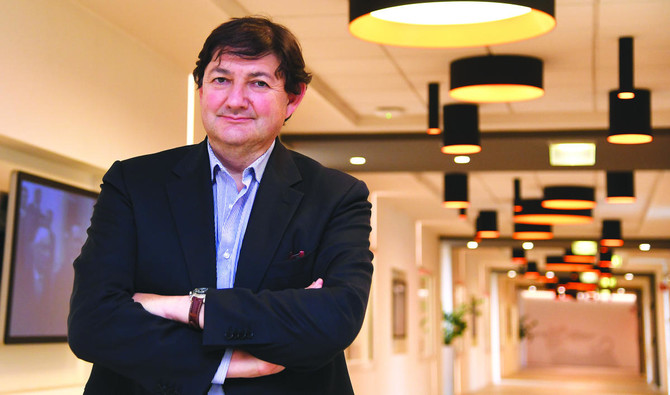
MILAN: Italian oil major Eni is betting billions on Luca Bertelli being able to achieve something he has been doing since he was 9 years old — spotting things others overlook.
The geologist, who heads Eni’s exploration team, began collecting rocks as a boy growing up in Tuscany, developing a curious eye that eventually led him to discover two of the world’s biggest gas fields this century.
His latest success, the Zohr field off Egypt, sits in an area that Royal Dutch Shell pored over for years before Bertelli persuaded his boss to embark on a drilling program that turned up the Mediterranean’s largest gas discovery.
Now the 59-year-old and his team are under pressure to show they can keep finding treasures others have missed — this time in waters off Mexico where former state oil monopoly Pemex has been exploring for decades.
“We feel there’s room for surprise, even in areas previously explored,” Bertelli said up in his 12th-floor office in Milan, fingering a specimen of crumbly oil-rich rock from the Amoca field it won, with two other fields, in 2015.
Bertelli is a lynchpin in Eni’s corporate strategy which in recent years has seen it break ranks with major rivals and ignore the rush to shale, focusing instead on eking out the world’s conventional energy resources.
In recent years weakness in its “downstream” businesses like refining and chemicals have dragged on profits and placed more of a premium on securing success in “upstream” exploration.
The story of how Eni discovered the giant Zohr field in 2015 offers a window into how Bertelli and his team operate.
He said geologic intuition and experience told him there could be something there that other companies hadn’t spotted.
Previous discoveries in the East Mediterranean had all been in sandstone. But it soon became clear this was not the case in Zohr, prompting a host of rivals to dismiss the site.
What Bertelli and his team saw instead were the outlines of a different kind of structure beneath a thick layer of salt and he had a hunch it could be a form of limestone — carbonate — that he had seen yielding oil and gas in fields as far flung as Kazakhstan and Venezuela.
“Intuition comes from experience,” he said. “In the case of Zohr we’d already seen similar geological features elsewhere.”
Then Eni’s supercomputer came in. It is the third most powerful in the industry after those operated by France’s Total and Norway’s Petroleum Geo-Services, processing 8 million billion operations a second.
It recrunched imaging data hailing from the 1990s to look for signs of carbonate formation, performing the task in a matter of days rather than the months that was once needed.
“The result gave us the confidence to back up our intuition,” said Bertelli. “We decided to go for drilling.”
But if Eni, the seventh-biggest major by output, might have an edge in exploration, its downstream business has struggled. The consequent shift of focus away from those areas has raised concerns it might be overly exposed to oil price volatility.
Its heavy presence in Africa, with the risk associated with working in places like Libya and Nigeria, is for some another reason why the company’s shares have underperformed peers like BP and Total.
A decade ago, Eni was all but washed-up as an explorer.
It was struggling to discover as much new oil and gas as it extracted each year. And its ability to run complex projects was in doubt after losing its role as sole operator of the huge Kashagan oilfield in 2008 due to delays and cost overruns.
Since then it has discovered two world-class gas fields, in Mozambique and Egypt, adding 115 trillion cubic feet of resources.
Bertelli attributes the turnaround to a strategy he helped CEO Claudio Descalzi implement — a focus on simple projects majority-owned by Eni to better control costs and time.
The decision not to chase the shale bonanza that reshaped the industry was also key. “We found a window of opportunity in a field no longer dominated by the super-majors but by smaller independent players.”
Bertelli points to a map on his wall of the company’s giant Mamba field off Mozambique, calling it one of a kind. Then he pauses for thought. “But it’s probably not unique,” he adds. “There’s another one out there waiting to be found.”
— Reuters


Eni bets big on Zohr explorer finding new Egyptian treasure
Eni bets big on Zohr explorer finding new Egyptian treasure

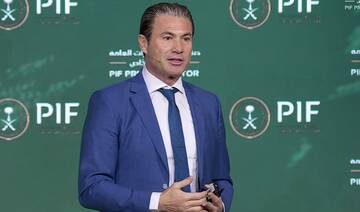
PIF’s Humain invests $3bn in Elon Musk’s xAI prior to SpaceX acquisition
JEDDAH: Humain, an artificial intelligence company owned by Saudi Arabia’s Public Investment Fund, invested $3 billion in Elon Musk’s xAI shortly before the startup was acquired by SpaceX.
As part of xAI’s Series E round, Humain acquired a significant minority stake in the company, which was subsequently converted into shares of SpaceX, according to a press release.
The transaction reflects PIF’s broader push to position Saudi Arabia as a central hub in the global AI ecosystem, as part of its Vision 2030 diversification strategy.
Through Humain, the fund is seeking to combine capital deployment with infrastructure buildout, partnerships with leading technology firms, and domestic capacity development to reduce reliance on oil revenues and expand into advanced industries.
The $3 billion commitment offers potential for long-term capital gains while reinforcing the company’s role as a strategic, scaled investor in transformative technologies.
CEO Tareq Amin said: “This investment reflects Humain’s conviction in transformational AI and our ability to deploy meaningful capital behind exceptional opportunities where long-term vision, technical excellence, and execution converge, xAI’s trajectory, further strengthened by its acquisition by SpaceX, one of the largest technology mergers on record, represents the kind of high-impact platform we seek to support with significant capital.”
The deal builds on a large-scale collaboration announced in November at the US-Saudi Investment Forum, where Humain and xAI committed to developing over 500 megawatts of next-generation AI data center and computing infrastructure, alongside deploying xAI’s “Grok” models in the Kingdom.
In a post on his X handle, Amin said: “I’m proud to share that Humain has invested $3 billion into xAI’s Series E round, just prior to its historic acquisition by SpaceX. Through this transaction, Humain became a significant minority shareholder in xAI.”
He added: “The investment builds on our previously announced 500MW AI infrastructure partnership with xAI in Saudi Arabia, reinforcing Humain’s role as both a strategic development partner and a scaled global investor in frontier AI.”
He noted that xAI’s trajectory, further strengthened by SpaceX’s acquisition, exemplifies the high-impact platforms Humain aims to support through strategic investments.
Earlier in February, SpaceX completed the acquisition of xAI, reflecting Elon Musk’s strategy to integrate AI with space exploration.
The combined entity, valued at $1.25 trillion, aims to build a vertically integrated innovation ecosystem spanning AI, space launch technology, and satellite internet, as well as direct-to-device communications and real-time information platforms, according to Bloomberg.
Humain, founded in August, consolidates Saudi Arabia’s AI initiatives under a single entity. From the outset, its vision has extended beyond domestic markets, participating across the global AI value chain from infrastructure to applications.
The company represents a strategic initiative by PIF to diversify the Kingdom’s economy and reduce oil dependence by investing in knowledge-based and advanced technologies.