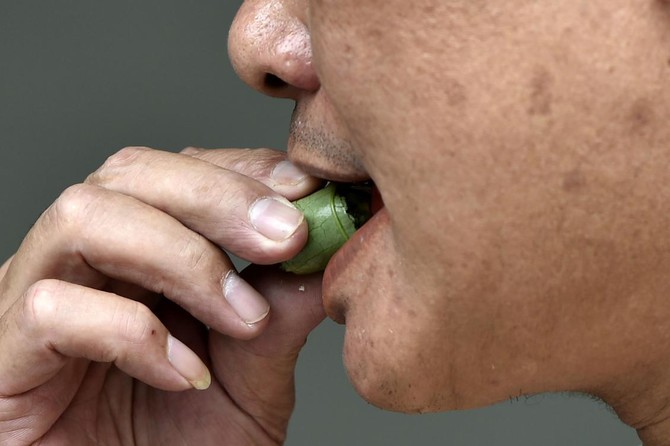
NANTOU CITY, Taiwan: For years Huang Sheng-yi helped feed Taiwan’s addiction to the betel nut, planting thousands of the trees on his mountainous farm.
Today he has felled most of them, incentivized by the government to grow something else, as part of its push to reduce availability of the nut, which is a stimulant and also a known carcinogen linked to oral cancer.
But the green nut, which is often wrapped in a betel leaf spread with slaked lime to enhance the stimulative effect, is still ubiquitously available at roadside kiosks across the island and chewed by millions daily.
The chance of a betel nut user developing oral cancer is 28 times the average person, according to the health ministry.
“Simply promoting the health risks is not enough. Betel nut chewing is too deeply ingrained in society,” says Chuang Li-chen, project manager at Sunshine Social Welfare Foundation, an NGO that offers rehabilitation services for oral cancer survivors.
Since a 2003 study confirmed betel nut as a carcinogen there has been a gradual decline in popularity, although around two million people still chew the nut, according to government figures.
The nut, which stains users’ teeth blood red, remains popular among the working class, particularly men, who rely on its stimulant properties to better cope with long hours of manual labor.
The government is attempting to reduce the amount of betel nut available as part of its plan to tackle the issue. It subsidizes farmers as much as Tw$250,000 ($8,315) per hectare if they convert to other crops.
Huang now grows oil-seed camellia which produces an edible extract often likened to olive oil at his farm in Lugu town in the central county of Nantou.
However, the 57-year-old says many are still hesitant to make the leap.
It will be more than two years before he can harvest the oil-seed camellia, he says, and he is only able to stay afloat because he has another tea-growing business.
“Farmers are reluctant because managing a new crop is much harder,” he told AFP.
“There needs to be even greater guidance and incentives to really make a difference.”
Authorities concede the program has not yet made a significant dent since it started in 2014.
Of the 42,940 hectares of betel plantations on the island, only 435 have changed crops under the initiative, although more may have done so without government assistance.
But Su Mao-hsiang, deputy director of Taiwan’s agriculture and food agency says applications have risen this year off the back of government offers of more support.
“We hope more farmers can participate in the conversion,” he told AFP.
Betel nut has been part of Taiwan’s aboriginal culture for thousands of years, used in ceremonies and rituals.
At the height of its popularity it was known as “green gold” because it was such a lucrative crop — second only to rice in value — and many had come to rely on it for their livelihood.
Its skinny palms still pervade parts of the rural landscape and flashing signs at roadside kiosks flag down drivers, although they are lower key than in the past.
Young women in skimpy outfits — known as “betel nut beauties” — often used to staff the stands are less common now after the government crackdown.
Despite the various measures to curb production and use, campaigners say there is still too little awareness of the damage betel nut can cause.
Former addict Chen Yung-an wishes he had believed his doctor when told he had early signs of oral cancer two decades ago.
“I didn’t think it was possible. Other people chewed it for years and nothing happened to them,” said Chen, now 53, who had a tumor removed three years ago, taking out a chunk of his right jaw.
Chen went through 200 a day at the peak of his habit, saying it served as a social lubricant among co-workers.
“In the rural areas betel nut is like fruit. We didn’t have the concept that it was bad for us,” he told AFP.
“It felt uncomfortable whenever my mouth wasn’t moving. While driving back I would buy Tw$200 to eat on the car.”
“My mouth would only rest when I was sleeping,” he explained.
Today he is limited to eating soft and bite-sized foods to avoid choking and has not worked since the disfiguring surgery.
“Of course it’s hard to find a job now. I would have to face the looks people give me,” he told AFP.
The disease can take 10 to 20 years to develop, which means many people do not seek treatment until it is too late, said Chuang.
Only about half of the population is aware of the fact that the betel nut directly induces cancer, even without any other additives, she adds.
“We’ve let the betel nut industry develop for decades. We can’t just ignore the livelihoods of these growers and vendors,” said Chuang.
It needs more coordination between education, agricultural and economic departments, she says.
“We need a comprehensive approach to effectively tackle this problem at its roots.”