ANKARA: Iraqi Kurdistan’s drive for independence and new efforts to end the conflict in Syria dominated talks in Tehran on Wednesday when Turkish President Recep Tayyip Erdogan began an official visit.
Erdogan met Iran’s supreme leader Ayatollah Ali Khamenei and President Hassan Rouhani, with cooperation on transport, trade, energy and border crossings also on the agenda.
Ankara and Tehran, with Russia, have driven the most recent peace efforts in Syria. They have established new cease-fire and de-escalation zones, and have deployed 500 observers each to monitor them.
Turkey and Iran also share borders with the Kurdistan Region of Iraq, and they vehemently opposed last month’s controversial referendum in which Kurds voted overwhelmingly in favor of independence. With Iraq, they fear that the vote will lead to greater regional instability and disrupt counter-terrorism efforts against Daesh.
The three countries are conducting military drills on the border in a show of force, and further punitive measures against the idea of an independent Kurdistan will follow, Erdogan said on Wednesday at a joint press conference with Rouhani. “There is no country in the world that recognizes it other than Israel. The decision made by sitting at the table with Mossad cannot be legitimate, it is illegitimate,” he said.
Rouhani said terror groups such as Daesh and the Kurdistan Workers’ Party (PKK) would not be allowed in the region, and Turkey and Iran supported the territorial integrity of both Syria and Iraq.
Two days before Erdogan’s visit, Turkish military Chief of Staff Gen. Hulusi Akar went to Tehran to meet his Iranian counterpart, Gen. Mohammed Hossein Bagheri, to discuss border security issues and joint efforts against terrorism.
During yesterday’s visit, Turkey and Iran also agreed to conduct bilateral trade through their own national currencies, in an effort to shore them up and reduce dependency on the US dollar.
“The Turkish lira went into free fall after the coup attempt last year, and President Erdogan has since pushed for trade in local currency, not only with Iran but also with other key trading partners such as Russia and China,” said Ahmad Majidyar, a fellow with the Middle East Institute in Washington.
“As far as Iran is concerned, existing US sanctions still limit Tehran’s access to dollars. As a result, the Iranian government seeks to establish its bilateral trade with key partners in local currency.”
The two countries also agreed to work more closely on mutual tourism to boost their economies, and Iran will make it easier for Turkish entrepreneurs to work there.
Three customs gates on the border between the countries will be now operational 24 hours a day with the aim of increasing bilateral trade volume from $10 to $30 billion, and Turkey will import more natural gas from Iran.
Convergence of interests and threat perception has compelled Tehran and Ankara to reconcile some of their differences and cooperate more to tackle regional challenges that threaten both countries, Majidyar told Arab News.
“Iran and Turkey both fiercely oppose the creation of an independent Kurdish state in Iraq as they fear such a move would strengthen separatism within their own sizable Kurdish minorities,” he said.
“Ankara has also realized that Washington is unwilling to take meaningful measures to topple the Assad regime or counter Iran’s influence in Iraq and Syria. Continued US support for Syrian Kurds has added to Ankara’s worries. As a result, Turkey is seeking to address some of its concerns by working with Iran, Russia and other regional and international players.”
However, despite a thaw in relations, there is still deep-seated mistrust between Tehran and Ankara and their transactional partnership in Syria and Iraq is unlikely to develop into a strategic alliance, Majidyar said.
Both countries perceive security threats from the instability that could arise from the Kurdish referendum, as this could result in a vacuum filled by terrorist groups such as the PKK and its Iranian offshoot the Kurdistan Free Life Party (PJAK), Prof. Nursin Atesoglu Guney, dean of the faculty of economics, administrative and social sciences at Bahcesehir Cyprus University in Iran, told Arab News.
“The relations between Turkey and Iran are therefore interest-based and can be labeled an alliance of convenience due to the common threat perception,” he said.
The geopolitical shift in the Middle East and Iran’s deteriorating relations with the West, mainly due to the impact of the Trump administration pressure on Tehran, also led to an improvement of relations between Turkey and Iran, Guney said.
“Throughout history, Turkey and Iran either cooperated on an issue-by-issue basis or got into competition in the region,” she said. “However, instead of competing in Syria, they found a window of opportunity to improve relations and go back to cooperation on a wide range of issues, from security to tourism and trade.”
Nevertheless, she did not expect joint military intervention by Turkey and Iran in the Kurdistan Region. “They can jointly take harsher measures, such as economic sanctions and an embargo on energy sources, but military action seems to be the last resort.”


![]()
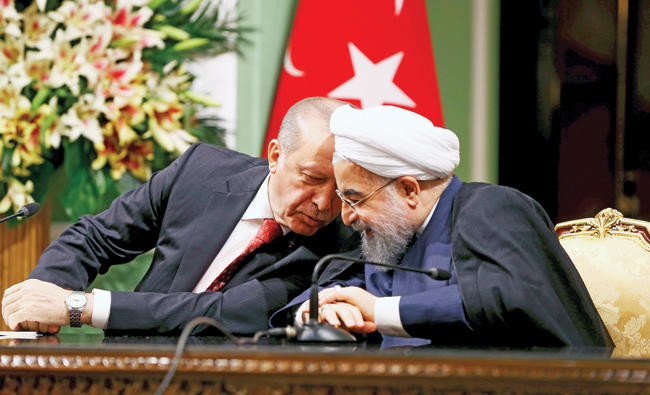
Erdogan, Rouhani vow to halt Iraqi Kurds’ secession
Erdogan, Rouhani vow to halt Iraqi Kurds’ secession

Latest updates




© 2026 SAUDI RESEARCH & PUBLISHING COMPANY, All Rights Reserved And subject to Terms of Use Agreement.