Sarin used in Syria 5 days before Khan Sheikhun: OPCW

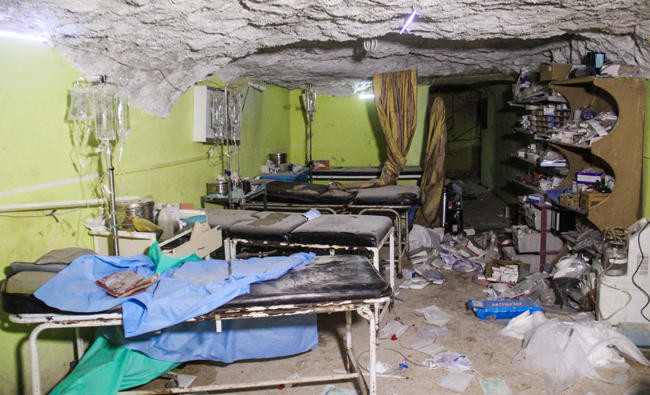
This file photograph taken on April 4, 2017, shows destruction at a hospital room in Khan Sheikhun, a rebel-held town in the northwestern Syrian province of Idlib, following a suspected toxic gas attack. (AFP / Omar Haj Kadour)
Updated 04 October 2017
Follow

Sarin used in Syria 5 days before Khan Sheikhun: OPCW

THE HAGUE: Sarin nerve agent was used in an ‘incident’ at a northern Syrian village in late March, five days before the deadly attack on Khan Sheikhun, the world’s chemical watchdog said Wednesday.
“Analysis of samples collected (by the OPCW)... relates to an incident that took place again in the northern part of Syria on the 30th of March this year,” the head of the Organization for the Prohibition of Chemical Weapons told AFP in an interview.
“The results prove the existence of sarin,” Ahmet Uzumcu said.
The Khan Sheikhun attack on April 4 was previously believed to have been the first use of sarin since the deadly August 2013 attack in and around Damascus which killed hundreds of people.
Two days after Khan Sheikhun incident, the United States fired 59 Tomahawk missiles at a Syrian air base from which it said the attack was launched.
At least 87 people including 30 children died in the attack on Khan Sheikhun, a town in the opposition-held province of Idlib.
But Uzumcu said Wednesday sarin had also been used the opposition-held village called Latamneh, some 25 kilometers (15 miles) south of Khan Sheikhun on March 30.
“What we know at the moment is not much. Fifty people were reportedly injured. There were no deaths reported,” he said.
He said the OPCW’s fact-finding mission had retrieved soil samples, clothing and metal parts “which were sent to our laboratories and we received the results a few days ago.”
It is “worrying that there is some sarin use or exposure even before the April 4 incident,” he said.
Uzumcu pointed out that the OPCW’s fact-finding mission team was unlikely to visit the area, where fighting is still ongoing between Syrian government forces and armed opposition groups.
“The (fact-finding team) is making every effort to contact the victims,” Uzumcu said.
Syria’s government has denied involvement and claims it no longer possesses chemical weapons after a 2013 agreement under which it pledged to surrender its chemical arsenal.
The OPCW earlier this year presented a report confirming sarin gas was used in the attack at Khan Sheikhun, but did not assign blame.
But UN war crimes investigators last month said they had evidence that Syrian forces were behind the attacks, the first UN report to officially blame the Assad regime.
Damascus has vehemently refuted the claims saying “Syria has not and will not use toxic gases against its people because it does not have them.”
In total, the OPCW is studying as many as 45 suspected chemical attacks in Syria since mid-2016, the watchdog said in April.
The JIM, a joint OPCW-United Nations panel which reports to the UN Security Council, is now probing the question of responsibility and its report on the attack is due within the next few weeks.
The JIM has already determined that Syrian government forces were responsible for chlorine attacks on three villages in 2014 and 2015, and that Daesh terrorists used mustard gas in 2015.
Uzumcu told AFP he did not believe there would be any difference between the JIM’s findings on Khan Sheikhun and those of the OPCW’s fact-finding mission about the use of sarin.
“The challenge is of course to identify the actors of these attacks. They should certainly be held accountable, prosecuted and punished,” Uzumcu said.
“That’s the only way to keep strong the international norm against the use of chemical weapons,” he said.


Abbas reiterates opposition to displacement of Palestinians

Russian President Vladimir Putin with Palestinian President Mahmoud Abbas at the Senate Palace of the Kremlin in Moscow. (AP)
Updated 23 January 2026
Follow

Abbas reiterates opposition to displacement of Palestinians

  • During Moscow talks, president calls for immediate halt to Israeli acts of terror
  • Historically, Russia has supported and stood by the Palestinian people at political and diplomatic levels

MOSCOW: The Palestinian National Authority’s President Mahmoud Abbas has reiterated his opposition to all attempts to displace Palestinian people from their land.

Speaking with Russian President Vladimir Putin at the presidential palace in Moscow, Abbas was reported by the Kremlin’s official website as saying that “the Palestinian people are holding on to their land, and we categorically oppose attempts by the Americans and Israelis to expatriate Palestinians beyond Palestinian territory.” 
He said the Palestinian people “will not abandon their land, whatever the cost.” Abbas stressed the need to fully implement US President Donald Trump’s peace plan, leading to the withdrawal of occupation forces and the launch of the reconstruction process.
He emphasized that the Palestinian Authority would assume a central role in administering the Gaza Strip, and that the enclave and the West Bank constituted two parts of a single territorial unit, with a unified and undifferentiated system of civilian institutions.
He stressed the need for an immediate halt to “Israeli settler colonialism and Israeli acts of terror in the West Bank, including Jerusalem, along with the release of withheld Palestinian funds and the cessation of all measures that undermined the Palestinian Authority and the two-state solution.”
He reaffirmed his commitment to continue the struggle for the realization of the Palestinian people’s right to self-determination and of their right to a fully sovereign, independent state based on the borders of June 4, 1967, with East Jerusalem as its capital, while living in security and peace with neighbors.
He told Putin: “What we need is peace, and we hope that with your help and support, we can achieve it — a peace built on the basis of international legal resolutions, decisions of the United Nations, and the principles established following the wars of 1967 and 1973.
“East Jerusalem remains the capital of Palestine, and we know that Russia has always supported — indeed, was the first to support — Palestine, maintaining a firm stance in support of our people.”
Abbas thanked his Russian counterpart for Moscow’s support and commended the bilateral “bonds of friendship” between both countries. He added: “We are friends of Russia and the Russian people. For over 50 years our nations have been bound by a strong friendship that has developed over the decades and continues on the correct path. Russia is a great friend and a nation upon which we rely in many spheres.
“Historically, Russia has supported and stood by the Palestinian people at political and diplomatic levels. Your economic and financial support is both significant in scale and crucial in importance.”
Abbas emphasized moving forward with the implementation of a comprehensive national reform program aimed at consolidating the rule of law, strengthening the principles of good governance, transparency, and accountability, and ensuring the separation of powers.
Putin affirmed Moscow’s “principled and consistent approach” to the Palestinian question.
He said: “We believe that only the establishment and full functioning of the Palestinian state can lead to a lasting settlement of the Middle East conflict.”