STRASBOURG/PARIS: The crisis in Catalonia poses a bigger threat to the EU than Brexit, a senior member of the European Parliament (MEP) warned Wednesday as the European Parliament prepared to hold an emergency debate on Spain’s worst political crisis in decades.
Catalonia’s leader has vowed to declare independence within days, claiming a mandate from a weekend referendum which was declared illegal by Madrid and the Spanish courts and marred by violence.
Images of the police crackdown on the vote drew a vocal reaction from some MEPs, with Belgium’s Philippe Lamberts, the head of the Green grouping in parliament, warning the crisis “threatened the spirit of European integration, even more than Brexit.”
Several Green and far-left deputies criticized the Spanish police for their actions.
But Esteban Gonzalez Pons, an MEP from Spanish Prime Minister Mariano Rajoy’s Popular Party, rejected calls for mediation, saying Spain did not need “looking after.”
“Deciding is Spain should break up or stay united is a matter for Spaniards and only for Spaniards,” he said.
“If today you let Spain break up with Catalonia, a domino effect will follow across the continent. Instead of a Europe of 27 we will have a non-Europe of mini-states.”
The European Commission, the EU’s executive arm, broke weeks of silence on Monday to call for dialogue but stressed that it still regarded the vote as an “internal matter” for Spain, drawing criticism from Catalan separatists.
Wednesday’s crisis debate in Parliament is due to kick off at 3 p.m., but Catalonia dominated a morning session on preparations for a summit of EU leaders later this month.
After a proposal by the three main political groups in the European Parliament — the conservatives, the socialists and the liberals — the debate will consider “constitution, rule of law and fundamental rights in Spain in the light of the events in Catalonia.”
This watered-down motion was preferred to a tougher motion criticizing Madrid, proposed by the Greens.
Meanwhile, French Economy Minister Bruno Le Maire has said that Britain needed to settle its bill with the EU before beginning talks on a post-Brexit trade deal, declaring: “We want our money back.”
In an interview with France’s CNews channel on Tuesday evening, Le Maire said it was time for Britain — which is wrangling with Brussels over the size of its divorce bill, among other issues — to pay up.
Echoing former British Prime Minister Margaret Thatcher, who launched a successful battle to reduce Britain’s payments to the then European Economic Community in 1980 by declaring: “I want my money back,” Le Maire said: “We, Europeans, say to the British: ‘We want our money back’.”
He accused Britain of trying to shirk the commitments it made to the EU’s budget.
“It’s as if you went to a restaurant, ordered a meal, began eating and then walked out in the middle of the meal, saying: ‘I’m not going to pay after all’. That’s not possible,” he said.
The EU reportedly estimates the cost for Britain to leave the union is between €60 billion and €100 billion ($70.7 billion to $118 billion).
Britain’s The Times newspaper reported that Prime Minister Theresa May was prepared to pay 45 billion euros — which her government has denied.
Le Maire backed EU’s Brexit negotiator Michel Barnier, who said Tuesday that the two sides had not made enough progress in their divorce talks to begin discussing a new relationship.
“Let’s find an agreement on the financial settlement, even if it’s not down to the exact euro, and then we can launch the next stages,” he said.


![]()
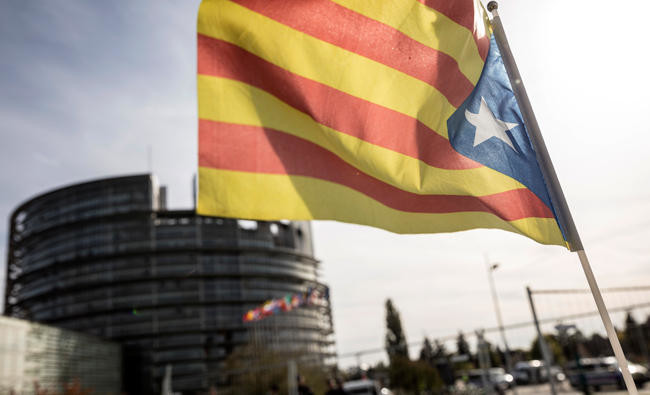
Catalan crisis ‘bigger threat to EU than Brexit,’ MEP warns
Catalan crisis ‘bigger threat to EU than Brexit,’ MEP warns
Latest updates





© 2026 SAUDI RESEARCH & PUBLISHING COMPANY, All Rights Reserved And subject to Terms of Use Agreement.