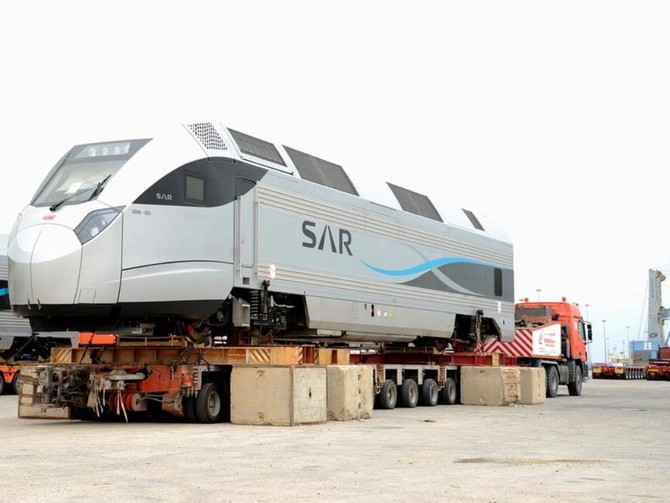
DUBAI: Thales has signed a two-year maintenance contract with Saudi Railway Company (SAR) to maintain the signaling, telecommunication and electromechanical systems of the Kingdom’s North-South Railways project.
The 2,400-kilometer rail project, transports passengers from the capital city of Riyadh to Qurrayat in northern Saudi Arabia in addition to the heavy transport of minerals such as raw phosphates and bauxite from the Wa’ad Al-Shamal phosphate mine.
As part of the agreement, Thales will work with Buraydah’s Saudi Railway Polytechnic to train 1,500 students to obtain vocational qualifications in the fields of health and safety, mechanical, electrical, civil engineering, signaling, telecommunications, rolling stock maintenance and train driving, the company said in a statement.
“This will allow SAR maintenance teams to gradually take over the maintenance activities for the duration of the two-year contract,” it said.
“In line with [Saudi Vision 2030] and [the National Transformation Program,] this project further illustrates Thales’ commitment to ensure the SAR maintenance [personnel] are able to continue in their efforts long after our contract expires, and contribute toward the kingdom’s success,” Jean-Yves Tolot, country director for Thales in Saudi Arabia said.

Thales signs two-year maintenance contract with Saudi Railway Company
ITC Infotech accelerates Vision 2030 through digital hub in Riyadh
ITC Infotech’s commitment to delivering real digital change in the Middle East is reinforced by strengthening collaboration and working more closely with customers on the ground. The establishment of its Digital and AI Engineering Hub in Riyadh brings superior digital engineering and AI skills closer to businesses, allowing for speedier collaboration, localized innovation, and solutions targeted to regional needs. This strategic expansion aligns with Saudi Arabia’s Vision 2030 and underscores ITC Infotech’s long-standing emphasis on partnership-led growth and customer-centric innovation.
The hub was officially inaugurated on Jan. 15 by Sanjiv Puri, chairman and managing director of ITC Ltd. This facility is designed to help enterprises leverage advanced technologies and convert digital ambitions into measurable business outcomes. This move aligns closely with Saudi Arabia’s efforts to build a knowledge-driven economy powered by innovation and technology.
Saudi Arabia’s digital leap
Vision 2030 is more than just economic diversification; it is a clear blueprint for creating a technologically advanced society. This vision is centered on the integration of artificial intelligence and digital engineering, which are transforming industries and enabling long-term, sustainable growth. The strategic importance of AI is clear, with the Saudi Data and AI Authority estimating that it may add $135 billion to the Kingdom’s GDP by 2030. This commitment is supported by significant investments, including $14.9 billion announced at LEAP 2025 to advance digital infrastructure, talent, and next-generation technologies, as well as historic projects like the $2.7 billion Hexagon Data Center in Riyadh. Together, these efforts are laying the foundation for a secure, resilient, and future-ready digital ecosystem that can support AI adoption, data-driven governance, and smart city development at scale.
What the hub offers
ITC Infotech’s Riyadh hub is designed to fuel this momentum by focusing on three core areas:
- AI-powered platforms: Delivering predictive analytics, intelligent automation, and data-driven insights to help businesses transition from reactive operations to proactive strategies.
- Digital engineering solutions: Leveraging Industry 4.0-driven smart manufacturing capabilities, integrating AI-led modeling, connected systems, and advanced analytics to optimize production performance, improve asset utilization, and proactively reduce operational and quality risks across the engineering lifecycle.
- Cloud-native architectures: Building agile, secure, and resilient ecosystems that enable faster innovation and seamless integration across enterprise systems.
These capabilities are designed to enable organizations to innovate, scale, and compete in a rapidly evolving digital economy. Beyond technology, the hub is fundamentally anchored in building a team of the region, from the region, for the region and for global impact. Through structured skill-building programs, deep partnerships with academia, systematic knowledge transfer, and immersive, hands-on delivery models, the hub is creating a future-ready Saudi workforce fully aligned with Vision 2030 and capable of serving both national and international priorities.
Driving enterprise transformation
The ITC Infotech hub aims to enable transformation rather than simply deploy technology. By driving AI adoption, accelerating digital engineering, and building cloud-native ecosystems, ITC Infotech seeks to help businesses:
- develop new business models to meet evolving market needs.
- improve operational efficiency through predictive insights and automation.
- support sustainability goals by optimizing resources and reducing risks.
- build a skilled local workforce capable of leading future innovations.
These outcomes support enterprises as they transition to more resilient, data-driven, and digitally mature operating models.
The road ahead
ITC Infotech is a wholly owned subsidiary of ITC Limited, one of India’s largest conglomerates, with over 25 years of experience as a trusted technology services partner to enterprises globally. The company focuses on next-generation enterprise transformation, delivering services across infrastructure and application modernization, cloud, cybersecurity, digital engineering, and AI-led innovation.
As Saudi Arabia continues its digital journey, ITC Infotech’s combination of global expertise, strong local presence, and collaborative delivery model positions it as a long-term partner in advancing Vision 2030. ITC Infotech’s hub in Riyadh reflects this commitment, bringing advanced capabilities closer to customers, investing in local talent, and enabling enterprises to adopt AI at scale as they compete in an increasingly digital world.