BARCELONA/MADRID: Catalonia will move as soon as this weekend to declare independence from Spain, the region’s leader said, moving the European Union country closer to a rupture that threatens the foundations of its young democracy.
The constitutional crisis has hit the euro and Spanish stocks and bonds and Volkswagen’s Spanish unit SEAT warned of disrupted activity on Tuesday due to protests. Catalonia’s Caixabank and Spain’s economy minister have meanwhile sought to assure bank customers that their deposits are secure.
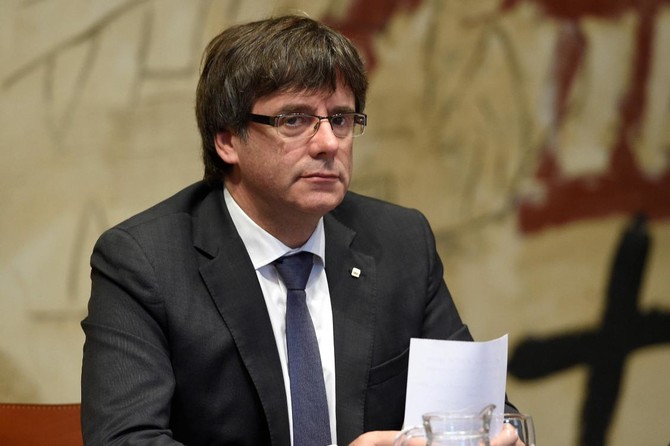
Catalan President Carles Puigdemont told the BBC in remarks published on Wednesday that his government would ask the region’s parliament to declare independence after tallying votes from last weekend’s referendum, which Madrid deems illegal.
His comment appeared after Spain’s King Felipe VI accused secessionist leaders on Tuesday of shattering democratic principles and dividing Catalan society, as tens of thousands protested against a violent police crackdown on Sunday’s vote.
“We are to declare independence 48 hours after all the official results are counted,” Puigdemont said in remarks posted on the BBC’s website.
“This will probably finish once we get all the votes in from abroad at the end of the week and therefore we shall probably act over the weekend or early next week.”
Puigdemont is due to make a statement at 9 p.m. (1900 GMT) on Wednesday.
Spain has been rocked by the Catalan vote and the Spanish police response to it, which saw batons and rubber bullets used to prevent people voting. Hundreds were injured, in scenes that brought international condemnation.
Catalans came out onto the streets on Tuesday to condemn the police action, shutting down road traffic, public transport and businesses, and ratcheting up fears of intensifying unrest in a region that makes up one-fifth of the Spanish economy.
Spain’s worst crisis in decades has shaken the euro and sharply increased Madrid’s borrowing costs, while banks led a fall in Spanish stocks on Wednesday.
Spanish Economy Minister Luis de Guindos sought to ease the anxieties of investor and customers. “Catalan banks are Spanish banks and European banks are solid and their clients have nothing to fear,” he said on the sidelines of a conference in Madrid.
Caixabank, Catalonia’s largest lender, said in an internal memo to employees late on Tuesday that its only objective was to “protect clients’, shareholders’ and employees’ interests.”
“IRRESPONSIBLE BEHAVIOUR“
Spain’s prime minister Mariano Rajoy, a conservative who has taken a hard-line stance on the issue, faces a huge challenge to see off Catalan independence without further unrest.
European Council President Donald Tusk has backed his constitutional argument but some fellow members of the bloc have criticized his tactics. Tusk has appealed to Rajoy to seek ways to avoid escalation in Catalonia and the use of force.
Brussels has in the past given little or no encouragement to separatist movements inside the European Union, whether those of the Catalans, Scots, Flemings or others.
Pro-independence parties who control the regional government had staged the referendum in defiance of the Constitutional Court, which had ruled that the vote violated Spain’s 1978 constitution which states the country is indivisible.
Catalonia has its own language and culture and a political movement for secession that has strengthened in recent years.
Participants in Sunday’s ballot — only about 43 percent of eligible voters — opted overwhelmingly for independence, a result that was expected since residents who favor remaining part of Spain mainly boycotted the referendum.
Outside of Catalonia, Spaniards mostly hold strong views against its independence drive. In his televised address, the king said the “irresponsible behavior” of the Catalan leaders had undermined social harmony in the region.
“Today Catalan society is fractured and in conflict,” he said. “They (the Catalan leaders) have infringed the system of legally approved rules with their decisions, showing an unacceptable disloyalty toward the powers of the state.”
The king said the crown was strongly committed to the Spanish constitution and to democracy and underlined his commitment to the unity and permanence of Spain. He had earlier met Rajoy to discuss the situation in Catalonia.
Opinion polls conducted before the vote suggested a minority of around 40 percent of residents in the region backed independence. But a majority wanted a referendum to be held, and the violent police crackdown angered Catalans across the divide.


![]()
Catalonia to declare independence from Spain as soon as weekend -leader
Catalonia to declare independence from Spain as soon as weekend -leader
Latest updates


© 2026 SAUDI RESEARCH & PUBLISHING COMPANY, All Rights Reserved And subject to Terms of Use Agreement.