LONDON: The International Energy Agency (IEA) has raised its forecasts for renewable energy over the next five years following a record 2016, mainly driven by a surge in solar photovoltaic (PV) capacity in China, India and the US.
In its medium-term renewables market report, the IEA expects global renewable electricity capacity to rise by more than 920 gigawatts, or 43 percent, by 2022, due to supportive policies for low-carbon energy and cost reductions for solar PV and wind.
The projected growth is 12 percent more bullish than the IEA’s forecast last year.
In 2016, net additions to renewable energy capacity — including hydropower, solar, wind, bioenergy, wave and tidal — set another world record, growing by 165 gigawatts (GW), 6 percent more than in 2015, the report said.
Solar PV capacity grew by 50 percent to reach more than 74 GW last year and it was the first time solar PV additions rose faster than any other fuel, surpassing the net growth in coal.
“We see renewables growing by about 1,000 GW by 2022, which equals about half of the current global capacity in coal power, which took 80 years to build,” Fatih Birol, the IEA’s executive director, said in a statement.
“What we are witnessing is the birth of a new era in solar PV. We expect that solar PV capacity growth will be higher than any other renewable technology through 2022,” Birol added.
The Paris-based IEA, the West’s leading energy forecaster, had been criticized by environment campaigners in previous years for underestimating the growth of renewables and over-emphasizing the continued role of fossil fuels.
The agency sees renewable power generation rising by more than a third to 8,169 terawatt-hours (TWh) in 2022 — from around 6,012 TWh in 2016 — which is equivalent to the combined electricity consumption of China, India and Germany.
Renewables will account for 29 percent of the global energy mix in five years’ time, compared to the 24 percent forecast last year.
“While coal remains the largest source of electricity generation in 2022, renewables close in on its lead. In 2016, renewable generation was 34 percent less than coal but by 2022 this gap will be halved to just 17 percent,” the report said.
China will be responsible for the largest amount of global renewable capacity growth, driven by strong government targets, economic incentives and air pollution concerns.
Despite policy uncertainty, the United States will remain the second-largest renewables growth market, mainly due to tax incentives and state-level policies for solar PV, the IEA said.
India’s renewable electricity growth could surpass the EU’s by 2022 for it to become the joint second-largest growth market alongside the US as it is seen more than doubling its current capacity.


![]()
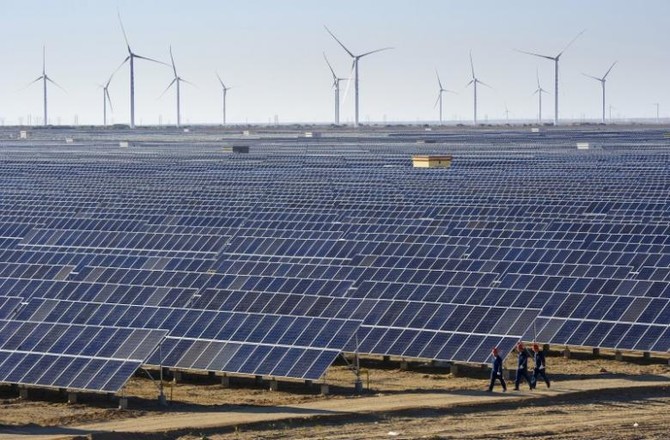
IEA lifts five-year renewables forecast after record 2016
IEA lifts five-year renewables forecast after record 2016


Latest updates


Recommended


© 2026 SAUDI RESEARCH & PUBLISHING COMPANY, All Rights Reserved And subject to Terms of Use Agreement.