Investcorp eyes businesses linked to Saudi Aramco

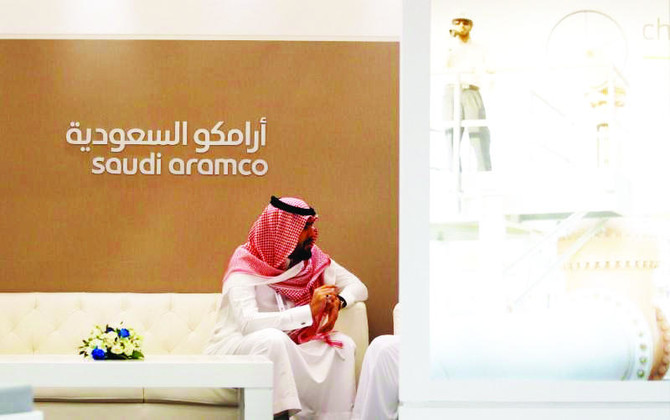
Investcorp said it is eyeing businesses that ‘live around Aramco’ such as chemicals companies and could consider buying Saudi Aramco’s assets that are sold off after its planned listing in 2018. (Reuters)
Updated 03 October 2017
Follow

Investcorp eyes businesses linked to Saudi Aramco

ABU DHABI: Bahrain-listed Investcorp aims to invest in companies that support oil giant Saudi Aramco and is also eyeing health care and education assets being sold in Saudi Arabia’s privatization drive, its executive chairman said.
The private equity and alternative asset firm, which has offices around the world, aims to more than double investments to $50 billion in five years by expanding existing businesses and through acquisitions in areas such as infrastructure.
“We are going to invest in the future of Saudi Arabia,” Mohammed Mahfoodh Alardhi told Reuters in Abu Dhabi.
The firm is eyeing businesses that “live around Aramco” such as chemicals companies and could consider buying Aramco assets that are sold off after its planned listing in 2018, he said.
Riyadh plans to sell about 5 percent of Aramco in an initial public offering (IPO), raising about $100 billion to invest in industries outside the oil sector, part of the Kingdom’s “Vision 2030” plan that aims to wean the nation off reliance on oil.
Saudi Aramco has some non-oil assets, such as a soccer stadium and projects to manage floodwater drainage in Jeddah. Some non-oil businesses could be sold off, sources say.
Investcorp is planning launch a $750 million health care fund, with part of that investment earmarked for Saudi Arabia.
“One of the things that this transformation is going to do in Saudi Arabia is take a lot of burden from the government and put that on the private sector,” Alardhi said. “One of them that we are very interested in is health care.”
Investcorp bought a stake last year in Saudi Arabia’s Al Borg Medical Laboratories, one of the largest private medical laboratory chains in the Gulf. It did not disclose the stake size, although a source said it was looking at 30 to 40 percent.
Under Alardhi, a former Omani air force chief who became the firm’s executive chairman in 2015, Investcorp has more than doubled its assets under his management, which have risen to $21.3 billion by end of June from $10.8 billion.
Alardhi said it wanted that figure to rise to $50 billion in five years, partly by expanding into new areas such as infrastructure and secondary market activities in private equity, as well as investing in growing markets like China.
Alardhi said Investcorp was working on 15 offerings for investors, which included sales of stakes in companies and other structured financial products. He did not give a timeline.
“Our global footprint is increasing, our brand is strengthening – we are no more just a bridge between the Gulf and North America,” he said.


Saudi investment hits 32% of GDP, non-oil fixed capital reaches 40%, minister says

Updated 05 January 2026
Follow

Saudi investment hits 32% of GDP, non-oil fixed capital reaches 40%, minister says

RIYADH: Saudi Arabia’s investment now accounts for 32 percent of gross domestic product, with non-oil fixed capital at 40 percent, according to the minister responsible for portfolio.

Speaking during his visit to the Shoura Council, Khalid Al-Falih said that foreign direct investment is expected to grow fivefold, signaling strong Vision 2030 progress.

“Regarding cumulative performance, the Kingdom has exceeded all expectations, achieving high levels of investment,” Al-Falih said, according to a video posted on Al-Ekhbariya’s X account focused on economic matters.

The minister added: “Today, investment accounts for 32 percent of the total GDP. In terms of non-oil GDP, fixed capital represents 40 percent, compared with 41 percent in China, the highest globally.”

If we take the non-oil GDP, he said, fixed capital will make 40 percent. “China is the largest globally with 41 percent. So, we will rank second if we compare it to the non-oil economy and fourth when measured against total GDP,” Al-Falih said.

He emphasized that the Kingdom offers an investment-attractive environment, noting that when focusing on foreign direct investment rather than overall investment, Saudi Arabia ranks among the world’s highest.

The minister of investment added that FDI is expected to grow fivefold by the end of 2025, though these data require confirmation, stressing that this is “a big indicator for the success of Saudi Vision 2030.”

During his address to the session, Al-Falih emphasized that Saudi Vision 2030 prioritizes economic diversification and reducing dependence on oil, through boosting the private sector’s contribution to inclusive economic development, supporting national sectoral priorities, and driving growth in the Kingdom’s GDP.

He highlighted key initiatives enabling the private sector, including the establishment of the Ministry of Investment and the Saudi Investment Promotion Authority, the launch of the “Shareek” program, the development of the National Investment Strategy, and linking all stakeholders in the investment ecosystem.

“The Cabinet’s adoption of the National Investment Strategy, launched by Crown Prince in 2021 and implemented in 2022 as a comprehensive national framework, has played a major role in positioning investment as a driver of economic growth,” he said.

Al-Falih revealed that the ministry has identified more than 2,000 investment opportunities worth over SR1 trillion ($267 billion), noting that 346 of these opportunities have been converted into closed deals valued at over SR231 billion through the “Invest Saudi” platform.

He also highlighted the success of the regional headquarters attraction program, with licenses issued to more than 700 global companies by the end of 2025, surpassing the 2030 target of 500 companies, across diverse sectors that reinforce Saudi Arabia’s role as a regional business hub.

The minister revealed that active investment licenses have grown tenfold, rising from 6,000 in 2019 to 62,000 by the end of 2025, highlighting the role of companies in creating over one million jobs, including numerous positions for Saudi nationals.

Al-Falih noted the Kingdom’s success in attracting 20 of the world’s top 30 banks, as part of efforts to strengthen the presence of leading asset managers and international banks in support of the Saudi banking sector.

He also discussed reforms to enhance the business environment, such as the Civil Transactions Law, Companies Law, and the updated Investment Law issued in mid-2024, which contributed to Saudi Arabia moving up 15 places in the global competitiveness ranking.

The minister also announced the update of the National Investment Strategy in 2025, focusing on quality, productivity, and directing investments toward sectors with the highest economic impact, while developing financing solutions for SMEs.