Tougher laws should not be ‘only’ tactic in fight against online extremism

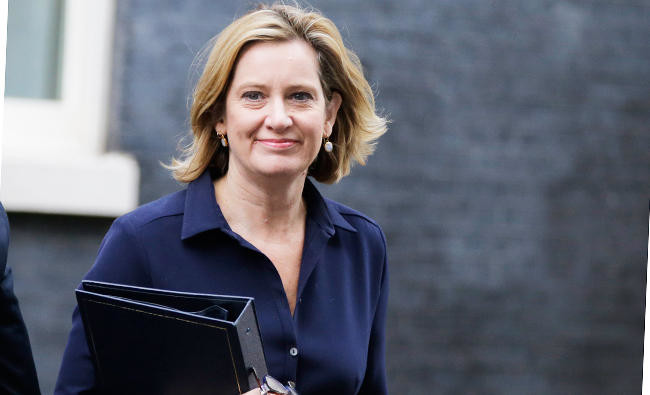
Britain's Home Secretary Amber Rudd looks at the media as she arrives for a Cabinet meeting at 10 Downing Street, in London, in this Sept. 21, 2017 photo. (AP)
Updated 04 October 2017
Follow

Tougher laws should not be ‘only’ tactic in fight against online extremism

LONDON: Tougher laws and harsh prison sentences should not be the only method of tackling the threat of terrorism, warn campaigners and academics as governments across Europe look to ramp up their anti-terror legislation.
The UK’s home secretary Amber Rudd announced plans on Tuesday to change the law to be able to sentence people who repeatedly view terrorist content online for up to 15 years in jail. Currently people can only be convicted of an offense if they download or store this material rather than view or stream it online.
It is a “critical difference” to the law, she said during a speech at the Conservative Party conference in Manchester.
Someone who publishes information on the UK police or armed forces for the purposes of preparing a terror attack could also face up to 15 years in jail, she said.
Her speech comes after a series of attacks by radical extremists across Europe this year, and on the same day as French MPs voted on an anti-terrorism law that could increase police powers.
Rudd also told the conference that social media and technology companies must do more to tackle online extremism.
That was a move welcomed by the Counter Extremism Project, a non-profit group based in London and New York. “Amber Rudd is correct, extremist content is too easily accessible and not enough is being done presently to pressure Internet and social media companies to more quickly and permanently remove extremist and terrorist content,” said executive director David Ibsen.
Others warn that some of Rudd’s tougher policies may have potentially negative and unintended consequences.
“Whilst we understand the Home Secretary’s intentions in changing the law in terms of viewing extremist material and the punishment served, we should not be complacent to think that this will eradicate extremism from our society,” said Saida Mughal, CEO of the Jan Trust, an organization that works with women — mainly mothers — to counter online extremism. Mughal is also a survivor of the London 7/7 bombings in July 2015.
“It may even push some to the more old-fashioned ways of being radicalized such as groups and study circle. Our government needs to drive on the bottom-up approach where communities are fully equipped to change hearts and minds,” she said.
Rik Coolsaet, professor of international relations at Ghent University in Belgium, wrote in a report published Tuesday that more grassroots efforts across Europe — such as working with vulnerable young people — are needed to prevent radicalization.
“Prevention will always be cheaper than intervention,” he wrote in a report looking at the current and potentially dwindling influence of Daesh. Coolsaet questions whether the group even holds the online allure that it once did.
“Daesh’s global media output has decreased significantly, and the golden age of its Twitter presence has definitely passed,” he wrote.
Hamed El-Said, professor of international business and political economy at Manchester Metropolitan University, said that filling up the UK’s prisons with those convicted of terror offenses is not the answer either.
“Prison alone is not a solution for this type of crime and it risks radicalizing individuals further to a point where they might start to believe that they are justified in resorting to violence. And that’s exactly what we want to avoid,” he said.
The UK prison system is not adequately equipped to prevent those convicted from becoming further radicalized, he said.
“Prison itself lacks comprehensive and effective deradicalization program that can achieve successfully rehabilitation and peaceful and compliant reintegration into society with minimum risks to the public,” he said.
During the first half of the year, only a handful of sentences of 15 years or more where handed out to defendants convicted of terror-related offenses, according to Home Office data.
The most common sentence length for defendants tried and convicted by the Crown Prosecution Service for a terrorism-related offense was between four and 10 years, with 26 defendants receiving this sentence in the first half of the year.


Britain’s Starmer seeks to bolster China ties despite Trump warning

Updated 4 sec ago
Follow

Britain’s Starmer seeks to bolster China ties despite Trump warning

  • “The UK has got a huge amount to offer,” he said in a short speech at the UK-China Business Forum at the Bank of China

SHANGHAI: Visiting Prime Minister Keir Starmer said on Friday Britain has a “huge amount to offer” China, after his bid to forge closer ties prompted warnings from US President Donald Trump.
Starmer’s trip is the first to China by a British prime minister in eight years, and follows in the footsteps of other Western leaders looking to counter an increasingly volatile United States.
Leaders from France, Canada and Finland have flocked to Beijing in recent weeks, recoiling from Trump’s bid to seize Greenland and tariff threats against NATO allies.
Trump warned on Thursday it was “very dangerous” for Britain to be dealing with China.
Starmer brushed off those comments on Friday, noting that Trump was also expected to visit China in the months ahead.
“The US and the UK are very close allies, and that’s why we discussed the visit with his team before we came,” Starmer said in an interview with UK television.
“I don’t think it is wise for the UK to stick its head in the sand. China is the second-largest economy in the world,” he said.
Asked about Trump’s comments on Friday, Beijing’s foreign ministry said “China is willing to strengthen cooperation with all countries in the spirit of mutual benefit and win-win results.”
Starmer met top Chinese leaders, including President Xi Jinping and Premier Li Qiang, on Thursday, with both sides highlighting the need for closer ties.
He told business representatives from Britain and China on Friday that both sides had “warmly engaged” and “made some real progress.”
“The UK has got a huge amount to offer,” he said in a short speech at the UK-China Business Forum at the Bank of China.
The meetings the previous day provided “just the level of engagement that we hoped for,” Starmer said.
He signed a series of agreements on Thursday, with Downing Street announcing Beijing had agreed to visa-free travel for British citizens visiting China for under 30 days, although Starmer acknowledged there was no start date for the arrangement yet.
The Chinese foreign ministry said only that it was “actively considering” the visa deal and would “make it public at an appropriate time upon completing the necessary procedures.”
Starmer hailed the agreements as “symbolic of what we’re doing with the relationship.”
He also said Beijing had lifted sanctions on UK lawmakers targeted since 2021 for their criticism of alleged human rights abuses against China’s Muslim Uyghur minority.
“President Xi said to me that that means all parliamentarians are welcome,” Starmer said in an interview with UK television.
He traveled from Beijing to economic powerhouse Shanghai, where he spoke with Chinese students at the Shanghai International College of Fashion and Innovation, a joint institute between Donghua University and the University of Edinburgh.

- Visas and whisky -

The visa deal could bring Britain in line with about 50 other countries granted visa-free travel, including France, Germany, Australia and Japan, and follows a similar agreement made between China and Canada this month.
The agreements signed included cooperation on targeting supply chains used by migrant smugglers, as well as on British exports to China, health and strengthening a bilateral trade commission.
China also agreed to halve tariffs on British whisky to five percent, according to Downing Street.
British companies sealed £2.2 billion in export deals and around £2.3 billion in “market access wins” over five years, and “hundreds of millions worth of investments,” Starmer’s government said in a statement.
Xi told Starmer on Thursday that their countries should strengthen dialogue and cooperation in the context of a “complex and intertwined” international situation.
Relations between China and the UK deteriorated from 2020 when Beijing imposed a national security law on Hong Kong and cracked down on pro-democracy activists in the former British colony.
However, China remains Britain’s third-largest trading partner, and Starmer is hoping deals with Beijing will help fulfil his primary goal of boosting UK economic growth.
British pharmaceutical group AstraZeneca said on Thursday it would invest $15 billion in China through 2030 to expand its medicines manufacturing and research.
And China’s Pop Mart, makers of the wildly popular Labubu dolls, said it would set up a regional hub in London and open 27 stores across Europe in the coming year, including up to seven in Britain.
Starmer will continue his Asia trip with a brief stop in Japan on Saturday to meet Prime Minister Sanae Takaichi.