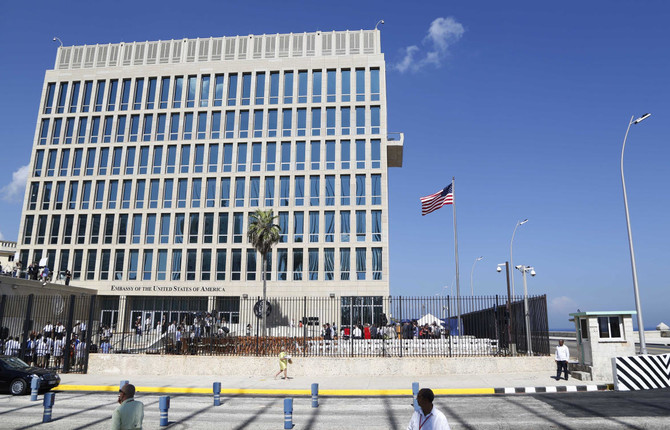
WASHINGTON: The US on Tuesday ordered the expulsion of 15 Cuban diplomats, accusing Havana of failing to protect American diplomats following a series of mysterious incidents in which embassy staff were sickened.
Secretary of State Rex Tillerson said, however, that the United States would continue to maintain diplomatic relations with Cuba even though the size of the US mission in Havana also would be reduced to a minimum.
“The decision was made due to Cuba’s failure to take appropriate steps to protect our diplomats in accordance with its obligations under the Vienna Convention,” he said in a statement.
“This order will ensure equity in our respective diplomatic operations,” he said.
“Until the government of Cuba can ensure the safety of our diplomats in Cuba, our embassy will be reduced to emergency personnel to minimize the number of diplomats at risk of exposure to harm,” Tillerson said.
The attacks, initially described as emanating from some sort of acoustic device, have affected at least 22 US embassy staff in Havana over the past few months.
Those affected have exhibited physical symptoms including ear complaints, hearing loss, dizziness, headache, fatigue, cognitive issues, and difficulty sleeping.
The US will “continue to maintain diplomatic relations with Cuba, and will continue to cooperate with Cuba as we pursue the investigation into these attacks,” he added.
US relations with Havana were only fully restored in 2015, and have deteriorated since President Donald Trump took office in January.
In late September, Tillerson said he was withdrawing more than half the personnel from its embassy in Cuba in response to the mysterious attacks.

US to expel 15 Cuban diplomats after 'attacks' on embassy staff in Havana
Kim unveils homes for kin of North Korean troops killed aiding Russia: KCNA
SEOUL: North Korean leader Kim Jong Un touted a newly built street of flats for families of soldiers killed supporting Russia’s war against Ukraine, state media reported Monday, with photos showing him accompanied by his daughter.
North Korea has deployed thousands of troops to fight for Russia, according to South Korean and Western intelligence agencies, and Seoul has estimated that around 2,000 have been killed.
Analysts say North Korea is receiving financial aid, military technology and food and energy supplies from Russia in return.
“The new street has been built thanks to the ardent desire of our motherland that wishes that... its excellent sons, who defended the most sacred things by sacrificing their most valuable things, will live forever,” Kim said in a speech released by the official Korean Central News Agency.
The report on Monday did not mention Russia, but Kim last week pledged to “unconditionally support” all of Russian President Vladimir Putin’s policies and decisions.
“Before their death, the heroic martyrs must have pictured in their mind’s eye their dear families living in the ever-prospering country,” he added.
Photos released by KCNA show Kim touring the new homes built for the families on Saeppyol Street, alongside his teenage daughter Ju Ae, widely viewed as his heir apparent.
Seoul’s spy agency said last week she had now been clearly “designated as a successor,” citing her participation in high-profile events with her father.
One photo shows Kim speaking with what appeared to be the family members of a fallen soldier on a sofa, his daughter standing behind them.
Other photos show families checking the utilities in their new flats.
The rollout comes ahead of Pyongyang’s biggest political event on the calendar — the party congress — scheduled to take place later this month, although the exact date has not been announced.
Attention is on which foreign and domestic policy directions Kim will declare to set the country’s course, as well as whether Ju Ae will be given any official party titles.
The timing of the street inauguration is a “highly calculated political move to justify its soldier deployment” ahead of the party congress, Hong Min, an analyst at the Korea Institute for National Unification, told AFP.
“It visualizes the state providing concrete compensation to the families of fallen soldiers... as a symbolic showcase,” he said.
North Korea has deployed thousands of troops to fight for Russia, according to South Korean and Western intelligence agencies, and Seoul has estimated that around 2,000 have been killed.
Analysts say North Korea is receiving financial aid, military technology and food and energy supplies from Russia in return.
“The new street has been built thanks to the ardent desire of our motherland that wishes that... its excellent sons, who defended the most sacred things by sacrificing their most valuable things, will live forever,” Kim said in a speech released by the official Korean Central News Agency.
The report on Monday did not mention Russia, but Kim last week pledged to “unconditionally support” all of Russian President Vladimir Putin’s policies and decisions.
“Before their death, the heroic martyrs must have pictured in their mind’s eye their dear families living in the ever-prospering country,” he added.
Photos released by KCNA show Kim touring the new homes built for the families on Saeppyol Street, alongside his teenage daughter Ju Ae, widely viewed as his heir apparent.
Seoul’s spy agency said last week she had now been clearly “designated as a successor,” citing her participation in high-profile events with her father.
One photo shows Kim speaking with what appeared to be the family members of a fallen soldier on a sofa, his daughter standing behind them.
Other photos show families checking the utilities in their new flats.
The rollout comes ahead of Pyongyang’s biggest political event on the calendar — the party congress — scheduled to take place later this month, although the exact date has not been announced.
Attention is on which foreign and domestic policy directions Kim will declare to set the country’s course, as well as whether Ju Ae will be given any official party titles.
The timing of the street inauguration is a “highly calculated political move to justify its soldier deployment” ahead of the party congress, Hong Min, an analyst at the Korea Institute for National Unification, told AFP.
“It visualizes the state providing concrete compensation to the families of fallen soldiers... as a symbolic showcase,” he said.
© 2026 SAUDI RESEARCH & PUBLISHING COMPANY, All Rights Reserved And subject to Terms of Use Agreement.