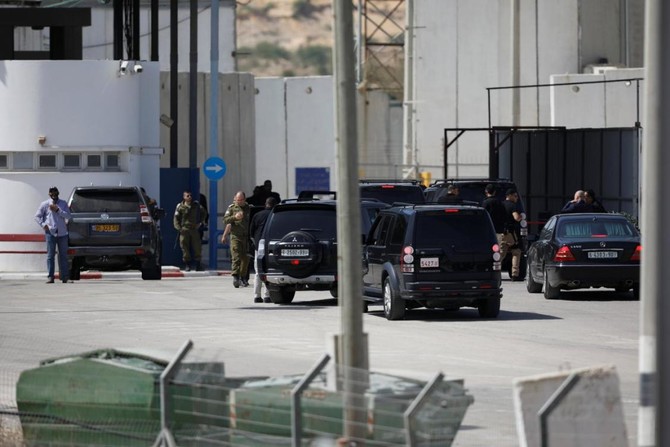
GAZA: Prime Minister Rami Al-Hamdallah on Tuesday chaired the first meeting of the Palestinian cabinet in Gaza for three years in a move toward reconciliation between the mainstream Fatah party and Islamist group Hamas.
Hamas seized the Gaza Strip in 2007 in fighting with Fatah forces loyal to President Mahmoud Abbas and has ruled the impoverished desert enclave of two million people since then.
The cabinet session was the first in Gaza since 2014, Hamdallah told his ministers, and a major step in a reconciliation process promoted by neighboring Egypt and other US-allied Arab countries.
“Today, we stand before an important, historical moment as we begin to get over our wounds, put our differences aside and place the higher national interest above all else,” he said.
Hamas, considered a terrorist group by Israel and the West, last month disbanded its Gaza shadow government after Egypt, Saudi Arabia and the United Arab Emirates imposed an economic boycott on its main donor, Qatar.
But while Hamas handed over administrative responsibilities to a unity government originally formed three years ago, its armed wing remains the dominant force in Gaza.
“We understand that returning official institutions to their legitimate and legal framework and ending all the impacts of division will require exhausting efforts and a lot of patience, of time and of wisdom,” he said.
Abbas told Egyptian TV station CBC on Monday there could be only “one state, one regime, one law and one weapon” in the Gaza Strip, reiterating a long-held position that security should only be in the hands of the Palestinian Authority (PA).
Abbas is based in the Israeli-occupied West Bank and heads the PA government that administers limited self rule in the territory.
A PA spokesman said Abbas would not lift sanctions on Gaza at this stage but rather await the outcome of talks planned between Fatah and Hamas in the next two weeks.
Pressuring Hamas to loosen its grip on Gaza, he halted payments for Israeli-supplied electricity to the enclave in June, a step that has led to lengthy, daily blackouts. He also withheld salaries for Gaza civil servants.
“Everything must be in the hands of the Palestinian Authority, it must be the one to control the crossing points (in and out of Gaza),” he said. Both Israel and Egypt maintain a partial blockade of Gaza, citing security concerns.
Under previous understandings, some 3,000 Fatah security men would be integrated gradually into a Gaza police force overseen by an Interior Ministry headed by Hamdallah. Hamas’s armed wing, analysts say, has at least 25,000 well-equipped fighters.
The United States, which is trying to revive Israeli-Palestinian peace talks that collapsed in 2014, is watching developments closely with the aim of improving humanitarian conditions in Gaza, Jason Greenblatt, US President Donald Trump’s Middle East envoy, said on Twitter.
But Greenblatt said: “The United States stresses that any Palestinian government must unambiguously and explicitly commit to non-violence, recognition of the State of Israel, acceptance of previous agreements and obligations between the parties, and peaceful negotiations.”
Hamas has long rejected those conditions.

Palestinian cabinet convenes in Gaza in move to reconcile with Hamas
Justice Department sees no basis for civil rights probe in Minnesota ICE shooting, official says
- And on Tuesday, Deputy Attorney General Todd Blanche said in a statement that “there is currently no basis for a criminal civil rights investigation”
WASHINGTON: The Justice Department does not believe there is currently any basis to open a criminal civil rights investigation into the killing of a woman by a US Immigration and Customs Enforcement officer in Minneapolis, a top department official said Tuesday.
The decision to keep the Justice Department’s Civil Rights Division out of the investigation into the fatal shooting of Renee Good marks a sharp departure from past administrations, which have moved quickly to probe shootings of civilians by law enforcement officials for potential civil rights offenses.
While an FBI probe is ongoing, lawyers in the Civil Rights Division were informed last week that they would not play a role in the investigation at this time, according to two people familiar with the matter who spoke on the condition of anonymity to discuss internal department deliberations.
And on Tuesday, Deputy Attorney General Todd Blanche said in a statement that “there is currently no basis for a criminal civil rights investigation.” The statement, first reported by CNN, did not elaborate on how the department had reached a conclusion that no investigation was warranted.
Federal officials have said that the officer acted in self-defense and that the driver of the Honda was engaging in “an act of domestic terrorism” when she pulled forward toward him.
The quick pronouncement by administration officials before any meaningful investigation could be completed has raised concerns about the federal government’s determination to conduct a thorough review of the chain of events precipitating the shooting. Minnesota officials have also raised alarm after federal officials blocked state investigators from accessing evidence and declared that Minnesota has no jurisdiction to investigate the killing.
Also this week, roughly half a dozen federal prosecutors in Minnesota resigned and several supervisors in the criminal section of the Civil Rights Division in Washington gave notice of their departures amid turmoil over the federal probe, according to people familiar with the matter.
Among the departures in Minnesota is First Assistant US Attorney Joseph Thompson, who had been leading the sprawling investigation and prosecution of fraud schemes in the state, two other people said. At least four other prosecutors in the Minnesota US attorney’s office joined Thompson in resigning amid a period of tension in the office, the people said. The people spoke on the condition of anonymity to discuss personnel matters.
They are the latest in an exodus of career Justice Department attorneys who have resigned or been forced out over concerns over political pressure or shifting priorities under the Trump administration. Hundreds of Justice Department lawyers have been fired or have left voluntarily over the last year.
Minnesota Democratic lawmakers criticized the departures, with Sen. Amy Klobuchar, a member of the Senate Judiciary Committee, calling the resignations “a loss for our state and for public safety” and warning that prosecutions should not be driven by politics. Gov. Tim Walz said the departures raised concerns about political pressure on career Justice Department officials.
The resignations of the lawyers in the Civil Rights Division’s criminal section, including its chief, were announced to staff on Monday, days after lawyers were told the section would not be involved in the probe. The Justice Department on Tuesday said those prosecutors had requested to participate in an early retirement program “well before the events in Minnesota,” and added that “any suggestion to the contrary is false.”
Founded nearly 70 years ago, the Civil Rights Division has a long history of investigating shootings by law enforcement even though prosecutors typically need to clear a high bar to mount a criminal prosecution.
In prior administrations, the division has moved quickly to open and publicly announce such investigations, not only to reflect federal jurisdiction over potential civil rights violations but also in hopes of soothing community angst that sometimes accompanies shootings involving law enforcement.
“The level of grief, tension and anxiety on the ground in Minnesota is not surprising,” said Kristen Clarke, who led the Civil Rights Division under the Biden administration. “And historically the federal government has played an important role by being a neutral and impartial agency committing its resources to conducting a full and fair investigation, and the public loses out when that doesn’t happen,” she said.
In Minneapolis, for instance, the Justice Department during the first Trump administration opened a civil rights investigation into the 2020 death of George Floyd at the hands of city police officers that resulted in criminal charges. The Minneapolis Police Department was separately scrutinized by the Biden administration for potential systemic civil rights violations through what’s known as a “pattern or practice” investigation, a type of police reform inquiry that is out of favor in the current Trump administration Justice Department.