LONDON: British authorities are scrambling to bring home 110,000 travelers after Monarch Airlines collapsed Monday, canceling all flights by what had been Britain’s fifth biggest carrier.
The Civil Aviation Authority said it has leased 30 aircraft to transport Monarch customers scattered around holiday destinations ranging from Turkey to Spain and Sweden. Flights will be provided at no additional cost to passengers.
“This is a hugely distressing situation for British holidaymakers abroad, and my first priority is to help them get back to the UK,” Transport Secretary Chris Grayling said in a statement. “That is why I have immediately ordered the country’s biggest ever peacetime repatriation to fly about 110,000 passengers who could otherwise have been left stranded.”
Monarch ceased operations after failing to reach a deal with regulators to extend the company’s license to sell package holidays to overseas destinations. Monarch Chief Executive Andrew Swaffield said the airline’s troubles stemmed from recent terror attacks in Egypt and Tunisia and the “decimation” of the tourist trade in Turkey.
The airline had tried to pivot from short-haul flights to long-haul travel to reduce losses as consumers shied away from Middle Eastern and North African destinations after the June 2015 attack on tourists at a resort in Tunisia, the bombing of a Russian airliner that had taken off from Sharm el-Sheikh, Egypt, a few months later and the attempted coup in Turkey in 2016.
The CAA is advising Monarch customers who are trying to get home from abroad to visit the agency’s website for information about their flights. Passengers who were preparing to leave the UK on Monarch flights should not go to the airport.
The first repatriation flight carrying 165 passengers from the Spanish resort island of Ibiza has already arrived at London’s Gatwick Airport, the aviation authority said.
“The scale and challenge of this operation means that some disruption is inevitable,” agency CEO Andrew Haines said. “We ask customers to bear with us as we work around the clock to bring everyone home.”
Monarch’s collapse represents the biggest ever failure of a British airline.
The Unite union, which represents around 1,800 engineers and cabin crew working for Monarch, claimed that the government rebuffed requests to provide a bridging loan that would have helped the airline keep operating.
The airline said companies affected by its failure include Monarch Airlines, Monarch Holidays, First Aviation, Avro, and Somewhere2stay.
“All future holidays and flights provided by these companies have been canceled and are no longer operating,” the company said.
Greybull Capital, which owns The Monarch Group, issued a statement saying it was “deeply saddened” by the airline’s failure. It said it was working with regulators to minimize disruptions.
— REUTERS


![]()
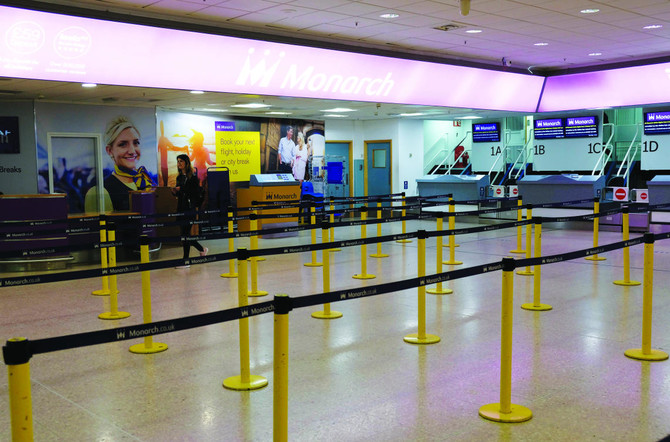
Monarch chief blames collapse on terror attacks
Monarch chief blames collapse on terror attacks

Latest updates


Recommended


© 2026 SAUDI RESEARCH & PUBLISHING COMPANY, All Rights Reserved And subject to Terms of Use Agreement.