


Spain in crisis after police violence in Catalan vote

People shout slogans as they wave Catalan pro-independence 'Estelada' flags during a protest in Barcelona on Monday, October 2, 2017, a day after hundreds were injured in a police crackdown during Catalonia's banned independence referendum. (AFP / PIERRE-PHILIPPE MARCOU)
Updated 02 October 2017
Follow

Spain in crisis after police violence in Catalan vote

MADRID: Spain came under international pressure Monday to resolve a spiraling crisis with its Catalan region after a banned independence referendum was marred by shocking scenes of police violence.
The country’s central government vowed to stop its northeastern region breaking away from Spain after Catalonia’s leader claimed that 90 percent of voters backed independence in Sunday’s referendum, which Madrid says is unconstitutional and a “farce.”
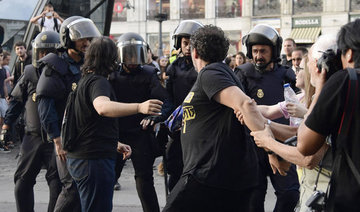
Abroad, the focus was on Sunday’s violence, which saw riot police move in on polling stations in towns and cities across the region to stop people from voting, in some cases baton-charging and firing rubber bullets to disperse crowds.
“We call on all relevant players to now move very swiftly from confrontation to dialogue. Violence can never be an instrument in politics,” European Commission spokesman Margaritis Schinas said, breaking weeks of virtual EU silence on the Catalan issue.
UN rights chief Zeid Ra’ad Al Hussein said he was “very disturbed” by the violence and urged the Spanish authorities to ensure a thorough and impartial investigation while EU President Donald Tusk urged Madrid to avoid “further use of violence.”
The European Parliament will hold a special debate on Wednesday on the referendum, the head of the assembly said.
In Catalan cities, many residents briefly stopped work at midday and descended onto the streets in silent, solemn protest.
In Barcelona, hundreds more stopped traffic as they rallied, many draped in the blue, yellow and red Estelada flag used by Catalan separatists, shouting “the streets will always be ours.”

No joy for Rajoy
The government of Prime Minister Mariano Rajoy was holding emergency talks after Catalan president Carles Puigdemont declared Sunday that the region — which accounts for a fifth of the nation’s GDP — had “won the right to an independent state.”
Puigdemont appealed for international mediation to help solve the crisis, and hinted he may be willing to drop the independence drive if that happened.
He also called for all police deployed to Catalonia from other parts of Spain for the vote to be removed.


The regional government said 2.26 million people took part in the vote, or just over 42 percent of the electorate in Catalonia.
But any attempt to unilaterally declare independence is likely to be opposed not just by Madrid but also a large section of the Catalan population, a region of 7.5 million people which is deeply split on the issue.
Rajoy reiterated his government’s position that the vote was an illegal act, to which the state had reacted “with firmness and serenity.”
Puigdemont has said he would now present the results to the region’s parliament, ruled by majority separatist lawmakers, which has the power to adopt a motion of independence.

'Resign!'
Several top figures in the far-left party Podemos called for Rajoy to resign over his handling of the crisis.
Shocking videos posted on social media showed police dragging voters from polling stations by their hair, throwing people down stairs and attacking Catalan firefighters protecting polling stations.
Puigdemont said close to 900 people had received medical attention, although Catalan authorities confirmed a total of 92 injured.
Four were hospitalized, two in serious condition — a 70-year-old man had a heart attack and another was hurt in his eye.
Adding to tensions, unions and Catalan associations have called a region-wide strike for Tuesday due to “the grave violation of rights and freedoms.”

'Biggest political crisis'
The Catalan situation is considered Spain’s biggest political crisis since an attempted military coup d’etat in 1981.
While Spanish newspapers were unanimous in criticizing Puigdemont for pushing ahead with the referendum despite a court ruling it unconstitutional, they also took aim at Rajoy’s handling of the crisis.
Rajoy will hold talks later Monday with the leader of the main opposition Socialist party, Pedro Sanchez, as well as Albert Rivera, the leader of the centrist party Ciudadanos, his minority government’s ally in parliament.
Justice Minister Rafael Catala said the government could invoke Article 155 of the constitution which would allow it to suspend the powers of Catalonia’s regional government in order to block any declaration of independence.
“That is a tool that is there... We have always said that we will use all the force of the law, all the mechanisms that the constitution and the laws grant the government,” he said in an interview with public television.
Some analysts said the images of the crackdown may help boost international support for the secessionists.
“Catalan secession remains unlikely, but separatist sentiment now has a momentum of its own,” said Federico Santi, an analyst at political risk consultancy Eurasia Group.
“The resulting institutional crisis will be severe and poses significant risks to Spain’s economic outlook.”
The euro and the Spanish stock market slid on Monday after the vote, with bank shares particularly hard hit.

Proposals on immigration enforcement flood into state legislatures, heightened by Minnesota action

Updated 16 January 2026
Follow

Proposals on immigration enforcement flood into state legislatures, heightened by Minnesota action

  • Oregon Democrats plan to introduce a bill to allow residents to sue federal officers for violating their Fourth Amendment rights against unlawful search and seizure

NASHVILLE, Tennessee: As Democrats across the country propose state law changes to restrict federal immigration officers after the shooting death of a protester in Minneapolis, Tennessee Republicans introduced a package of bills Thursday backed by the White House that would enlist the full force of the state to support President Donald Trump’s immigration crackdown.
Momentum in Democratic-led states for the measures, some of them proposed for years, is growing as legislatures return to work following the killing of Renee Good by an Immigration and Customs Enforcement officer. But Republicans are pushing back, blaming protesters for impeding the enforcement of immigration laws.

Democratic bills seek to limit ICE

Democratic Gov. Kathy Hochul wants New York to allow people to sue federal officers alleging violations of their constitutional rights. Another measure aims to keep immigration officers lacking judicial warrants out of schools, hospitals and houses of worship.
Oregon Democrats plan to introduce a bill to allow residents to sue federal officers for violating their Fourth Amendment rights against unlawful search and seizure.
New Jersey’s Democrat-led Legislature passed three bills Monday that immigrant rights groups have long pushed for, including a measure prohibiting state law enforcement officers from cooperating with federal immigration enforcement. Democratic Gov. Phil Murphy has until his last day in office Tuesday to sign or veto them.
California lawmakers are proposing to ban local and state law enforcement from taking second jobs with the Department of Homeland Security and make it a violation of state law when ICE officers make “indiscriminate” arrests around court appearances. Other measures are pending.
“Where you have government actions with no accountability, that is not true democracy,” Democratic state Sen. Scott Wiener of San Francisco said at a news conference.
Democrats also push bills in red states
Democrats in Georgia introduced four Senate bills designed to limit immigration enforcement — a package unlikely to become law because Georgia’s conservative upper chamber is led by Lt. Gov. Burt Jones, a close Trump ally. Democrats said it is still important to take a stand.
“Donald Trump has unleashed brutal aggression on our families and our communities across our country,” said state Sen. Sheikh Rahman, an immigrant from Bangladesh whose district in suburban Atlanta’s Gwinnett County is home to many immigrants.
Democrats in New Hampshire have proposed numerous measures seeking to limit federal immigration enforcement, but the state’s Republican majorities passed a new law taking effect this month that bans “sanctuary cities.”
Tennessee GOP works with White House on a response
The bills Tennessee Republicans are introducing appear to require government agencies to check the legal status of all residents before they can obtain public benefits; secure licenses for teaching, nursing and other professions; and get driver’s licenses or register their cars.
They also would include verifying K-12 students’ legal status, which appears to conflict with a US Supreme Court precedent. And they propose criminalizing illegal entry as a misdemeanor, a measure similar to several other states’ requirements, some of which are blocked in court.
“We’re going to do what we can to make sure that if you’re here illegally, we will have the data, we’ll have the transparency, and we’re not spending taxpayer dollars on you unless you’re in jail,” House Speaker Cameron Sexton said at a news conference Thursday.
Trump administration sues to stop laws
The Trump administration has opposed any effort to blunt ICE, including suing local governments whose “sanctuary” policies limit police interactions with federal officers.
States have broad power to regulate within their borders unless the US Constitution bars it, but many of these laws raise novel issues that courts will have to sort out, said Harrison Stark, senior counsel with the State Democracy Research Initiative at the University of Wisconsin Law School.
“There’s not a super clear, concrete legal answer to a lot of these questions,” he said. “It’s almost guaranteed there will be federal litigation over a lot of these policies.”
That is already happening.
California in September was the first to ban most law enforcement officers, including federal immigration officers, from covering their faces on duty. The Justice Department said its officers won’t comply and sued California, arguing that the laws threaten the safety of officers who are facing “unprecedented” harassment, doxing and violence.
The Justice Department also sued Illinois last month, challenging a law that bars federal civil arrests near courthouses, protects medical records and regulates how universities and day care centers manage information about immigration status. The Justice Department claims the law is unconstitutional and threatens federal officers’ safety.
Targeted states push back
Minnesota and Illinois, joined by their largest cities, sued the Trump administration this week. Minneapolis and Minnesota accuse the Republican administration of violating free speech rights by punishing a progressive state that favors Democrats and welcomes immigrants. Illinois and Chicago claim “Operation Midway Blitz” made residents afraid to leave their homes.
Homeland Security spokesperson Tricia McLaughlin accused Minnesota officials of ignoring public safety and called the Illinois lawsuit “baseless.”