Trump condemns Las Vegas mass shooting as ‘act of pure evil’

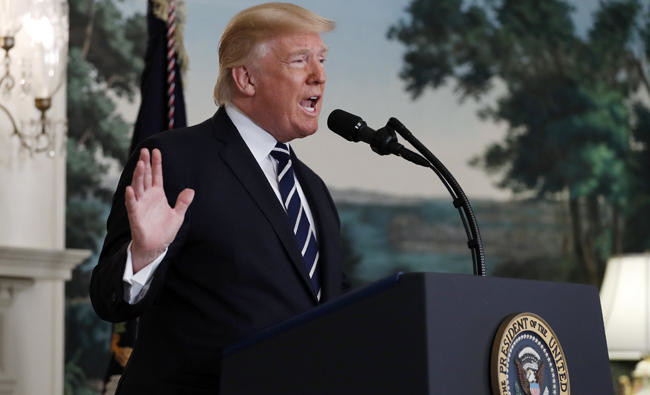
President Donald Trump speaks in the Diplomatic Reception Room of the White House in Washington on Monday, Oct. 2, 2017, about the mass shooting in Las Vegas. (AP Photo/Carolyn Kaster)
Updated 02 October 2017
Follow

Trump condemns Las Vegas mass shooting as ‘act of pure evil’

WASHINGTON: President Donald Trump on Monday condemned the largest mass shooting in modern US history as an “act of pure evil” and said the nation was “joined together in sadness, shock and grief” after more than 50 people were gunned down in Las Vegas.
Speaking slowly and somberly from the White House, Trump declared that the nation would rally together in the face of the latest act of senseless violence.
“Our unity cannot be shattered by evil, our bonds cannot be broken by violence,” the president said. “We call upon the bonds that unite us: our faith, our family, and our shared values. We call upon the bonds of citizenship, the ties of community, and the comfort of our common humanity.”
In the measured statement, Trump did not describe the gunman in any way or suggest any possible motivation or affiliation. He praised the first responders who he said prevented further loss of life and said he would visit Las Vegas on Wednesday. He offered condolences to the families of those killed, saying “We cannot fathom their pain. We cannot imagine their loss.”
“We are praying for you,” he said. “We are here for you.”
He also ordered that the American flag at the White House and at all public buildings across the nation be flown at half-staff.
Trump spoke hours after a gunman on the 32nd floor of a Vegas Strip casino unleashed a hail of bullets on an outdoor country music festival below. The gunman killed at least 50 people as tens of thousands of concertgoers screamed and ran for their lives.
More than 400 other victims were taken to hospitals, and investigators spent Monday morning combing the debris-strewn concert site along the iconic Vegas Strip.
Trump, who quoted from Scripture and invoked God several times, said he prays for the day when the “innocent are safe from hatred and from fear.”
“At times such as these I know we are searching for some type of meaning in the chaos, some kind of light in the darkness. The answers will not come easy,” the president said.
Hours earlier, he tweeted “my warmest condolences and sympathies to the victims and families of the terrible Las Vegas shooting. God bless you!” First Lady Melania Trump tweeted, “My heart and prayers goes out to victims, families & loved ones! #PrayForLasVegas“


White House spokeswoman Sarah Huckabee Sanders said that officials “are monitoring the situation closely and offer our full support to state and local officials.” She sad that the president had spoken to the governor of Nevada, the mayor of Las Vegas and the city’s sheriff.
The US Homeland Security Department said there was no “specific credible threat” involving other locations. Police have not yet determined a motive in the shootings.
SWAT teams using explosives stormed the gunman’s room in the Mandalay Bay hotel and found he had killed himself, authorities said. He had as many as 10 guns with him, including rifles, they said.
The gunman was identified as Stephen Craig Paddock, 64, of Mesquite, Nevada. He had checked into the hotel room on Thursday, authorities said.
Since Trump’s inauguration, there have been other mass shootings, including one in Texas last month, when a gunman killed eight and was fatally shot by police. But the Las Vegas attack is the deadliest in US history.
The president offered a somber response in June, after a shooting at a shooting at a congressional baseball practice that wounded five, including seriously injuring Rep. Steve Scalize. But Trump has drawn criticism for more inflammatory and self-referential reactions to other acts of violence.
After a shooting at a gay nightclub in Orlando that left 49 dead in 2016, he tweeted, “Appreciate the congrats for being right on radical Islamic terrorism.” In the wake of a deadly terror attack in London in June, Trump targeted the city’s mayor on Twitter, suggesting he wasn’t taking the attacks seriously enough.
After the June 2016 Orlando shooting, Trump — a presidential candidate competing in the GOP primary — called for a travel ban targeting Muslim-majority countries. The Orlando shooter, Omar Mateen, was born in New York to Afghan immigrants. After becoming radicalized online, he pledged his allegiance to the Daesh group.


“The bottom line is that the only reason the killer was in America in the first place was because we allowed his family to come here,” Trump said.
And he drew sharp bipartisan criticism in August when he suggested there was blame “on both sides” during a violent clash in Charlottesville, Virginia between white supremacists and anti-racist demonstrators that left one person dead.
Unlike his predecessor, Barack Obama, who often used mass shootings to call for stricter gun control measures, Trump made no mention of firearms restrictions on Monday.
During the presidential campaign, Trump cast himself as an ardent protector of the Second Amendment and proclaimed that if more “good guys” were armed with firearms there would be fewer gun tragedies. After the Orlando nightclub shooting, he suggested that if the club wasn’t a gun-free zone, someone would have been able to stop the bloodshed.
“When I said that if, within the Orlando club, you had some people with guns, I was obviously talking about additional guards or employees,” he tweeted in the days following the attack.
Trump has long offered strong support for gun rights. Earlier this year, he signed a resolution passed by the GOP-led Congress blocking an Obama-era rule designed to keep guns out of the hands of certain mentally disabled people.
Speaking to a gathering of the National Rifle Association in April, Trump told members they have a “true friend” in the White House.
But in the hours after the Las Vegas shooting, some in Washington did call for a review of the nation’s gun laws. Democratic Sen. Chris Murphy of Connecticut said it was time for Congress to end its inaction that followed other mass shootings, including the one in Orlando and the 2012 school shooting in his home state.


Ahead of strikes, Trump was told Iran attack is high risk, high reward

Updated 6 sec ago
Follow

Ahead of strikes, Trump was told Iran attack is high risk, high reward

  • Experts caution that the unfolding conflict could take dangerous turns and the first official said ‌the Pentagon’s planning did not appear to guarantee the outcome of any conflict

WASHINGTON: Ahead of the US attack on Iran, President Donald Trump received briefings that not only delivered blunt assessments about the risk of major US casualties but also touted the prospect of a geopolitical shift in the Middle East in favor of US interests, ​a US official told Reuters. The launch of what the Pentagon called Operation Epic Fury on Saturday plunged the Middle East into a new and unpredictable conflict. The US and Israeli militaries struck sites across Iran, triggering retaliatory Iranian attacks against Israel and nearby Gulf Arab countries.
The official, who spoke on condition of anonymity, said the briefers described the operation to the president as a high-risk, high-reward scenario that could present a once-in-a-generation opportunity for change in the region.

HIGHLIGHTS

• Trump briefings included risks, opportunities in Middle East 

• Diplomatic efforts with Iran fail to avert ‌military confrontation 

• Iran vows retaliation, targets US and Israeli interests

Trump himself appeared to echo that sentiment when he acknowledged the stakes at the onset of the operation, saying “the lives of courageous American heroes may be lost.”
“But we’re doing this not for now, we’re doing this for the future, and it is a noble mission,” Trump said in a video address announcing the start of major combat operations.
“For 47 years, the Iranian regime has chanted death to America and waged an unending campaign of ‌bloodshed and mass murder ... We’re ‌not gonna put up with it any longer.”
The briefings from Trump’s national security team help explain ​how ‌the ⁠president decided ​to ⁠pursue arguably the riskiest US military operation since the invasion of Iraq in 2003.
Ahead of the strikes, Trump received multiple briefings from officials, including CIA Director John Ratcliffe, US General Dan Caine, the chairman of the Joint Chiefs of Staff, US Secretary of State Marco Rubio and Defense Secretary Pete Hegseth.
On Thursday, Admiral Brad Cooper, who leads US forces in the Middle East as the head of Central Command, flew to Washington to join discussions in the White House Situation Room.
A second US official said that before the strikes, the White House had been briefed on risks associated with operations against Iran, including retaliatory strikes on multiple US bases in the region by Iranian missiles that could overwhelm defenses, as well as Iranian proxies attacking US troops in Iraq and Syria.
The official said that despite the massive military ⁠buildup by the United States, there were limits to the air defense systems that had been rushed into ‌the region.
Experts caution that the unfolding conflict could take dangerous turns and the first official said ‌the Pentagon’s planning did not appear to guarantee the outcome of any conflict.
Trump called on Iranians ​to topple the government but that is easier said than done, said ‌Nicole Grajewski with the Carnegie Endowment for International Peace.
“The Iranian opposition is pretty fragmented. It’s unclear what the population is willing to do in ‌terms of rising up,” Grajewski said.
Both US officials requested anonymity due to the sensitivity of the internal discussions.
The White House did not immediately respond to requests for comment. The Pentagon declined to comment.

TRUMP’S SWEEPING GOALS

In the weeks leading up to the attack, Trump ordered a major military buildup in the Middle East. Reuters reported military planning to carry out a sustained campaign against Iran, if that is what the president chose. Plans included targeting individual officials, officials said.
An Israeli official said Iran’s Supreme Leader Ayatollah ‌Ali Khamenei and President Masoud Pezeshkian were both targeted but the result of the strikes was unclear. Speaking on Saturday, Israeli Prime Minister Benjamin Netanyahu said there were many signs indicating that Khamenei “is no longer” and ⁠called on Iranians to “take to the streets ⁠to finish the job.”
Trump made clear on Saturday that his objectives in Iran were sweeping, saying he would end the threat posed by Tehran to the United States and give Iranians a chance to topple their rulers. To accomplish this, he outlined plans to lay waste to much of Iran’s military as well as deny it the ability to build a nuclear weapon. Iran denies seeking a nuclear weapon.
“We are going to destroy their missiles and raze their missile industry to the ground... We’re going to annihilate their navy,” he said. “We’re going to ensure that the region’s terrorist proxies can no longer destabilize the region or the world and attack our forces.”
Trump’s decision demonstrates an increasing risk appetite, far greater than when he ordered US special operations forces into Venezuela last month to seize that country’s president in an audacious raid.
The unfolding campaign against Iran is also riskier than when Trump ordered US forces to bomb Iran’s nuclear sites in June.
Iran’s Revolutionary Guards threatened all US bases and interests in the region and said Iran’s retaliation would continue until “the enemy is decisively defeated.”
Experts warn that Iran has many options for retaliation, including missile strikes but also drones and cyber warfare.
Daniel Shapiro, a former senior ​Pentagon official for Middle East issues, said that despite the US ​and Israeli strikes, Tehran would still be capable of causing some pain.
“Iran has many more ballistic missiles that can reach US bases than the US has interceptors ... some Iranian weapons will get through,” said Shapiro, also a former US ambassador to Israel. “(The strikes are) a major gamble.”