BERLIN: The premiers of two regions where the far-right Alternative for Germany (AfD) party made big gains in Sunday’s national election warned that Chancellor Angela Merkel’s conservatives must change course to stop the former East Germany’s rightward drift.
Merkel’s Christian Democrats (CDU) suffered big losses across much of Germany in the election, in which the AfD, with its anti-immigration message, became the first far-right party in the national parliament in over half a century.
The calls for a rightward shift add to the challenge Merkel faces as she tries to assemble an already tricky three-party coalition including the left-wing Greens, the pro-business Free Democrats (FDP) and her own increasingly fractious party.
The AfD’s surge prompted much soul-searching within the conservative camp, with many blaming Merkel’s 2015 decision to open the doors to over a million migrants fleeing war and poverty in the Middle East and Africa for the far-right’s surge.
The conservative premiers of Saxony, where the AfD topped polls, and of Saxony Anhalt called for the CDU to move to the right to stem the losses.
“People want Germany to stay Germany,” said Stanislaw Tillich, premier of Saxony, in an interview with the Funke newspaper network. “They don’t want parallel societies and rising criminality.”
Rainer Haseloff, premier of Saxony-Anhalt, echoed this, telling newspaper Die Welt: “People want to know how Germany will preserve its identity.”
These calls align the two influential state leaders more closely with the CDU’s Bavarian sister party, the Christian Social Union (CSU), which wants a hard immigration ceiling.
While both premiers stuck to Merkel’s line that a firm upper limit would be impractical, their calls for the state to take a firmer hand with immigrants could strengthen the CSU’s hand as the sister parties attempt to thrash out a common position ahead of coalition talks with the FDP and Greens.
Some warn that a black (CDU)-yellow (FDP)-Green “Jamaica coalition,” risks heightening a sense of alienation among voters in the former East Germany.
Given the losses all three parties had suffered in the East, “a Jamaica coalition would be seen as a West German coalition in the east,” Green MP Canan Bayram said.
But Merkel, in a podcast released on Saturday, warned against treating Germany’s poorer east as a homogenous bloc.
“We see these fears of globalization, of anonymity, about old-age care everywhere, including in the west,” she said. “We have to get people listening, to win people over by solving their problems. That’s my task.”


![]()
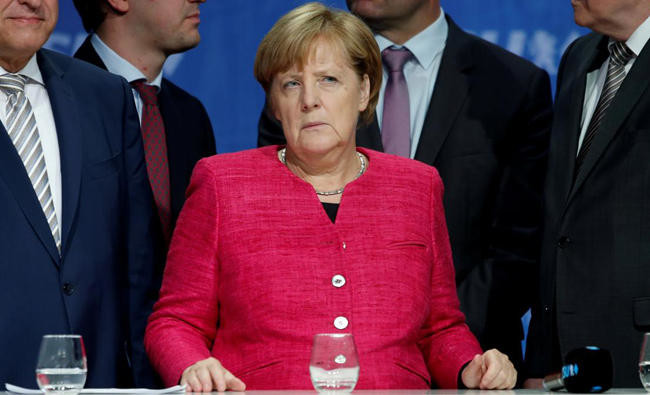
Merkel allies fret over former East Germany’s rightward shift
Merkel allies fret over former East Germany’s rightward shift

Latest updates


© 2026 SAUDI RESEARCH & PUBLISHING COMPANY, All Rights Reserved And subject to Terms of Use Agreement.