SAARBRUECKEN, Germany: When voters head to the polls in the German state of Saarland later this month, they are likely to deliver an upset to Chancellor Angela Merkel that could be a foretaste of September’s national election.
One of Germany’s smallest states, Saarland is — like federal Germany — currently governed by a “grand coalition” of Merkel’s conservatives and the Social Democrats (SPD).
But polls suggest a left-leaning “red-red-green” alliance of the SPD, the far-left Linke party and the Greens — or even a “red-red” coalition if the Greens fail to win enough votes — could emerge after the state votes on March 26. And while obstacles remain, the parties seem to be warming to the idea of cooperating.
The vote in Saarland, the first of three regional elections this year, is seen as a test for the federal election on Sept. 24 in which Merkel is standing for a fourth term.
National polls suggest “red-red-green” could just about get a majority in the Bundestag, the lower house of Parliament.
Above all, Saarland is the first electoral test of the SPD under its new leader, former European Parliament President Martin Schulz, who has helped the party climb 10 points in opinion polls in the last eight weeks and hopes to oust Merkel.
“This is the first election since the so-called Schulz effect so it will show us whether that really translates into votes for the Social Democrats, and it’s an election in which one of Mrs. Merkel’s close confidants is running,” said Thomas Jaeger, politics professor at Cologne University.
A three-way leftist alliance in Saarland would be the third at state level after Berlin and the eastern region of Thuringia.
Relations between the SPD and Linke have been bad for years, with many in the SPD still angry that their former party chairman Oskar Lafontaine deserted them for the Linke.
Now the Linke’s candidate in Saarland, Lafontaine told Reuters the atmosphere between him and the SPD candidate was “pleasant” and his party had “no problems” working with the SPD at state and municipal level.
“It’s different at the federal level. The SPD is sticking to policies that resulted in losses of income and pension cuts and we can’t accept that,” the 73-year-old said.
Schulz has said he wants to revise labor reforms introduced by the last SPD-led government and detested by the Linke but Lafontaine said Schulz had not given the impression that he would be correcting key parts of those reforms.
Lafontaine said cooperation in Saarland would improve the atmosphere. But he stressed there were big sticking points at national level over the welfare state, tax, the military and Europe — and Schulz did not seem ready to make big changes there.
The Linke rejects NATO and wants to raise the top income tax rate to 75 percent — ideas at odds with the SPD. But issues that once looked like dealbreakers for the Linke no longer seem certain to prevent a red-red-green alliance from forming.
His SPD counterpart, Anke Rehlinger, told Reuters that if the two parties found common ground and if the Linke wanted to push ahead with social justice — which Schulz has made a major campaign issue — then “we won’t rule it out, just as we won’t rule out continuing the grand coalition.”
Some voters, like pensioner Susanne Schumacher, 81, struggle to accept the Linke as many of its members came from the successor party to the Communists in East Germany.
But Fred Weber, a 62-year-old teacher, said he would be happy to see a switch to red-red-green: “It’s time Merkel goes ... she’s been in power since 2005 and that’s quite enough.”


![]()
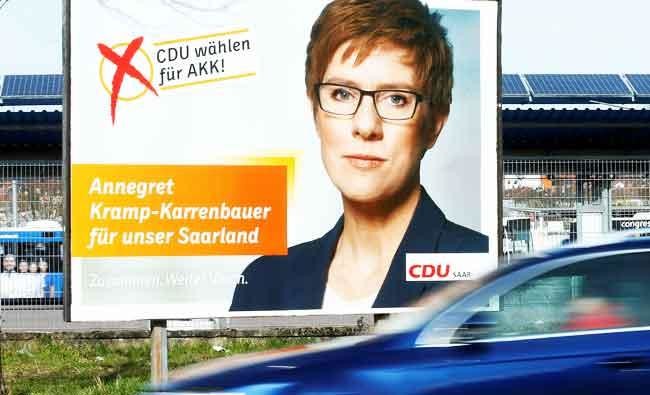
German alliance likely to oust Merkel’s conservatives in Saarland state
German alliance likely to oust Merkel’s conservatives in Saarland state
Latest updates




© 2026 SAUDI RESEARCH & PUBLISHING COMPANY, All Rights Reserved And subject to Terms of Use Agreement.