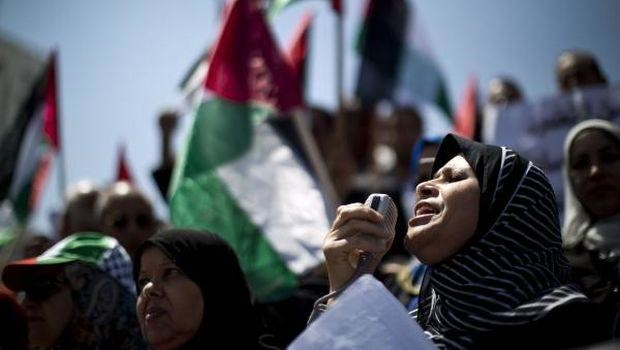
GAZA CITY: Ties between Palestinian rivals Fatah, a secular party, and the Islamist Hamas have been tense for a decade, at times erupting into deadly conflict.
Hamas controls the narrow Mediterranean Gaza enclave of the Palestinian territories, while Fatah is based in larger landlocked West Bank.
With Palestinian prime minister Rami Hamdallah due in the Gaza Strip on Monday, here is a look at the relationship between the groups.
Hamas takes part for the first time in 2006 in legislative elections for the Palestinian National Authority and beats out Fatah, which has been in control for 10 years.
A unity government is installed with Hamas taking key posts.
Simmering tensions between the two erupt into bloody clashes early 2007.
After a week of violence in Gaza in June, Palestinian president Mahmud Abbas fires the unity government and declares a state of emergency in the territory.
But Hamas routs forces loyal to Fatah and takes control of the strip, a move Abbas calls a coup.
In April 2011, Fatah and Hamas say they have reached an understanding to create an interim government of independents to prepare for elections.
Implementation of the deal is repeatedly delayed, however.
The rivals strike a prisoner-exchange accord in January 2012. The following month they agree that Abbas should lead an interim government, but the decision is disputed within Hamas and never applied.
In April 2014, the Fatah-dominated Palestine Liberation Organization (PLO) and Hamas finally agree on a unity government.
It is sworn in on June 2 but fails to exercise authority over Gaza where Abbas charges Hamas has set up a parallel administration to his own internationally recognized government.
In July-August 2014, though, the parties show a united response after Israel launches a 50-day blitz against Gaza in response to rocket fire.
The unity government falls apart months later.
In a stark revision of its founding charter, Hamas eases its stance on Israel in May 2017, after having long called for its destruction.
The Islamist group also pronounces that its struggle is not against Jews but against Israel as an occupier, and accepts the idea of a Palestinian state in territories occupied by Israel.
Hamas — considered a terrorist organization by Israel, the United States and the European Union — is seen as seeking to ease its international isolation while not marginalizing hard-liners within its ranks.
However, tensions remain between the rivals over the creation by Hamas months earlier of an “administrative committee” seen as a rival Palestinian government.
Abbas puts the squeeze on Hamas including by cutting electricity supplies to Gaza.
Under pressure, Hamas agrees on September 17 to the dissolution of the committee and says it is ready for talks on a new unity government and elections.
It calls on the Palestinian Authority government “to come to Gaza to exercise its functions and carry out its duties immediately.”

Fatah and Hamas: a decade of strained relations
Khartoum markets back to life but ‘nothing like before’
- The hustle and bustle of buyers and sellers has returned to Khartoum’s central market, but “it’s nothing like before,” fruit vendor Hashim Mohamed told AFP, streets away from where war first broke out
KHARTOUM: The hustle and bustle of buyers and sellers has returned to Khartoum’s central market, but “it’s nothing like before,” fruit vendor Hashim Mohamed told AFP, streets away from where war first broke out nearly three years ago.
On April 15, 2023, central Khartoum awoke to battles between the Sudanese army and the paramilitary Rapid Support Forces (RSF), who had been allies since 2021, when they ousted civilians from a short-lived transitional government.
Their war has since killed tens of thousands and displaced millions.
In greater Khartoum alone, nearly four million people — around half the population — fled the city when the RSF took over.
Hashim Mohamed did not.
“I had to work discreetly, because there were regular attacks” on businesses, said the fruit seller, who has worked in the sprawling market for 50 years.
Like him, those who stayed in the city reported having lived in constant fear of assaults and robberies from militiamen roaming the streets.
Last March, army forces led an offensive through the capital, pushing paramilitary fighters out and revealing the vast looting and destruction left behind.
“The market’s not what it used to be, but it’s much better than when the RSF was here,” said market vendor Adam Haddad, resting in the shade of an awning.
In the market’s narrow, dusty alleyways, fruits and vegetables are piled high on makeshift stalls or tarps spread on the ground.
Two jobs to survive
Khartoum, where entire neighborhoods have been damaged by the fighting, is no longer threatened by the mass starvation that stalks battlefield cities and displacement camps elsewhere in Sudan.
But with the economy a shambles, a good living is still hard to provide.
“People complain about prices, they say it’s too expensive. You can find everything, but the costs keep going up: supplies, labor, transportation,” said Mohamed.
Sudan has known only triple-digit annual inflation for years. Figures for 2024 stood at 151 percent — down from a 2021 peak of 358 percent.
The currency has also collapsed, going from trading at 570 Sudanese pounds to the US dollar before the war to 3,500 in 2026, according to the black market rate.
One Sudanese teacher, who only a few years ago could provide comfortably for his two children, told AFP he could no longer pay his rent with a monthly salary of 250,000 Sudanese pounds ($71).
To feed his family, pay for school and cover health care, he “works in the market or anywhere” on his days off.
“You have to have another job to pay for the bare minimum of basic needs,” he said, asking for anonymity to protect his privacy and to avoid “problems with security services.”
Beyond Khartoum, the war still rages, with the RSF in control of much of western and southern Sudan and pushing into the central Kordofan region.
For Adam Haddad, the road to recovery will be a long one.
“We don’t have enough resources or workers or liquidity going through the market,” he said, adding that reliable electricity was still a problem.
“The government is striving to restore everything, and God willing, in the near future, the power will return and Khartoum will become what it once was.”
On April 15, 2023, central Khartoum awoke to battles between the Sudanese army and the paramilitary Rapid Support Forces (RSF), who had been allies since 2021, when they ousted civilians from a short-lived transitional government.
Their war has since killed tens of thousands and displaced millions.
In greater Khartoum alone, nearly four million people — around half the population — fled the city when the RSF took over.
Hashim Mohamed did not.
“I had to work discreetly, because there were regular attacks” on businesses, said the fruit seller, who has worked in the sprawling market for 50 years.
Like him, those who stayed in the city reported having lived in constant fear of assaults and robberies from militiamen roaming the streets.
Last March, army forces led an offensive through the capital, pushing paramilitary fighters out and revealing the vast looting and destruction left behind.
“The market’s not what it used to be, but it’s much better than when the RSF was here,” said market vendor Adam Haddad, resting in the shade of an awning.
In the market’s narrow, dusty alleyways, fruits and vegetables are piled high on makeshift stalls or tarps spread on the ground.
Two jobs to survive
Khartoum, where entire neighborhoods have been damaged by the fighting, is no longer threatened by the mass starvation that stalks battlefield cities and displacement camps elsewhere in Sudan.
But with the economy a shambles, a good living is still hard to provide.
“People complain about prices, they say it’s too expensive. You can find everything, but the costs keep going up: supplies, labor, transportation,” said Mohamed.
Sudan has known only triple-digit annual inflation for years. Figures for 2024 stood at 151 percent — down from a 2021 peak of 358 percent.
The currency has also collapsed, going from trading at 570 Sudanese pounds to the US dollar before the war to 3,500 in 2026, according to the black market rate.
One Sudanese teacher, who only a few years ago could provide comfortably for his two children, told AFP he could no longer pay his rent with a monthly salary of 250,000 Sudanese pounds ($71).
To feed his family, pay for school and cover health care, he “works in the market or anywhere” on his days off.
“You have to have another job to pay for the bare minimum of basic needs,” he said, asking for anonymity to protect his privacy and to avoid “problems with security services.”
Beyond Khartoum, the war still rages, with the RSF in control of much of western and southern Sudan and pushing into the central Kordofan region.
For Adam Haddad, the road to recovery will be a long one.
“We don’t have enough resources or workers or liquidity going through the market,” he said, adding that reliable electricity was still a problem.
“The government is striving to restore everything, and God willing, in the near future, the power will return and Khartoum will become what it once was.”
© 2026 SAUDI RESEARCH & PUBLISHING COMPANY, All Rights Reserved And subject to Terms of Use Agreement.