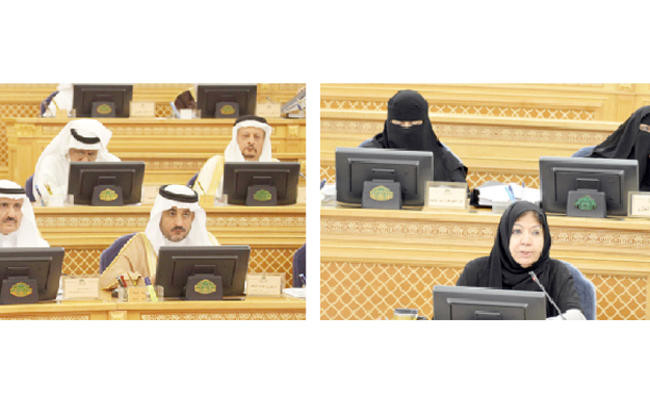
RIYADH: The Shoura Council has expressed its appreciation to King Salman and Crown Prince Mohammed bin Salman on the issuance of the royal decree on traffic law provisions and its executive regulations, including the issuance of driving licenses to both males and females.
Addressing the regular 54th session of the council, Deputy House Speaker Mohammed Al-Jafri said the royal decree achieves the aspirations of many female citizens in line with applicable Islamic and regulatory measures.
Meanwhile, the council approved amendments on the basic rules of social houses and care centers, and rehabilitation programs for the disabled.
The council also approved the addition of an article and two new provisions to the above basic rules that will authorize the Ministry of Labor and Social Development to care for certain groups of society who are unable to care for themselves and protect their rights.
The Committee on Economy and Energy called on the Saudi Exports Development Authority (SEDA) to achieve integration and coordination between the SEDA and Saudi commercial missions abroad to increase the volume of Saudi exports.
Among other recommendations, the committee asked the SEDA to study the possibility of becoming a self-funded entity from services it is providing to private sector companies.
Commenting on the committee’s recommendations, one member stressed the need to raise the rate of non-oil exports in line with Vision 2030.
On another topic, the Committee on Water, Agriculture and Environment asked the Saline Water Conversion Corp. (SWCC) to establish small-scale desalination plants along the coasts and purification plants on the banks of dams using renewable energy.
The committee also asked the SWCC to evaluate its long-term developmental plan to shift from the desalination stage to develop and localize the desalination industry.
Commenting on the committee’s report, one member affirmed the importance of localizing the desalination industry, while another member called for devising practical solutions to minimize costs of desalination and distribution of water.
Another member stressed the need to exploit solar energy in desalination operations while another member called for preparing a strategy to ensure a continued supply of desalinated water.
Women members
Meanwhile, Thuraya Al-Rayyed, a Shoura member, said: “It’s wonderful news and it’s for time us to celebrate the happy occasion.”
Women will feel that they have received their long-awaited rights that will help them do their work independently without depending on the traditional chauffeurs, Al-Rayyed noted.
She described it as a wise decision of the Saudi leadership which has been taken after considering the tremendous developments that are taking place within the country.
The Shoura member further said that she is thankful to King Salman, Crown Prince Mohammed bin Salman and their advisers to have made such a fruitful decision which would make a positive influence on society as well as the economy of the country.
Another Shoura member, Noura Al-Shaaban, also affirmed that the decision by King Salman allowing women to drive is a landmark in the history of Saudi women and keeps pace with the current stage.
Speaking to Arab News Mohamed Al-Khunaizi, a senior member of the Shoura Council, welcomed the royal decree allowing women to drive in the Kingdom.
Describing it as a “historic decision” Al-Khunaizi thanked King Salman for issuing this decree which led people to the streets celebrating the landmark decision.
“This is a forward-looking decision in a string of social and economic reforms underway in the Kingdom,” he said, adding that “this decision is in line with the National Transformation Program (NTP-2020) and Saudi Vision 2030.”
Welcoming the decision Al-Khunaizi further underscored that “this will give equal opportunity for women to drive like men,” which is important.
There are a lot of families who depend on house drivers or taxis for their transport needs. He pointed that this was long awaited and good news for women as well as men.
“Now, women can drive safely on their own,” he said adding, “this is why I believe it is a great decision toward modernization and development.”
Meanwhile, the Council of Senior Scholars commended the royal order to apply the traffic laws and the executive regulations including the issuance of driving licenses to both males and females.
The council in a statement pointed out that fatwas of all scholars concerning women’s driving of vehicles focused on the interests and evils, but not on driving in itself which is not forbidden by anyone.
Praising the decision, Mona Salahuddin Al-Munajjed, a sociologist, and the author of “Saudi Women,” told Arab News Wednesday: “Allowing women to drive is a wonderful and very positive step toward the advancement and empowerment of Saudi women.”
This will introduce big changes in the Kingdom and on the social as well as economic level, she added.
Dania Al-Maeena, chief executive office of the Al-Oula Non-profit Organization for Charity, told Arab News that it was a dream come true for women in Saudi Arabia.
Describing it as a positive transition toward empowering women in the Kingdom, Al-Maeena said that the women, who are mothers, students, teachers and working in offices will be able to drive their vehicles on their own without depending on domestic drivers who were extra burden on the family budget.
“We welcome this wise decision of King Salman, who is a visionary leader having the youthful exuberance of Crown Prince Mohammad Bin Salman as part of his team. This is fabulous for the fulfillment of Vision 2030,” Amir Qayyum, director of business development at a private establishment, told Arab News.
Appreciating the landmark decision, Halah Al-Hamrani, owner of FlagBoxing, told Arab News that it was a pleasant surprise.
“Women driving was the only problem in the Kingdom. Having realized the growing needs of women, the new leadership has launched the new system which would allow women to drive their vehicles in the Kingdom,” said Al-Hamrani, the only Saudi female kickboxing and boxing trainer in the Kingdom.
She also thanked King Salman and others who were responsible for this move.