

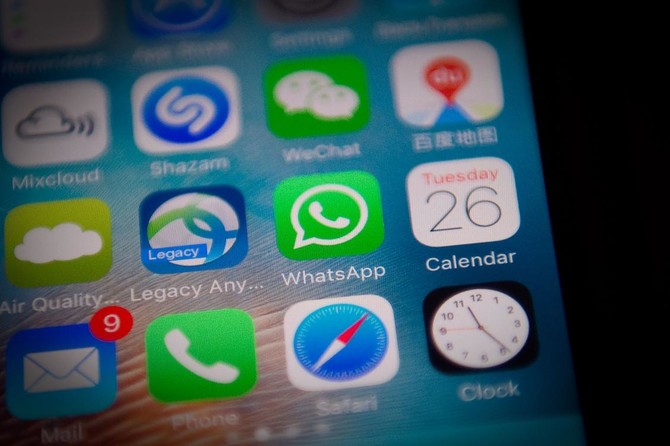
China disrupts WhatsApp ahead of Communist Party meeting

Chinese authorities appear to have severely disrupted the WhatsApp messaging app in the latest step to tighten censorship as they prepare for a major Communist Party congress next month. (AFP)
Updated 26 September 2017
Follow

China disrupts WhatsApp ahead of Communist Party meeting

BEIJING: Chinese authorities appear to have severely disrupted the WhatsApp messaging app in the latest step to tighten censorship as they prepare for a major Communist Party congress next month.
Users in China have reported widespread disruptions in recent days to the Facebook-owned service, which previously malfunctioned in the country over the summer.
Experts said the problems began on Sunday, but text messaging, voice calls and video calls appeared to be working again on Tuesday, though voice messages and photos were not going through.
WhatsApp provides message encryption technology that likely does not please Chinese authorities, which closely monitor and restrict cyberspace through their “Great Firewall.”
Many Chinese activists favor WhatsApp over local messaging apps because of its end-to-end encryption function.
China has tightened online policing this year, enacting new rules that require tech companies to store user data inside the country as well as imposing restrictions on what is permissible content.
Chinese cyberspace regulators said Monday they slapped “maximum” fines on major Chinese tech firms Baidu and Tencent for allowing the publication of pornographic, violent and other sorts of banned material on their social media platforms. The amount of the fines was not disclosed.
websites such as Facebook, Twitter, Pinterest and a slew of foreign media have been blocked for years.
The WhatsApp troubles emerged ahead of the Communist Party congress on October 18, when President Xi Jinping is expected to be given a second five-year term as the party’s general secretary.
“It smells like Party congress pre-emptive blocking,” said Jason Ng, who researches China’s Internet at the Citizen Lab at the University of Toronto.
China usually steps up surveillance around major events, Ng said.

While the WeChat messaging app owned by China’s Tencent company is more widely used in the country, many WhatsApp users complained about the disruptions.
“As we get closer to the Party congress, I think authorities will use more extreme censorship measures. The public knows that WeChat isn’t safe,” prominent Beijing-based activist Hu Jia told AFP.
“Me and other dissidents use WhatsApp to communicate 70 percent of the time. For the few days WhatsApp was completely inaccessible, we didn’t talk at all,” Hu said.
Earlier this month, WeChat informed its users in a new privacy policy that it would “retain, preserve or disclose” users’ data to “comply with applicable laws or regulations” — confirming long-held public assumptions about the company’s practices.
Other users in China noted that the WhatsApp disruptions would make it difficult to work with clients abroad.
“Facebook, Twitter, Gmail, Viber were blocked before. Now even WhatsApp is blocked? Without good messaging tools, it will reduce the efficiency of the foreign trade industry,” wrote one person on Weibo, China’s Twitter-like social media website.
“I can live without the others (applications), but blocking WhatsApp is driving me crazy,” said another.
WhatsApp declined to comment.
The Open Observatory of Network Interference, a global censorship detection group, said China started blocking WhatsApp on Sunday.

To operate in China, some foreign tech companies have complied with local regulations. But others such as Google have chosen to pull out completely from mainland China.
In July, Apple removed software allowing Internet users to skirt China’s “Great Firewall” from its app store in the country, drawing criticism that it was bowing to Beijing’s ever-growing web censorship.
Such software, called virtual private networks (VPN), allow people in China to access any website, even those that are blocked.
Beijing mandated in January that all developers must obtain government licenses to offer VPNs and there has been concern that it might ban them outright.



Prince Harry’s war against UK press reaches showdown with Daily Mail case

Updated 16 January 2026
Follow

Prince Harry’s war against UK press reaches showdown with Daily Mail case

  • Prince Harry to give evidence in London court for second time
  • Media accused of phone hacking and other privacy intrusions

LONDON:Prince Harry’s war against the British press heads into a final showdown next week with the start of his
privacy ​lawsuit against the publisher of the powerful Daily Mail newspaper over alleged unlawful action he says contributed to his departure for the US
The 41-year-old Harry, a boy when his mother Princess Diana died in a 1997 car crash with paparazzi in pursuit, has long resented the often aggressive tactics of British media and pledged to bring them to account.
Harry, who is King Charles’ younger son, and six other claimants including singer Elton John are suing Associated Newspapers over years of alleged unlawful behavior, ranging from bugging phone lines to obtaining personal health records.
Associated has rejected any wrongdoing, calling the accusations “preposterous smears” and part of a conspiracy.
Over the course of nine weeks, Harry, John and the other claimants – John’s husband David Furnish, actors Liz Hurley and Sadie ‌Frost, campaigner Doreen ‌Lawrence, and former British lawmaker Simon Hughes – will give evidence to the High Court ‌in London ⁠and be ​grilled by ‌Associated’s lawyers.
The prince is due to appear next Thursday. It will be his second such court appearance in the witness box in three years, having become the first British royal to give evidence in 130 years in 2023 in another lawsuit.
Current and former senior Associated staff, including a number of editors of national newspapers, will likewise be quizzed by the claimants’ legal team. The stakes for both sides are high, with not just the reputation of media and claimants on the line, but because legal costs are set to run into tens of millions of pounds. Critics say Harry, the Duke of Sussex, is bitter over unfavorable coverage, from partying in his youth to quarrelling with his family and leaving ⁠the UK in later years.
But supporters say it is a noble cause against sometimes immoral media.
“He seems to be motivated by a lot more than money,” said Damian Tambini, ‌an expert in media and communications regulation and policy at the London School ‍of Economics.
“He’s actually trying to, along with many of the ‍other complainants, affect change in the newspapers.”
Harry and his American wife Meghan have cited media harassment as one of the main ‍factors that led them to stepping down from royal duties and moving to California in 2020. Elton John, 77, also has history in the courts with the British press, successfully suing newspapers including the Daily Mail for libel. He received 1 million pounds ($1.34 million) from the Sun in a 1988 settlement over a false allegation about sex sessions with male prostitutes.
Having successfully sued Mirror Group Newspapers, and also won damages, an apology ​and some admission of wrongdoing from Rupert Murdoch’s News Group Newspapers (NGN), the case against Associated could be Harry’s most significant. The 130-year-old Daily Mail, renowned for championing traditional, conservative values, for decades has been one of, if not ⁠the most powerful media force within Britain and unlike the Mirror and NGN has not been embroiled in the phone-hacking scandal.
It says it gives voice to millions in “Middle England,” holding the rich, powerful and famous to account.
In 1997, it famously ran a front page denouncing five men accused of the racist killing of Black teenager Stephen Lawrence as murderers and challenging anyone to sue if that was wrong.
The case was a defining moment in race relations in Britain.
Despite that, one of those now suing the Mail is Doreen Lawrence, the mother of murdered Stephen, who says journalists tapped her phones, monitored her bank accounts and phone bills, and paid police for confidential information.
The Associated case will mark one of the final airings in court of accusations of phone-hacking which have dogged the British press for more than 20 years.
The practice of unlawfully accessing voicemails fully burst onto the public agenda in 2011, leading to the closure of Murdoch’s News of the World tabloid, the jailing of its former editor who had later worked as a communications chief for ex-Prime Minister David Cameron, and ‌a public inquiry.
Murdoch’s NGN and the Mirror Group have since both paid out hundreds of millions of pounds to victims of the unlawful activity.
If the claimants lose, Tambini said, “this could be the moment when phone hacking, finally, as a set of issues, went away.”