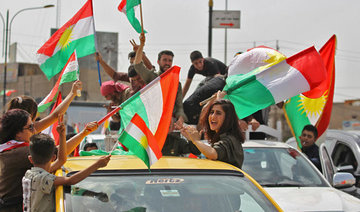
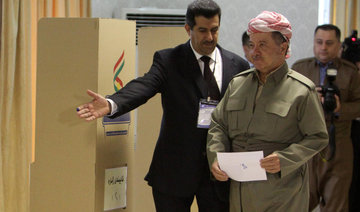
BAGHDAD: Iraq’s Parliament demanded on Monday that troops be sent to disputed areas in the north controlled by the Kurds since 2003 as the autonomous Kurdish area staged a referendum on independence.
“Parliament demands that the head of the army (Prime Minister Haider Al-Abadi) deploy forces in all of the zones the autonomous region of Kurdistan has taken control of since 2003,” a resolution said.
Under Iraq’s constitution, the government is obliged to comply with the parliamentary vote.
Asked about the risks of armed conflict, Al-Abadi’s spokesman Saad Al-Hadithi told AFP: “If there are clashes in these zones, it will be the job of federal forces to apply the law.”
Karim Al-Nuri, a head of the Badr Brigade which forms part of the powerful Al-Hashd Al-Shaabi paramilitary units that have fought alongside the army in the drive against Daesh, pointed to the flashpoint region of Kirkuk.
“Out next objective is Kirkuk and the disputed zones occupied by armed gangs, outlaws who do not respond to the army command,” he said.
The zones disputed between the Kurds and the federal government in Baghdad are not part of the three provinces in northern Iraq that form the autonomous Kurdish area.
The disputed areas are the oil-rich province of Kirkuk, as well as parts of Nineveh, Diyala and Salaheddin provinces.
Most of the disputed areas were conquered by Kurdish peshmerga forces in 2014 in the chaos that followed a sweeping offensive by Daesh men.
The Syrian foreign minister, meanwhile, said the regime rejected the referendum.
“We in Syria only recognize a united Iraq and reject any procedure that leads to the fragmentation of Iraq,” Foreign Minister Walid Al-Mouallem was cited as saying by Syrian state news agency SANA.
“This step is rejected and we do not recognize it and yesterday I informed the Iraqi foreign minister of this stance.”
An assistant to the Syrian foreign minister told the pro-regime Syrian newspaper Al-Watan that what is happening in Iraq “is a product of American policies that aim to fragment the region’s countries and create conflict between its parts.”
The referendum “harms Iraq and harms our Kurdish brothers,” Ayman Soussan added in the comments published on Monday.
The Syrian regime, which is regaining territory with Iranian and Russian military backing, also opposes steps taken by Syrian Kurds toward autonomy in northern Syria since the start of the country’s civil war in 2011.
Iran’s Foreign Ministry said that its border with Iraqi Kurdistan remained open despite the referendum, reversing an earlier statement.
A statement by the ministry said: “The land border between Iran and the Kurdistan region of Iraq is open. For now, only air borders between Iran and this region are closed,” it added.
That went against an earlier statement by ministry spokesman Bahram Ghasemi, who had told reporters: “At the request of the Iraqi government, we have closed our land and air borders.”
The vote is “illegal and illegitimate,” Ghasemi said.
President Hassan Rouhani spoke overnight with Al-Abadi, saying: “The Islamic republic of Iran fully supports the central government of Iraq.”
Iran fears the vote could encourage separatists in its own Kurdish region, and said last week that independence could mean an end to all of border and security arrangements.
Iranian security forces have faced regular attacks by militant Kurdish separatists, primarily based across the border in Iraqi Kurdistan.
On Sunday, Iran’s powerful Revolutionary Guard launched a military exercise in its northwestern Kurdish region in a sign of Tehran’s concerns over the vote.


![]()

Iraq Parliament demands troops go to areas disputed with Kurds
Iraq Parliament demands troops go to areas disputed with Kurds

Latest updates


© 2026 SAUDI RESEARCH & PUBLISHING COMPANY, All Rights Reserved And subject to Terms of Use Agreement.