Indonesia: Tens of thousands flee rumbling Bali volcano

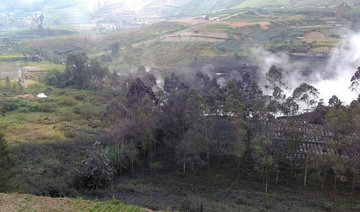
Mount Agung looms over a nearly deserted village on the Indonesian resort island of Bali. (AFP)
Updated 24 September 2017
Follow

Indonesia: Tens of thousands flee rumbling Bali volcano

KARANGASEM, Indonesia: More than 34,000 people have fled from a rumbling volcano on the resort island of Bali as the magnitude of tremors grows, prompting fears it could erupt for the first time in more than 50 years, an official said Sunday.
Indonesia’s disaster mitigation agency said the number of people fleeing their homes surrounding the volcano had tripled since Friday amid growing alarm that Mount Agung could erupt at any moment.
“The evacuation process is ongoing and we expect the number of evacuees to continue to rise,” the agency spokesman Sutopo Purwo Nugroho said.
The volcano, located about 75 kilometers from the tourist hub of Kuta, has been rumbling since August.
Officials announced the highest possible alert level on late Friday following the increasing volcanic activities and urged people stay at least nine kilometers away from the crater.
“I am actually very worried to leave, I left my cows and pigs at home because we were ordered to vacate our village immediately,” villager Nyoman Asih who evacuated with her entire family told AFP.
The international airport in Bali’s capital, Denpasar, was anticipating possibilities of airport closure but no flight schedules had been affected as of Sunday.
The airport has prepared buses and trains to divert passengers to alternative hubs in neighboring provinces if the mountain erupts.
The Indonesian Center for Volcanology and Geological Hazard Mitigation said tremors happened less frequently on Sunday but were stronger than in previous days.
“The mountain has not erupted until now, the earthquake happens less frequently but the magnitude is getting stronger,” Gede Suantika, a senior volcanologist at the agency told AFP.
More than 1,000 people died when Mount Agung last erupted in 1963.


UK court jails Christian camp leader for drugging, sexually abusing boys

Jon Ruben. (Supplied)
Updated 07 February 2026
Follow

UK court jails Christian camp leader for drugging, sexually abusing boys

  • Ruben admitted offenses relating to ill-treatment of children and sexual abuse — as well as to drugging his wife, who was volunteering at the camp, in order to avoid detection

LONDON: A court in England on Friday jailed a man for more than 31 years for drugging and sexually abusing young boys at a Christian summer camp he led last summer.
Police say they are now talking to other groups he worked with in the past as part of an ongoing investigation.
Former vet Jon Ruben, 76, was leading the camp last July, said a statement from prosecutors released after Friday’s judgment.
He laced sweets with sedatives and tricked children at the camp into eating them by encouraging them to take part in a game.
“Later on, while the boys were heavily asleep, he went into their dormitory and chose individual boys to sexually abuse them,” said prosecutors.
Volunteers at the camp in Leicestershire, central England, raised the alarm after finding the children still nauseous, drowsy and disoriented the next day.
Eight boys aged between eight and 11 were taken to hospital and Ruben was arrested.
Investigators found syringes and sedatives at the camp location.
On his devices they found indecent images of children as well as evidence he had procured tranquilizer drugs and tried to join an online paedophile network.
Ruben admitted offenses relating to ill-treatment of children and sexual abuse — as well as to drugging his wife, who was volunteering at the camp, in order to avoid detection.
A court in Leicester sentenced him on Friday to a total of 31 years and 10 months behind bars under special provisions for defendants designated by prosecutors as particularly dangerous.
Leicestershire police said the investigation into Ruben was still “very much ongoing.”
Officers are contacting schools and youth organizations in central England with whom Ruben was involved with over the past two decades.